Concrete Slabs, Pads & Foundations in Gaithersburg, MD
Concrete slabs, pads, and foundation-related pours provide the flat, stable bases that outbuildings, equipment, and structures rest on across Gaithersburg properties. Gaithersburg Concrete pours general-purpose slabs for sheds, equipment pads for HVAC and generators, hot tub pads, utility pads, and foundation-related concrete work. Every slab project starts with a review of the intended load, dimensions, site access, and base conditions, because the right thickness, reinforcement, and preparation depend on what the slab will carry. We do not claim to provide structural engineering services — we build to the specifications and requirements appropriate to each project.
Concrete Slabs & Pads in Gaithersburg
A concrete slab or pad is a poured flat surface built to support a specific load — a shed, a piece of equipment, a hot tub, or a small structure. Unlike a driveway or patio built for people and vehicles, a slab is often sized to the object it carries, with thickness and reinforcement matched to the weight and use.
Foundation-related concrete refers to the concrete elements that support or adjoin a structure, such as footing pours, base slabs, and related concrete work. We handle the concrete flatwork aspects of these projects but do not claim to provide structural engineering services. Where engineering or specific permitting is required, we coordinate around those requirements rather than assuming one approach fits every project.
Because a pad exists to carry weight, the planning phase — load, dimensions, base, and reinforcement — matters as much as the pour itself. A slab built for the wrong load or over an unprepared base will settle or crack under the weight it was meant to support.
Common Uses for Concrete Slabs & Pads
Sheds & Outbuildings
Concrete shed slabs provide a level, durable floor for backyard storage structures and outbuildings, sized to the building footprint.
Equipment & HVAC Pads
Pads for HVAC units, generators, and utility equipment keep heavy or vibrating equipment off the soil and on a stable base.
Hot Tubs & Spa Slabs
Hot tub pads are poured to carry the combined weight of the tub, water, and occupants, with reinforcement and thickness matched to the load.
How Concrete Slabs Are Prepared & Poured
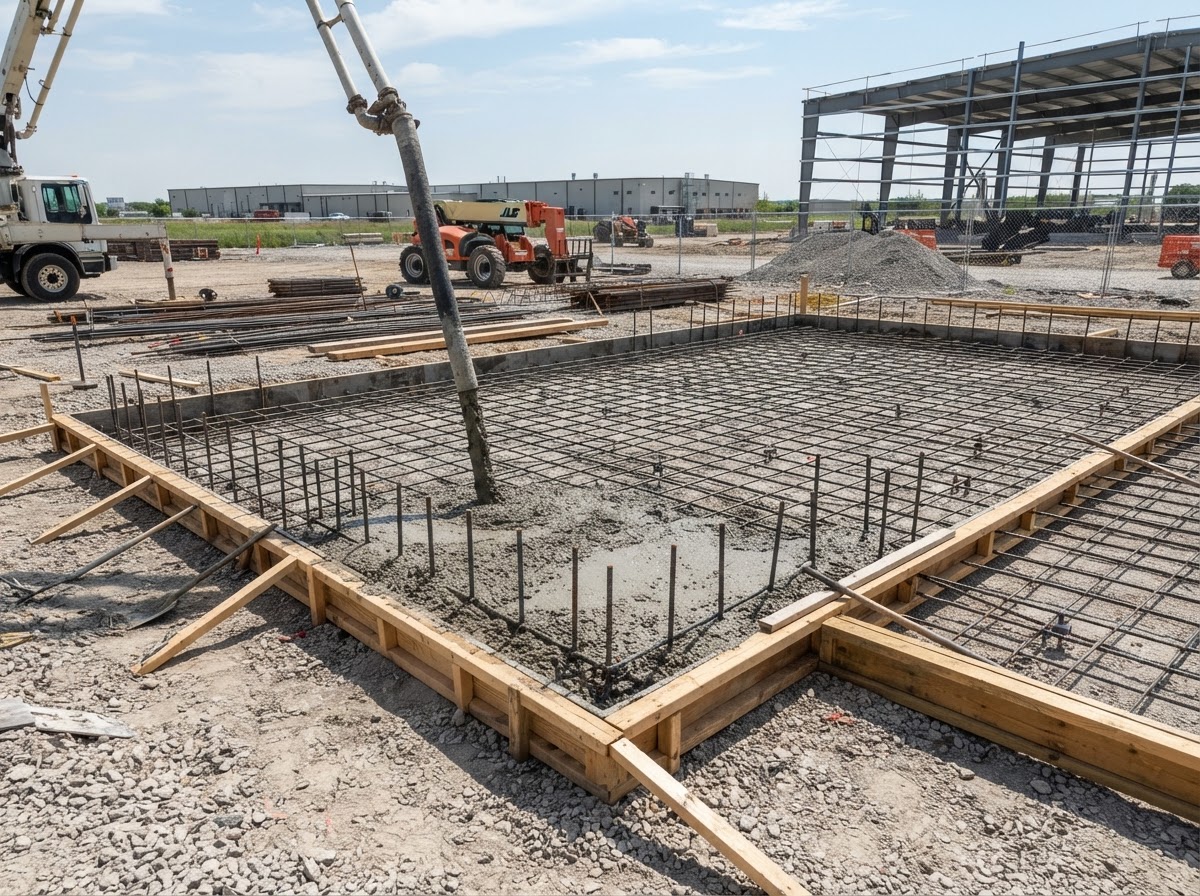
A slab pour follows the same fundamentals as any flatwork, with thickness and reinforcement matched to the intended load.
- 1Site review — assess access, grade, soil, and the intended load.
- 2Excavation — remove soil to the depth needed for base and slab.
- 3Subgrade preparation — compact the soil to a stable, uniform surface.
- 4Base — add and compact base material where appropriate.
- 5Forms — set forms to the slab dimensions and elevation.
- 6Reinforcement where specified — add reinforcement suited to the load and project.
- 7Thickness planning — pour to the thickness appropriate for the use.
- 8Placement and screeding — pour and level the concrete.
- 9Finishing — apply a finish suited to the slab's purpose.
- 10Joints and curing — place control joints and allow the slab to cure.
Slab Thickness, Reinforcement & Project Planning
There is no universal thickness that fits every slab. A shed pad, a hot tub slab, and an equipment pad each carry different loads, and the right thickness, reinforcement, and base depend on the weight, the soil, and the use. A heavier load on a thinner, unreinforced slab leads to cracking and settlement.
Planning Factors We Consider
- Load — the weight the slab will carry, static or dynamic
- Dimensions — the size and shape required for the structure or equipment
- Soil and base — the conditions the slab will rest on
- Intended use — storage, equipment, hot tub, or work area
- Edges and reinforcement — matched to the load and project
- Local requirements — any specifications or requirements that apply
We do not provide one universal thickness for every project. For heavier commercial applications, our commercial concrete and flatwork services cover larger slabs, and concrete driveway installation addresses vehicle-load slabs. Existing slab damage can often be addressed through concrete repair before a full repour becomes necessary.
Projects requiring a dedicated base may include concrete garage floors, shed pads, hot tub pads and generator or equipment pads — each with its own load and planning considerations.
For dedicated applications, see our concrete garage floors and garage slabs, shed pads and storage building slabs, hot tub and spa pads, and generator and equipment pads.
For structural support under additions, porches, or small structures, see our concrete footings and addition foundations services. Interior slab work is covered in our basement and interior concrete floor installation page.
Related specialty slab services: concrete footings and addition foundations and basement and interior concrete floors.
Concrete Pad & Foundation Considerations in Gaithersburg
Pads and slabs in Gaithersburg face the same freeze-thaw cycles and moisture exposure as any exterior concrete, but the added concern is the load they carry. A pad that settles unevenly under a shed or hot tub can tilt the structure; an equipment pad that cracks can destabilize the unit it supports. Drainage and base preparation are what keep a slab level under load over time.
Ground movement is a factor throughout Montgomery County, and water management — directing runoff away from the slab and preventing erosion beneath it — affects how stable the base remains. Freeze-thaw cycles stress the soil and the slab alike, and a poorly prepared base that shifts with the seasons takes the slab with it.
Site access also matters. Many pads are installed in backyards or side yards with limited equipment access, which affects how the pour is planned and executed. We account for access, existing grades, and the surrounding landscape when planning a pad so the finished slab sits level and stable.
Discuss Your Concrete Project
Have questions about scope, timing, or whether repair or replacement is the right call? We are happy to review your project and provide a clear, honest estimate.
Concrete Slab & Pad FAQs
How thick should a concrete slab be?
Slab thickness depends on the load it will carry, the soil and base conditions, and the intended use. A shed pad, a hot tub slab, and an equipment pad each require different thicknesses. We recommend thickness based on what the slab will support rather than applying one dimension to every project.
Does every concrete slab need reinforcement?
Not necessarily. Reinforcement is specified based on the load, span, and project conditions. Some slabs benefit from reinforcement to manage cracking and carry heavier loads, while lighter-use pads may not require it. We recommend reinforcement where appropriate to the specific project.
Can you pour a slab for a shed?
Yes. We pour shed slabs sized to the building footprint, with thickness and base preparation suited to the shed. A level, well-prepared slab provides a durable floor for the structure and helps prevent settling that could tilt the shed over time.
Can you pour a concrete hot tub pad?
Yes. Hot tub pads are poured to carry the combined weight of the tub, water, and occupants, with thickness and reinforcement matched to the load. Proper base preparation helps keep the pad level under the significant weight of a filled hot tub.
What affects the cost of a concrete slab?
Slab cost depends on dimensions, thickness, reinforcement, excavation and base work, site access, and any demolition of existing concrete. Heavier-load slabs that require more preparation and reinforcement cost more than light-use pads. We provide project-specific estimates based on the intended use.
Can a slab be poured next to existing concrete?
Yes, a new slab can be poured adjacent to existing concrete when the elevations, transitions, and drainage are planned to match. Clean connections avoid lips and trip points. We plan the elevation and edge details so the new slab integrates cleanly with surrounding surfaces.
How long does a slab need to cure?
Concrete gains strength over time, and curing duration depends on the mix, weather, thickness, and application. Light foot traffic may be acceptable sooner, while heavier loads require more curing time. We advise when the slab is ready for its intended use before we finish the project.
Request a Concrete Slab Estimate
Whether you need a shed slab, an equipment pad, a hot tub base, or a foundation-related pour, Gaithersburg Concrete will review the load, dimensions, and site, then provide a clear estimate. Serving Gaithersburg and surrounding Montgomery County communities.
Related Concrete Services Near Gaithersburg
Commercial Concrete & Concrete Flatwork
High-spec flatwork for commercial centers, retail plazas, loading docks, dumpster pads, and multi-family communities.
Learn moreConcrete Driveway Installation & Replacement
Durable residential and light commercial concrete driveways built to withstand vehicular weight and Maryland freeze-thaw cycles.
Learn moreConcrete Repair & Crack Repair
Targeted structural crack filling, spalling remediation, and damaged section patching to extend concrete longevity.
Learn moreRequest a Concrete Slab Estimate
Whether you need a shed slab, an equipment pad, a hot tub base, or a foundation-related pour, Gaithersburg Concrete will review the load, dimensions, and site, then provide a clear estimate. Serving Gaithersburg and surrounding Montgomery County communities.
- Project-specific estimates — no obligation
- Residential and commercial concrete work
- Serving Gaithersburg and surrounding Montgomery County
Request a Free Estimate
Tell us about your concrete project in Gaithersburg or nearby.