Concrete Repair vs. Replacement: How to Decide in Gaithersburg, MD
Concrete can often be repaired when damage is localized and the slab remains stable, but replacement becomes more practical when cracking, settlement, deterioration, or movement is widespread or when the existing slab can no longer provide a dependable base for repair. This decision guide from Gaithersburg Concrete walks through how to evaluate damaged concrete in Gaithersburg, Maryland — what signs point toward repair, what signs point toward replacement, and how the cause of the damage should shape the choice. The goal is to help homeowners and property managers make an informed decision rather than guess at scope, and to move cleanly from understanding the problem to the right service — whether that is crack repair, leveling, resurfacing, partial replacement, or a full new pour.
Request a Free Estimate
Tell us about your concrete project in Gaithersburg or nearby.
Should Concrete Be Repaired or Replaced?
Concrete can often be repaired when damage is localized and the slab remains stable. Replacement becomes more practical when cracking, settlement, deterioration, or movement is widespread, or when the existing slab can no longer provide a dependable base for repair. The right choice depends on the extent of the damage, whether the cause is still active, and what the slab is expected to do going forward.
Repair May Make Sense When
- Cracks are localized rather than widespread
- Spalling is minor and confined to small areas
- Joint damage is isolated
- Damaged areas are small relative to the whole slab
- The slab is stable with no ongoing movement
- Settlement is limited and the slab is suitable for leveling
Replacement May Make Sense When
- Cracking is widespread across most of the slab
- Settlement is significant or ongoing
- Spalling is extensive
- Sections are badly broken
- The base has failed
- Previous repairs have repeatedly failed
- A major layout or drainage change is planned
The framework is straightforward: assess the extent, confirm whether the cause is still active, and weigh the remaining usable life of the slab. A single crack on a sound driveway is a repair; a driveway failing throughout is a replacement.
Signs Concrete May Be Repairable
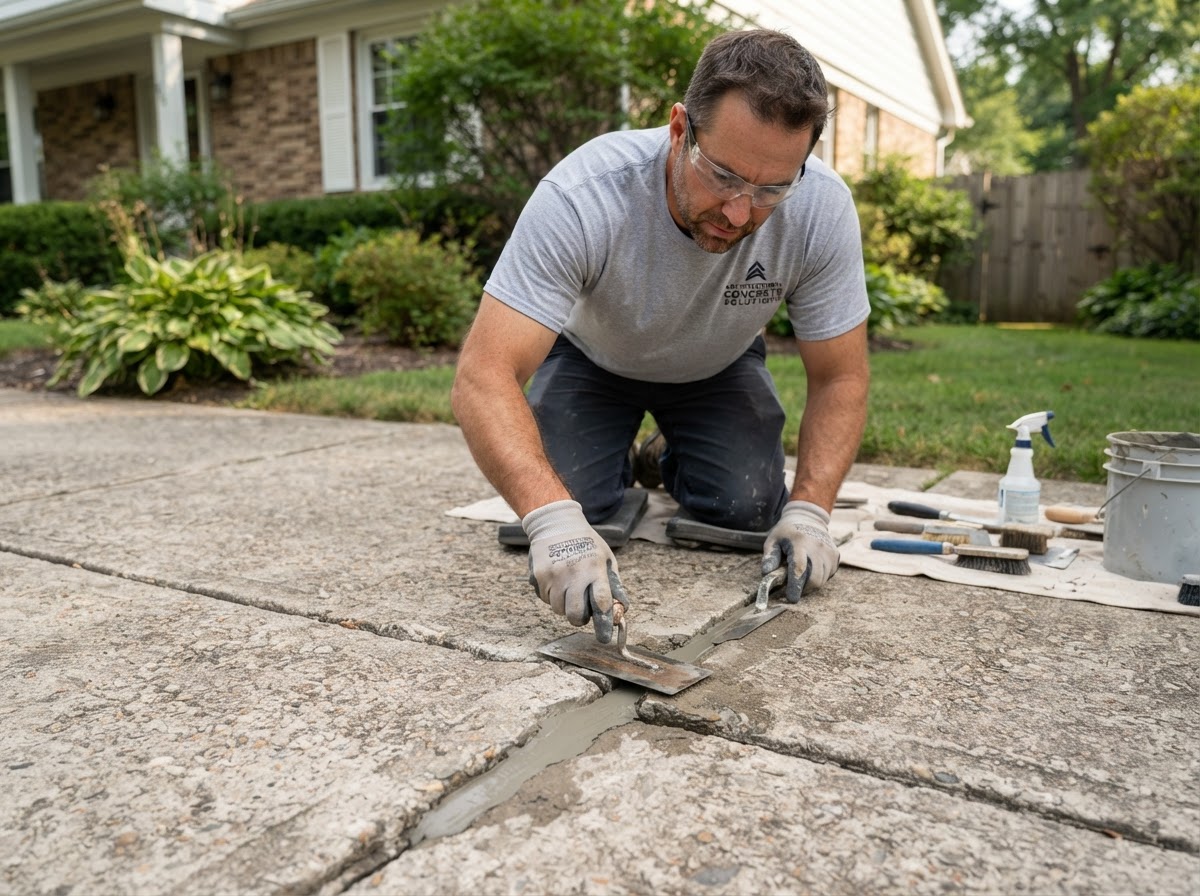
Repairable damage is typically localized and sits on a slab that is otherwise stable. When the surrounding concrete is sound and the cause of the damage is understood and addressed, a targeted repair can extend the life of the surface without the cost and disruption of full replacement.
Common Repairable Conditions
- Isolated cracking — a single crack on an otherwise sound slab
- Localized spalling — a small area of surface flaking
- Minor surface deterioration — wear without structural failure
- Damaged joints — failed sealant or joint material
- Small broken edges — chipped corners on an intact panel
- Suitable sunken slabs — a settled but intact panel that can be leveled
- A stable overall surface with one or two problem spots
Repair Options by Condition
- Crack repair — for localized cracks on stable slabs
- Joint repair — for failed sealant or joint material
- Patching — for spalled or broken areas
- Leveling — for settled but intact slabs
- Resurfacing — for stable but cosmetically worn surfaces
Signs Concrete May Need Replacement
Replacement becomes the more practical choice when the damage is too widespread for targeted repair to hold up, or when the underlying slab has failed in a way that repair cannot address. These are not absolute rules — each slab is evaluated on its own condition — but the signs below typically point toward replacement.
Common Replacement Indicators
- Multiple intersecting cracks across the slab
- Widespread slab movement or shifting
- Severely broken concrete with failed sections
- Extensive spalling across most of the surface
- Major settlement that has cracked the slab through
- Failed sections that no longer carry their intended load
- Inadequate drainage that requires reconstruction to correct
- Repeated previous repairs that have failed
- A poor original layout that a new pour can correct
- A major change in how the surface will be used
When several of these signs appear together, a series of repairs rarely performs as well as a new pour built on a properly prepared base. Replacement also gives a chance to correct drainage, layout, or thickness problems the original pour had — which is why it is often the better long-term value when damage is extensive.
Repair, Level, Resurface or Replace?
The decision matrix below maps common conditions to the option that typically fits. It is a starting point — the actual recommendation depends on a hands-on assessment — but it shows how the condition drives the scope.
| Condition | Possible Option | Why |
|---|---|---|
| Localized crack | Crack repair | Isolated damage on a stable slab |
| Failed joint | Joint repair | Sealant or joint material has failed |
| Surface wear on stable slab | Resurfacing | Slab is sound but cosmetically worn |
| Sunken intact slab | Leveling | Panel settled but not cracked through |
| Widespread structural failure | Replacement | Slab cannot serve as a base for repair |
| Severely broken panel | Partial or full replacement | Section has failed; surrounding slab may be sound |
For a driveway specifically, full replacement is covered on our driveway installation and replacement page, and the cost factors behind each option are detailed in our driveway cost guide and repair cost guide.
What Caused the Damage?
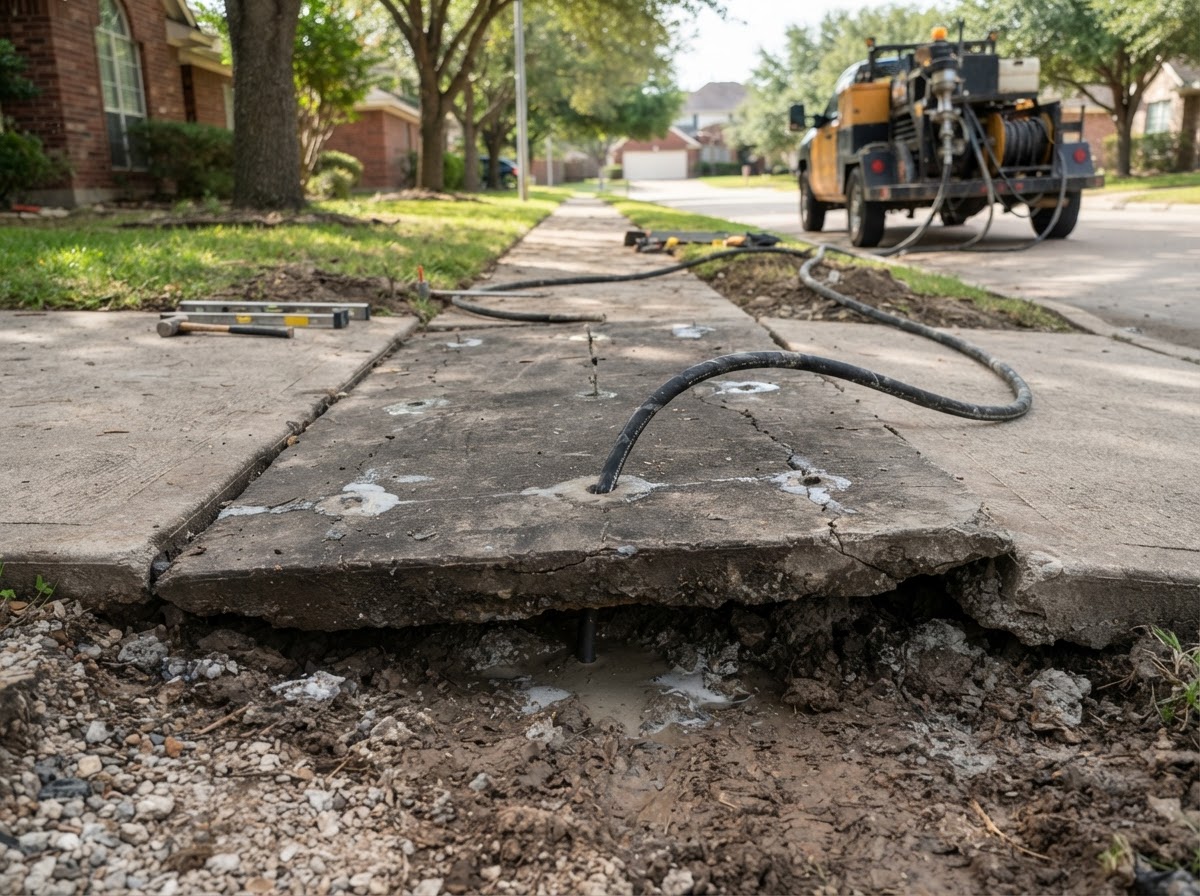
A repair decision should consider the cause, not just the symptom. Repairing a crack without understanding why it appeared often leads to the same crack returning — which is why diagnosis comes before a repair method.
Common Causes of Concrete Damage
- Shrinkage during curing — common, often cosmetic hairline cracks
- Settlement — base compaction, erosion, or soil movement
- Erosion — water washing material from beneath the slab
- Drainage problems — water pooling or running beneath the surface
- Freeze-thaw — moisture expanding as it freezes, stressing the surface
- Deicing salts — accelerating surface scaling
- Base failure — the foundation the slab rests on has degraded
- Loads beyond what the slab was built for
- Impact damage — a strike or point load
- Age — the cumulative effect of years of traffic and weather
- Construction joints — cracks that follow joint placement
Repairing the symptom without considering the cause can lead to recurring damage. A crack caused by ongoing settlement may reopen because the slab is still shifting; spalling caused by poor drainage will return if the water is not redirected. That is why we assess whether the cause is still active before recommending a repair — and why, when the cause is structural or the slab has failed, replacement is often the more durable answer.
Concrete Repair or Replacement Checklist
Ask These Questions
- Is the damage localized or widespread across the slab?
- Is the slab still moving, or has the cause stopped?
- Is there significant settlement that has cracked the slab through?
- Is the surface structurally intact, or are sections broken?
- Is drainage contributing to the damage?
- Have previous repairs failed and recurred?
- Is the slab still suitable for its intended use?
- Is a major layout or use change planned that a new pour could address?
- Is appearance consistency across the surface important?
If most answers point to localized damage on a stable slab, repair is likely the right path. If most point to widespread failure, ongoing movement, or a failed base, replacement is usually the more practical long-term value. The checklist is a starting point — a hands-on assessment confirms which option fits a specific slab.
For the cost side of the decision, see our repair cost guide and overall concrete cost guide. For driveway replacement specifically, see our driveway installation and replacement page.
Discuss Your Concrete Project
Have questions about scope, timing, or whether repair or replacement is the right call? We are happy to review your project and provide a clear, honest estimate.
Repair vs. Replacement FAQs & Estimates
Can cracked concrete be repaired instead of replaced?
Often, yes, when the crack is localized and the slab is stable. A single crack on an otherwise sound surface is a focused repair. When cracking is widespread, settlement is ongoing, or the base has failed, replacement is typically the more durable option. We assess the extent and whether the cause is still active before recommending a scope.
When is a driveway too damaged to repair?
A driveway is typically too damaged to repair when cracking runs through most of the panels, settlement is significant or ongoing, the base has failed, or previous repairs have repeatedly failed. In those cases a series of patches rarely holds up as well as a new pour built on a properly prepared base.
Can sunken concrete be leveled instead of replaced?
Often, when the slab is structurally sound and only settled. Concrete leveling raises a settled panel back toward grade by filling voids and lifting it, which is less scope than demolition and a new pour. When the slab is cracked through or the base has failed, replacement is usually the better option.
Can spalling concrete be resurfaced?
Yes, when the spalling is surface-level and the slab beneath is stable. Resurfacing renews a worn surface with an overlay or topping. When the spalling runs deeper or the slab has cracked through, repair or replacement is more appropriate than resurfacing.
Does resurfacing fix structural cracks?
No. Resurfacing renews the appearance of a stable, sound surface, but it does not repair structural cracks or address underlying movement. A slab with structural cracking or active settlement needs repair or replacement first — resurfacing over a failing slab will not hold.
Is partial slab replacement possible?
Yes, in some cases a single failed section can be removed and replaced while the surrounding slab remains. Matching the elevation, finish, and drainage of the existing concrete can be difficult, so partial replacement works best when the damage is confined and the rest of the slab is sound.
What causes repaired concrete to fail again?
Repaired concrete typically fails again when the underlying cause was not addressed — ongoing settlement, active movement, poor drainage, or a failed base. Repairing the visible symptom without correcting the cause leads to recurring damage, which is why diagnosis comes before a repair method.
How can I get help deciding between repair and replacement?
Call (240) 690-6035 or request a free estimate through our contact page. We assess the damage type, whether movement is active, the condition of the base, and the underlying cause, then recommend repair, leveling, resurfacing, or replacement based on what will perform best long-term.
Discuss Your Concrete Repair or Replacement Options
Not sure whether your concrete can be repaired or needs to be replaced? Gaithersburg Concrete will assess the condition, identify the cause, and give you an honest recommendation. Call (240) 690-6035 or request a free estimate.
Keep Learning About Concrete in Gaithersburg
Concrete Cost Guide for Gaithersburg, MD
What affects concrete project costs in Gaithersburg — size, demolition, access, base, thickness, reinforcement, finish, grading and drainage.
Read the guideConcrete Repair Cost Guide for Gaithersburg, MD
What affects concrete repair cost in Gaithersburg — crack type, spalling, settlement, repair size, access and replacement needs.
Read the guideConcrete Driveway Cost Guide for Gaithersburg, MD
What changes concrete driveway cost in Gaithersburg — dimensions, removal, base, thickness, reinforcement, drainage and finish.
Read the guideRelated Concrete Services Near Gaithersburg
Concrete Repair & Crack Repair
Targeted structural crack filling, spalling remediation, and damaged section patching to extend concrete longevity.
Learn moreConcrete Leveling, Lifting & Mudjacking
Cost-effective lifting of sunken, uneven concrete slabs to eliminate trip hazards and restore positive drainage.
Learn moreConcrete Resurfacing & Concrete Overlays
Restorative polymer-modified micro-toppings and decorative cement overlays for structurally sound yet worn concrete.
Learn moreConcrete Demolition, Removal & Replacement
Concrete demolition, removal, haul-away, and replacement for driveways, patios, walkways, and slabs.
Learn moreConcrete Driveway Installation & Replacement
Durable residential and light commercial concrete driveways built to withstand vehicular weight and Maryland freeze-thaw cycles.
Learn moreDiscuss Your Concrete Repair or Replacement Options
Not sure whether your concrete can be repaired or needs to be replaced? Gaithersburg Concrete will assess the condition, identify the cause, and give you an honest recommendation. Call (240) 690-6035 or request a free estimate.
- Project-specific estimates — no obligation
- Residential and commercial concrete work
- Serving Gaithersburg and surrounding Montgomery County
Request a Free Estimate
Tell us about your concrete project in Gaithersburg or nearby.