
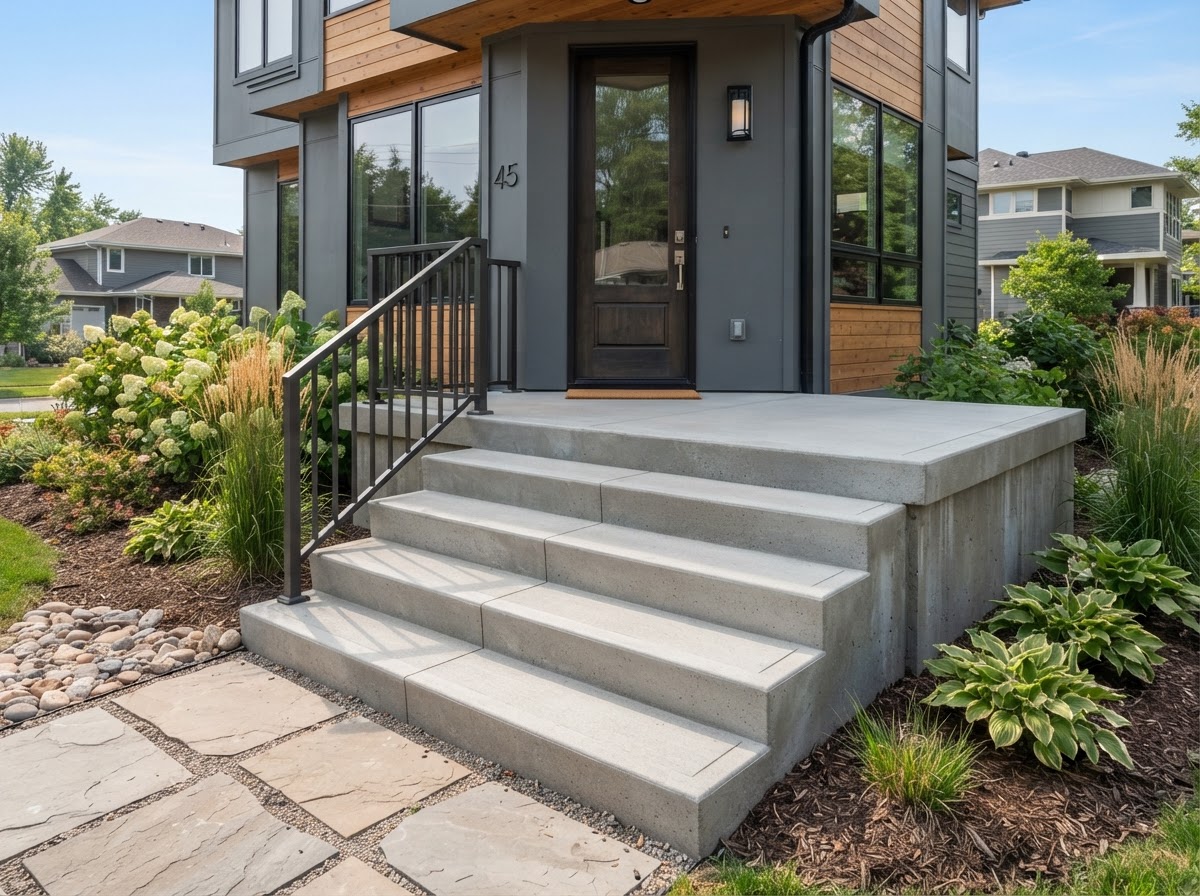
Concrete Steps, Stairs & Stoops in Gaithersburg, MD
Concrete steps, stairs, and stoops create the durable transition between your Gaithersburg home's entry and the surrounding grade — from front stoops that frame the front door to side-entry stairs and garden steps that handle changes in elevation. Gaithersburg Concrete installs new entry steps and replaces cracked, spalled, or settled stoops that have become unsafe or unsightly. Because steps combine elevation changes, daily foot traffic, and exposure to Maryland weather, every project starts with a review of the rise, run, landing, drainage, and how the steps connect to walkways and the porch. The result is a set of steps built for safe, stable access and finished to complement the home.
Concrete Steps & Stoops in Gaithersburg
Concrete steps and stoops are the poured structures that bridge changes in elevation at a home's entries. A front stoop frames the front door and provides a landing; side-entry stairs handle grade changes along the side of a home; and garden or porch steps manage transitions across the landscape. Unlike walkways, steps involve risers and treads, which makes dimensions and uniformity central to both safety and appearance.
New installation lets you size the stoop or stair to the entry and the surrounding grade. Replacement is often the right choice when an existing stoop has cracked, spalled, pulled away from the house, or settled unevenly. A failing stoop is not just a cosmetic issue — uneven treads and broken corners are safety concerns on a surface people use every day.
Durable access is the goal. Steps need to be stable, evenly proportioned, and connected cleanly to the walkway and porch so water sheds away and there are no awkward transitions.
Signs Concrete Steps May Need Repair or Replacement
Because steps carry people up and down a change in elevation, defects that might be tolerable on a flat surface become real hazards. We do not make structural safety determinations without inspection, but the following signs commonly indicate a stoop or stair that needs attention.
Common Step and Stoop Problems
- Cracks across treads, risers, or the stoop slab
- Spalling and surface wear on the top of steps
- Broken corners and chipped edges
- Uneven treads where settlement has dropped one step below another
- Settlement that has separated the stoop from the house
- Separation between the stoop and the foundation or walkway
Settlement and separation are particularly common on older stoops, where the base beneath the stoop has compacted or eroded and the structure has pulled away from the home. That gap is more than cosmetic — it affects how the stoop drains and how stable it feels underfoot. Where damage is localized, repair may restore the step; where the stoop has shifted or deteriorated broadly, replacement is usually the safer, more durable solution.
Concrete Step & Stoop Installation Process
Building steps involves forming risers and treads to consistent dimensions, tying the stoop to the surrounding grade, and finishing for traction and appearance.
- 1Measurement and layout — determine the total rise, tread depth, and number of steps.
- 2Existing concrete removal — break up and haul away the old stoop where replacing.
- 3Base and support preparation — prepare a stable base for the new stoop or stairs.
- 4Forming — set forms to the rise, run, and landing dimensions.
- 5Reinforcement where appropriate — add reinforcement suited to the stoop and loads.
- 6Placement — pour the concrete into the forms.
- 7Finishing — apply a traction-friendly finish to treads and landings.
- 8Curing — allow the concrete to gain strength before the steps are used.
Concrete Step Design & Surface Options
Step design is about dimensions and finish. The total rise, tread depth, and landing size determine how the steps feel to walk, while the finish affects both traction and curb appeal. A broom finish gives reliable grip on outdoor treads, and decorative finishes can elevate a front stoop's appearance.
Design Considerations
- Dimensions sized for comfortable, uniform rise and run
- Landings at the entry and any direction changes
- Broom finish for traction on treads and landings
- Decorative finishes on front stoops where curb appeal matters
- Clean transitions to the walkway and porch
- Porch connections that match the existing or new porch elevation
Railings are a coordination consideration on many step projects, but we do not claim to provide railing installation unless it is part of the agreed scope — railings are typically coordinated separately. For the walkway that leads to the steps, our concrete walkway services tie the entry together, and decorative front stoops can draw on stamped and decorative concrete. Existing step damage on an otherwise sound stoop can often be addressed through concrete repair.
Existing porches, entries and stoops may also require repair when cracking, settlement or surface deterioration develops rather than full replacement.
For damaged front entry concrete specifically, see our porch, front entry and stoop repair services.
Exterior Concrete Steps & Maryland Weather
Front stoops and exterior steps in Gaithersburg face some of the harshest conditions on a property. Water, snow, and ice collect on treads and landings through the winter, and freeze-thaw cycles stress the surface and any existing cracks. Traction matters more on steps than on almost any other surface because a slip on a stair is more dangerous than a slip on flat ground.
Drainage is central to how well a stoop performs. Water that sits on a landing or runs beneath the stoop contributes to settlement and the separation from the house that develops over time. Proper base preparation and slope help direct water away from the structure and the foundation.
Surface wear accumulates from foot traffic, snow shoveling, and deicers. A well-finished, well-drained stoop holds up better than one poured over a poor base, but no exterior step is immune to years of winter exposure. We do not promise that steps will never show wear — we build them to handle Maryland conditions as well as the site and scope allow.
Discuss Your Concrete Project
Have questions about scope, timing, or whether repair or replacement is the right call? We are happy to review your project and provide a clear, honest estimate.
Concrete Step & Stoop FAQs
Can cracked concrete steps be repaired?
Yes, cracks in steps can often be repaired, especially when the stoop is stable and the cracking is localized. Widespread cracking, settlement, or separation from the house may make replacement the better option. We assess whether the cause is ongoing before recommending repair or replacement.
When should a stoop be replaced?
A stoop is typically a replacement candidate when it has settled away from the house, has widespread cracking or spalling, has broken corners, or has treads that have become uneven. When the structure has shifted, repair often cannot restore safe, stable access as well as a new pour.
How are concrete steps formed?
Concrete steps are formed by building wood or metal forms that define the rise, run, and landing dimensions, then pouring concrete into those forms. The forms hold the shape while the concrete sets, after which they are removed and the surface is finished for traction and appearance.
Can new steps connect to an existing walkway?
Yes. New steps and stoops can be built to connect cleanly to an existing walkway when the elevations and transitions are planned to match. Clean connections avoid trip points and help drainage flow correctly between the surfaces.
Can concrete steps have decorative finishes?
Yes. Front stoops and entry steps can receive decorative and stamped finishes for added curb appeal, often combined with a traction-friendly texture on treads. The decorative finish sits on a structurally sound stoop, so base and drainage still apply.
Why do stoops pull away from a house?
Stoops pull away from a house when the base beneath them settles or erodes, allowing the stoop to drop or shift relative to the foundation. Poor drainage, water running beneath the stoop, and freeze-thaw cycles all contribute. Proper base preparation and drainage help reduce this movement.
How long before concrete steps can be used?
Fresh concrete needs time to gain strength before it carries regular foot traffic. Timing depends on the mix, weather, and stoop thickness. We advise when the steps are safe to use before we finish the project, and generally recommend avoiding heavy loads until the concrete has cured further.
Request a Concrete Steps Estimate
Whether you need a new front stoop, replacement steps, or repair of a cracked entry stair, Gaithersburg Concrete will review the rise, run, and connections, then provide a clear estimate. Serving Gaithersburg and surrounding Montgomery County communities.
Related Concrete Services Near Gaithersburg
Concrete Sidewalks, Walkways & Paths
Safe, level pedestrian access ways, garden paths, front walkways, and commercial footpaths built for heavy foot traffic.
Learn moreConcrete Repair & Crack Repair
Targeted structural crack filling, spalling remediation, and damaged section patching to extend concrete longevity.
Learn moreStamped & Decorative Concrete
Premium slate, cobblestone, stone, and wood-plank patterns combined with integral colors and protective sealants.
Learn moreRequest a Concrete Steps Estimate
Whether you need a new front stoop, replacement steps, or repair of a cracked entry stair, Gaithersburg Concrete will review the rise, run, and connections, then provide a clear estimate. Serving Gaithersburg and surrounding Montgomery County communities.
- Project-specific estimates — no obligation
- Residential and commercial concrete work
- Serving Gaithersburg and surrounding Montgomery County
Request a Free Estimate
Tell us about your concrete project in Gaithersburg or nearby.