Concrete Repair & Crack Repair in Gaithersburg, MD
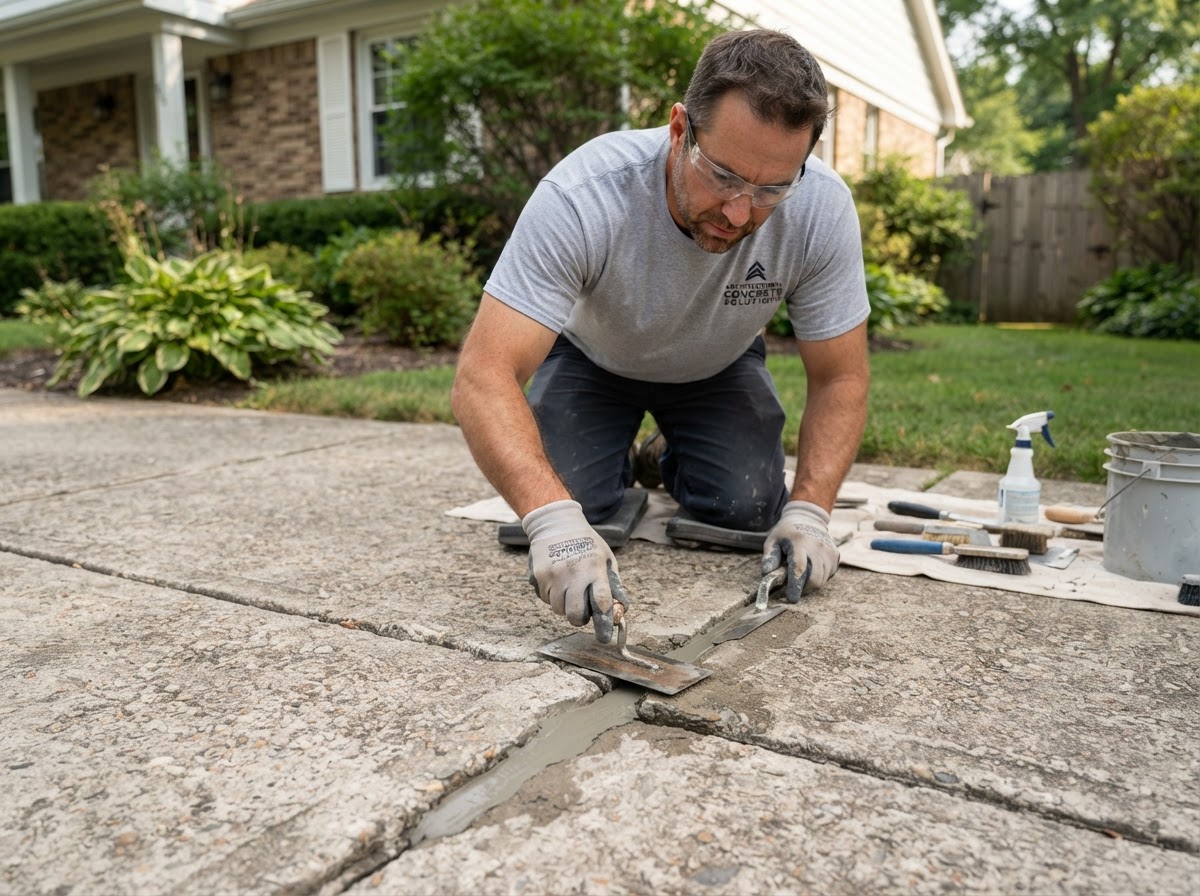
Concrete repair addresses the cracks, damaged areas, and surface deterioration that develop on driveways, patios, walkways, and slabs across Gaithersburg over time. Gaithersburg Concrete evaluates each defect before recommending a fix, because not every crack means the same thing — some are cosmetic and easily repaired, while others signal ongoing movement that requires a deeper solution. Our repair work covers crack treatment, spalling remediation, broken-corner restoration, joint repair, and patching of damaged sections. The goal is to extend the usable life of sound concrete where repair makes sense, and to tell you honestly when replacement is the better long-term call.
Concrete Repair in Gaithersburg
Concrete repair is the targeted treatment of cracks, damaged areas, broken edges, and surface defects on an otherwise serviceable slab. Rather than replacing an entire driveway, patio, or walkway, repair addresses the specific spots where the concrete has failed — extending the life of the surrounding surface and postponing the cost of full replacement.
In Gaithersburg, exterior concrete develops defects for predictable reasons: freeze-thaw cycles, moisture, settlement, age, and the loads placed on the surface. A crack in a driveway, a spalled patio corner, or a broken walkway edge are all common issues that repair can often resolve — provided the underlying concrete is stable and the cause of the damage is understood.
Assessment comes first. Before any repair material is mixed, we evaluate the type, width, and depth of the defect and whether the slab is still moving. A repair applied over an active problem will not last, so understanding the cause is the most important step in any concrete repair.
Common Concrete Problems We Evaluate
Different defects call for different responses. Some are surface-level and cosmetic; others indicate deeper movement that cosmetic patching will not solve.
Defects We Commonly Assess
- Hairline cracks — narrow surface cracks that may be cosmetic
- Larger structural cracks — wider cracks that may indicate movement
- Spalling and flaking — surface concrete breaking away from the slab
- Broken corners and edges — chipped or missing concrete at slab perimeters
- Settlement and uneven slabs — panels that have dropped below their neighbors
- Surface scaling — thin flaking often related to freeze-thaw and deicers
- Joint deterioration — failed or broken expansion and control joints
Some of these conditions indicate deeper movement or base failure and cannot be solved by surface patching alone. A wide, uneven crack that continues to grow, or a slab section that is actively settling, points to an underlying issue that repair alone may not address. We are straightforward about when a defect is repairable and when it signals the need for leveling or replacement.
How Concrete Repairs Are Completed
A durable repair depends on preparation as much as on the repair material itself. Loose material, contamination, and moisture all affect how well a repair bonds.
- 1Inspection — evaluate the defect type, extent, and whether movement is ongoing.
- 2Cleaning and preparation — remove loose material, dirt, and debris from the damaged area.
- 3Removing loose concrete — cut back to sound material so the repair bonds to stable concrete.
- 4Repair material selection — choose a material suited to the defect and surface.
- 5Crack treatment — fill or seal cracks appropriate to their width and type.
- 6Patching — place repair material in spalled, broken, or deteriorated areas.
- 7Joint repair — restore failed expansion or control joints where needed.
- 8Surface finishing — match the surrounding texture as closely as practical.
- 9Curing — allow the repair to set and gain strength before the area returns to use.
Concrete Repair vs. Concrete Replacement
Repair makes sense when the damage is localized and the surrounding slab is stable — a single crack, one spalled corner, or a small broken section on an otherwise sound surface. In those cases, targeted repair extends the slab's life without the cost and disruption of full replacement.
Replacement becomes more practical when deterioration is extensive. Widespread cracking across most of the slab, significant and ongoing settlement, a failed base, or structural damage all point toward replacement as the more durable solution. Continuing to patch a slab that is failing throughout rarely pays off.
Where a slab is sound but uneven, concrete leveling may restore it without repair or replacement. For surfaces that are stable but cosmetically worn, concrete resurfacing can renew the appearance. And when a driveway has reached the end of its life, full driveway replacement is the cleanest path. We recommend the approach that fits the actual condition, not the one that is easiest to sell.
Surface deterioration such as spalling, flaking or crumbling may require localized repair, resurfacing or replacement depending on severity. For that specific problem, see our dedicated spalling, flaking and crumbling concrete repair page. Front entry concrete that has cracked or settled is also covered in our porch, front entry and stoop repair services. For cracks and damaged expansion joints specifically, see our concrete crack and expansion joint repair page.
Related problem-focused services: spalling and crumbling concrete repair and porch and stoop repair. For damaged joints and gaps, see our concrete crack and expansion joint repair.
Why Concrete Cracks in Gaithersburg & Maryland
Concrete cracks for a combination of reasons, and Maryland's climate amplifies several of them. Shrinkage during curing, movement in the base, settlement of the subgrade, and the loads placed on the surface all contribute. Freeze-thaw cycles add stress as moisture inside and beneath the slab expands and contracts with the seasons.
Water is a recurring factor. Poor drainage that lets water run beneath a slab, or moisture that enters cracks and freezes, accelerates deterioration. Joint performance matters too — control and expansion joints exist to manage cracking, and when they fail or fill with debris, cracks appear elsewhere. Age and the cumulative effect of years of traffic and weather eventually take a toll on any exterior surface.
Not every crack means failure. Hairline shrinkage cracks are common and often harmless, while active, widening cracks deserve attention. We do not imply that every crack signals a structural problem — the context, width, and movement pattern determine whether a crack is a concern.
Discuss Your Concrete Project
Have questions about scope, timing, or whether repair or replacement is the right call? We are happy to review your project and provide a clear, honest estimate.
Concrete Repair FAQs & Estimates
Can cracked concrete be repaired?
Yes, many cracks can be repaired, especially hairline and surface cracks on stable slabs. Wider cracks or those linked to ongoing movement may need a different approach. We evaluate the crack type and whether the cause is still active before recommending a repair method.
When should concrete be replaced instead?
Replacement is typically the better choice when cracking is widespread, settlement is ongoing, the base has failed, or the slab shows extensive structural deterioration. When damage spans most of the surface, repair becomes a series of patches that rarely holds up as well as a new pour.
Can you repair spalling concrete?
Yes, spalled and flaking surfaces can often be repaired by removing the loose material and applying a compatible patching material. The repair's longevity depends on addressing the cause of the spalling, which is often moisture or freeze-thaw related, not just covering the surface.
Why does concrete crack in winter?
Winter cracking is largely driven by freeze-thaw cycles. Moisture that enters the slab or sits beneath it expands as it freezes, stressing the concrete and any existing cracks. Deicing salts and poor drainage make the problem worse. Proper joints and drainage help reduce winter-related cracking.
Can cracks return after repair?
They can, if the underlying cause is still active. A crack caused by ongoing settlement or movement may reopen because the slab is still shifting. That is why we assess whether movement has stopped before repairing — addressing the cause is what keeps a repair intact.
What causes concrete surfaces to flake?
Flaking, or spalling, is usually caused by freeze-thaw cycling, moisture, deicing salts, or finishing issues from the original pour. Surface concrete breaks away from the slab when these factors weaken the top layer. Repairing spalling means removing the loose material and addressing the moisture source.
Can uneven concrete be repaired without replacement?
Often, yes. Uneven but structurally sound slabs can frequently be leveled or lifted rather than replaced. Concrete leveling raises settled sections back toward grade. We assess whether the slab is a candidate for leveling or whether replacement is necessary based on its condition.
Request a Concrete Repair Estimate
Not sure whether your cracked or damaged concrete can be repaired or needs replacement? Gaithersburg Concrete will assess the condition and give you an honest recommendation. Call (240) 690-6035 or request a free estimate.
Related Concrete Services Near Gaithersburg
Concrete Leveling, Lifting & Mudjacking
Cost-effective lifting of sunken, uneven concrete slabs to eliminate trip hazards and restore positive drainage.
Learn moreConcrete Resurfacing & Concrete Overlays
Restorative polymer-modified micro-toppings and decorative cement overlays for structurally sound yet worn concrete.
Learn moreConcrete Driveway Installation & Replacement
Durable residential and light commercial concrete driveways built to withstand vehicular weight and Maryland freeze-thaw cycles.
Learn moreConcrete Steps, Stairs & Stoops
Solid poured entry stairs, replacement porch stoops, and grade-transition steps built for safety and architectural appeal.
Learn moreRequest a Concrete Repair Estimate
Not sure whether your cracked or damaged concrete can be repaired or needs replacement? Gaithersburg Concrete will assess the condition and give you an honest recommendation. Call (240) 690-6035 or request a free estimate.
- Project-specific estimates — no obligation
- Residential and commercial concrete work
- Serving Gaithersburg and surrounding Montgomery County
Request a Free Estimate
Tell us about your concrete project in Gaithersburg or nearby.