
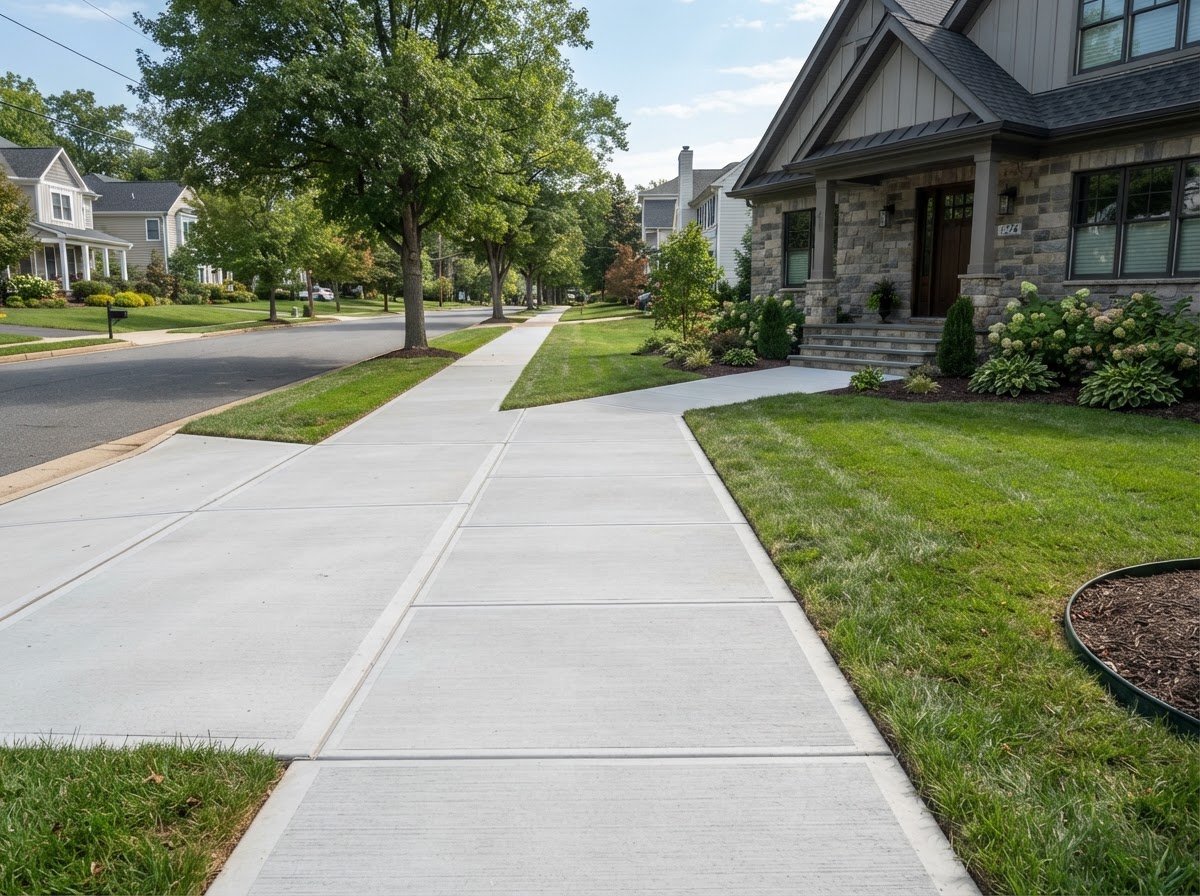
Concrete Sidewalks, Walkways & Paths in Gaithersburg, MD
Concrete sidewalks, walkways, and paths provide safe, level pedestrian access across Gaithersburg properties — from front walks connecting the street to the entry, to side-yard paths and backyard routes that tie a landscape together. Gaithersburg Concrete installs new walkways and replaces cracked, settled, or uneven ones that have become trip hazards. Every walkway project begins with a review of the route, width, slope, and how the path connects to driveways, steps, and patios. Proper layout, base preparation, forming, drainage, and finishing determine how well a walkway performs and how long it holds up under foot traffic and Maryland weather.
Concrete Walkway & Sidewalk Installation in Gaithersburg
A concrete walkway is a poured pedestrian slab that provides a stable, non-slip route across a property. In Gaithersburg, walkways range from formal front walks leading to the front door to informal backyard paths connecting patios, gardens, and outbuildings. Unlike steps or driveways, a walkway is built primarily for foot traffic, which shapes its thickness, finish, and slope.
New walkway installation lets you define the route, width, and connections across your yard. Replacement becomes the right choice when an existing walkway has cracked, settled, or become uneven enough to create trip hazards. Replacing a damaged walkway also gives you the chance to correct drainage problems or adjust the route to match how the landscape has matured.
Connections matter as much as the path itself. A walkway that links cleanly to the driveway, entry steps, or patio feels intentional, while one that ends abruptly or meets other surfaces at the wrong elevation creates trip points and drainage issues. We plan those transitions as part of the installation.
When Concrete Walkways Need Replacement or Repair
Walkways in the Gaithersburg area develop predictable problems over years of exposure. The question is whether those problems can be repaired or whether the walkway has reached the point where replacement delivers better value.
Signs a Walkway Needs Attention
- Trip hazards where panels have settled at different elevations
- Cracks running across walkway panels or between sections
- Settlement that has dropped panels below their original grade
- Broken panels with crumbling edges or missing corners
- Poor drainage that leaves water pooling on the walking surface
- Surface deterioration and scaling from freeze-thaw exposure
Root-related movement is one possible factor — as nearby trees grow, roots can lift or crack walkway panels — but it is not the cause of every crack. We evaluate the actual condition rather than assuming. Where a single panel has settled but the rest is sound, leveling may restore it. Where cracking and settlement are widespread, replacement is usually the cleaner solution.
Our Concrete Walkway Installation Process
A walkway installation follows the same fundamentals as any flatwork, sized and finished for pedestrian use.
- 1Layout — mark the route, width, and connections to driveways, steps, and patios.
- 2Width planning — size the walkway to its use, from narrow garden paths to wider front walks.
- 3Excavation — remove soil to the depth needed for base and slab.
- 4Base preparation — add and compact base material for a stable foundation.
- 5Forming — set forms to the final shape, including curves where desired.
- 6Grading — establish slope so water sheds off the walking surface.
- 7Placement — pour and screed the concrete to a consistent level.
- 8Finishing — apply a broom or chosen texture for traction.
- 9Joints — place control joints to manage cracking.
- 10Curing — allow the concrete to gain strength before foot traffic returns.
Walkway Layouts & Finish Options
Walkways can be straight and formal or curved to follow a landscape, and the finish defines both appearance and traction. A broom finish is the practical standard for outdoor walkways, providing grip in wet weather. Decorative borders and stamped surfaces elevate the look for front walks where curb appeal matters.
Layout and Finish Choices
- Straight walks for formal, direct routes
- Curved walks that follow the landscape
- Broom finish for reliable outdoor traction
- Decorative borders and stamped accents for front entries
- Seamless connections to patios, steps, and driveways
Where a walkway meets a change in elevation, our concrete steps and stoops work connects the path to entry stoops and grade changes. For a walkway that leads to a backyard entertaining area, our concrete patios tie the route into the living space. Decorative front walks can draw on stamped and decorative concrete for added curb appeal.
Safer, More Functional Concrete Paths for Gaithersburg Properties
A walkway in Gaithersburg faces freeze-thaw cycles, winter ice, and the constant presence of foot traffic. Trip hazards are the most important safety concern — a settled or uneven panel that someone might catch a foot on is a problem worth fixing promptly, especially on front walks and routes used daily.
Drainage and surface traction both affect safety and durability. A walkway that sheds water stays cleaner and resists the scaling that freeze-thaw and deicers cause over time. Transitions between walkways and other surfaces — driveways, steps, patios — need clean elevation matches to avoid lips and trip points.
Accessibility matters on routes used regularly. We do not claim ADA compliance for a walkway unless a project is specifically built and verified to the relevant standards, but we plan slope and transitions with usability in mind. Where a grade change calls for a ramp, our ADA concrete ramps and accessible ramp installation page covers those installations. Where a settled walkway is the issue and the slab is sound, concrete leveling may restore safe passage without full replacement.
Discuss Your Concrete Project
Have questions about scope, timing, or whether repair or replacement is the right call? We are happy to review your project and provide a clear, honest estimate.
Concrete Walkway FAQs & Estimates
How wide should a concrete walkway be?
Walkway width depends on its use. Front walks and primary paths are commonly wider to accommodate comfortable passage, while narrow garden paths may be tighter. We size the walkway to how it will be used and how it connects to the rest of the property rather than applying one width to every project.
Can an uneven sidewalk be repaired?
Often, yes. If the slab is structurally sound but panels have settled at different elevations, concrete leveling may raise the low sections back toward grade. If the concrete is cracked or broken, repair or replacement may be needed. We assess whether leveling is viable or whether replacement is the better approach.
How long does a walkway installation take?
Most residential walkway installations are completed over a few days of active work, including excavation, base preparation, forming, pouring, and finishing. The timeline varies with the length, site access, and whether existing walkway concrete must be removed. We outline a schedule during your estimate.
What finish is best for outdoor walkways?
A broom finish is the practical standard for outdoor walkways because its light texture provides traction in wet and icy conditions. Decorative and stamped finishes can be used where curb appeal is the priority, often on front walks. We recommend a finish based on where the walkway is and how it will be used.
Why do sidewalk slabs become uneven?
Sidewalk slabs become uneven when the base beneath them compacts, erodes, or shifts. Poor drainage, water running beneath the slab, freeze-thaw cycles, and ground movement all contribute to settlement. Where the slab is sound, leveling can restore it; where it is cracked, replacement may be needed.
Can walkways connect to existing concrete?
Yes. New walkways can tie into existing driveways, patios, or steps when the elevations and transitions are planned to match. Clean connections avoid lips and trip points and help drainage flow correctly between surfaces. We plan those transitions as part of the installation.
Can decorative concrete be used for walkways?
Yes. Stamped and decorative finishes, borders, and color can be applied to walkways, particularly front walks where appearance is a priority. The decorative finish sits on a structurally sound slab, so base preparation and drainage still apply. We help choose a finish suited to the walkway's location and use.
Request a Walkway or Sidewalk Estimate
Whether you need a new front walk, a backyard path, or a replacement for a cracked sidewalk, Gaithersburg Concrete will review your route and provide a clear estimate. Serving Gaithersburg and surrounding Montgomery County communities.
Related Concrete Services Near Gaithersburg
Concrete Steps, Stairs & Stoops
Solid poured entry stairs, replacement porch stoops, and grade-transition steps built for safety and architectural appeal.
Learn moreConcrete Patio Installation & Replacement
Custom concrete backyard patios engineered for outdoor living, cookouts, and year-round family entertainment.
Learn moreStamped & Decorative Concrete
Premium slate, cobblestone, stone, and wood-plank patterns combined with integral colors and protective sealants.
Learn moreConcrete Leveling, Lifting & Mudjacking
Cost-effective lifting of sunken, uneven concrete slabs to eliminate trip hazards and restore positive drainage.
Learn moreRequest a Walkway or Sidewalk Estimate
Whether you need a new front walk, a backyard path, or a replacement for a cracked sidewalk, Gaithersburg Concrete will review your route and provide a clear estimate. Serving Gaithersburg and surrounding Montgomery County communities.
- Project-specific estimates — no obligation
- Residential and commercial concrete work
- Serving Gaithersburg and surrounding Montgomery County
Request a Free Estimate
Tell us about your concrete project in Gaithersburg or nearby.