Concrete Driveway Cost Guide for Gaithersburg, MD
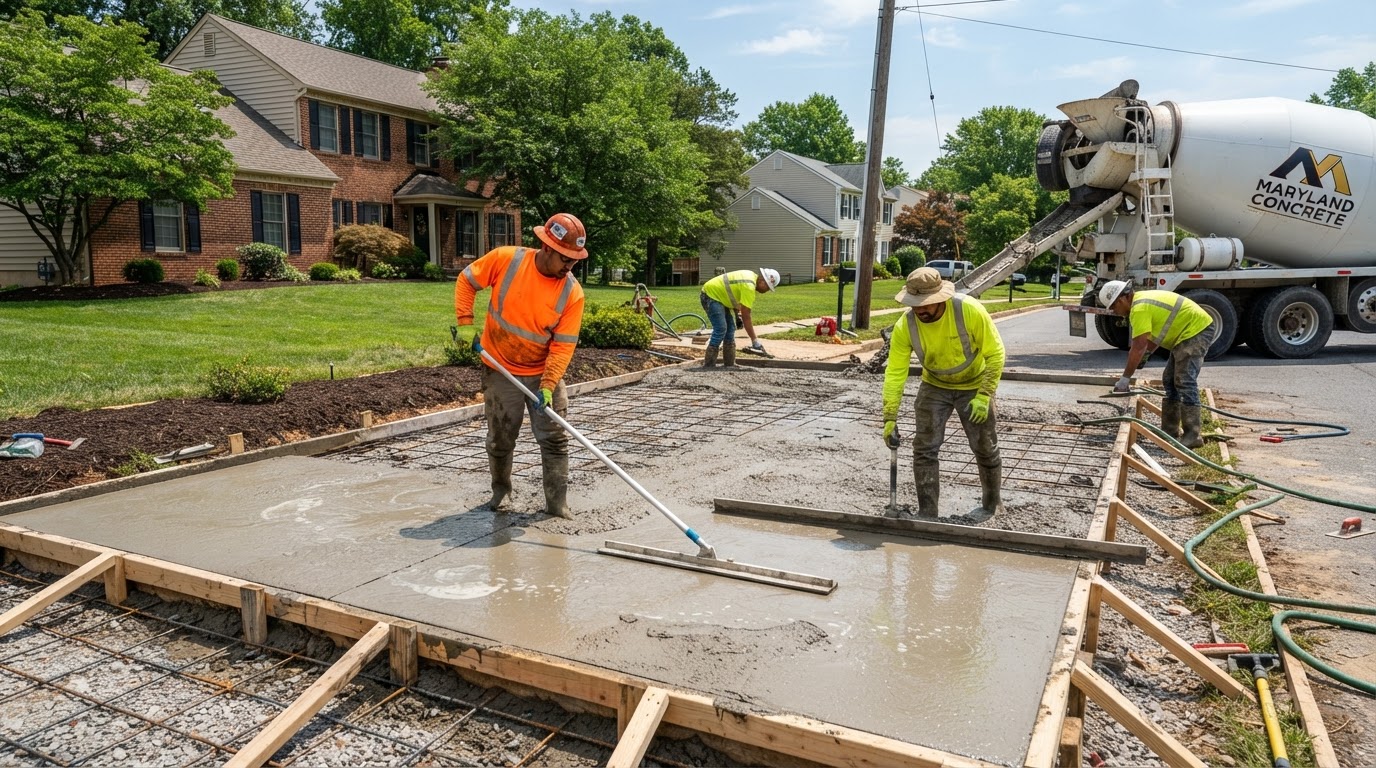
There is no single reliable concrete driveway price without knowing the dimensions and site conditions of a specific property. Concrete driveway cost in Gaithersburg depends on driveway area, removal of existing pavement, excavation, base preparation, concrete thickness, reinforcement, drainage, finish, and access — and two driveways with the same square footage can cost meaningfully different amounts when these factors differ. This guide from Gaithersburg Concrete walks through what changes a driveway estimate, how new installation, replacement, widening, and apron work each carry different scope, and what information helps produce a more accurate number for a residential or light-commercial driveway project in Gaithersburg, Maryland.
Request a Free Estimate
Tell us about your concrete project in Gaithersburg or nearby.
How Much Does a Concrete Driveway Cost in Gaithersburg?
There is no single reliable driveway price without knowing the dimensions and site conditions of the property. Major cost variables include driveway area, removal of existing pavement, excavation, base preparation, concrete thickness, reinforcement, drainage, finish, and access — and each of these can move a quote substantially.
Driveway Cost Drivers
- Driveway square footage and total area
- Driveway width and length
- Vehicle loads the slab must carry
- Old driveway removal and disposal
- Asphalt versus concrete removal where applicable
- Base and subgrade condition
- Grading and drainage work
- Reinforcement for the application
- Broom finish versus decorative finish
- Apron work and walkway connections
- Garage transition and threshold
- Site access for trucks and equipment
A straightforward new driveway on open, accessible ground carries one set of costs; a replacement that requires demolition, base correction, and decorative borders carries another — even when the finished footprint is the same. We do not publish fabricated per-square-foot pricing, because real driveway cost reflects these variables rather than a flat rate.
What Changes the Cost of a Concrete Driveway?
Driveway Square Footage
Larger driveways use more concrete, labor, and forming, but benefit from efficiency of scale. A short, narrow driveway still requires mobilization, setup, and cleanup, so the per-square-foot cost of a compact pour is often higher than a large one even though the total is lower.
Width, Length & Vehicle Loads
A driveway built for side-by-side parking of two vehicles is wider and uses more material than a single-lane drive. Vehicle loads also influence thickness and reinforcement — a driveway carrying trucks or an RV is planned differently than one serving a single passenger car.
Old Driveway Removal
Replacing an existing driveway means demolishing, loading, and hauling away the old concrete (or asphalt) before any new work begins. Removal adds labor, equipment, and disposal costs that a new pour on raw ground does not carry.
Base & Subgrade Condition
The subgrade beneath a driveway determines how well it resists settlement. Excavation to the right depth, compaction, and a properly prepared base all add scope — and skipping them is the most common reason a driveway cracks or sinks prematurely.
Grading & Drainage
A driveway must shed water toward the street or a drainage path, not toward the garage or foundation. Grading, slope correction, and drainage features add scope but protect both the slab and the structures around it.
Reinforcement
Reinforcement is used where appropriate for the vehicle loads and slab span. A driveway carrying heavier vehicles typically uses more reinforcement than a light-use walkway, and that material and labor is part of the estimate.
Finish & Decorative Options
A standard broom finish is the most economical. Decorative borders, stamped accents, exposed aggregate, and colored concrete each add labor, material, and detail work. The more decorative the finish, the more scope it adds.
Apron, Walkway & Garage Transitions
How the driveway ties into the street apron, connecting walkways, and the garage slab all require coordination. Transitions that need to line up with existing surfaces add forming and finishing scope.
Site Access
A driveway reachable directly by a concrete truck costs less to pour than one where material must be wheeled or pumped. Overhead lines, narrow streets, and landscaping all affect how concrete reaches the pour.
New Driveway vs. Driveway Replacement Costs
New installation, full replacement, widening, and apron work each carry different scope — and treating them as interchangeable leads to inaccurate expectations. The breakdown below explains what each involves.
New Driveway
A new driveway on open ground includes layout, excavation, grading, new base, forming, reinforcement where appropriate, concrete placement, finishing, joints, and curing. There is no demolition or haul-away because no existing surface is being removed.
Driveway Replacement
A replacement adds demolition of the existing driveway, loading and haul-away, base evaluation and recompaction, and then reconstruction. Replacement is more involved than a new pour of the same size because of the removal step and the need to correct whatever caused the old driveway to fail.
Driveway Widening
Widening extends an otherwise usable driveway with an adjacent excavation, new base, and a tied-in extension. The old/new transition is a key scope item — the new concrete has to match elevation and slope and connect cleanly to the existing slab. Widening is typically less than full replacement when the existing driveway is sound.
Driveway Apron
An apron is the transition slab at the street or garage entrance. Apron work is its own scope — it involves the entrance transition, drainage, and often coordination with the public right-of-way, which can carry its own requirements.
For the service pages behind each scope, see our driveway installation and replacement, driveway widening, and driveway apron pages.
Standard Finish vs. Decorative Driveway Options
The finish is one of the largest variables in driveway cost after size and demolition. A standard broom finish is practical and economical; decorative options add labor, material, and detail that increase scope.
| Option | Appearance | Added Complexity | Maintenance |
|---|---|---|---|
| Broom finish | Practical, slip-resistant, uniform | Lowest | Routine cleaning, occasional sealing |
| Decorative borders | Contrasting edge band, custom look | Moderate | More attention to edges and sealing |
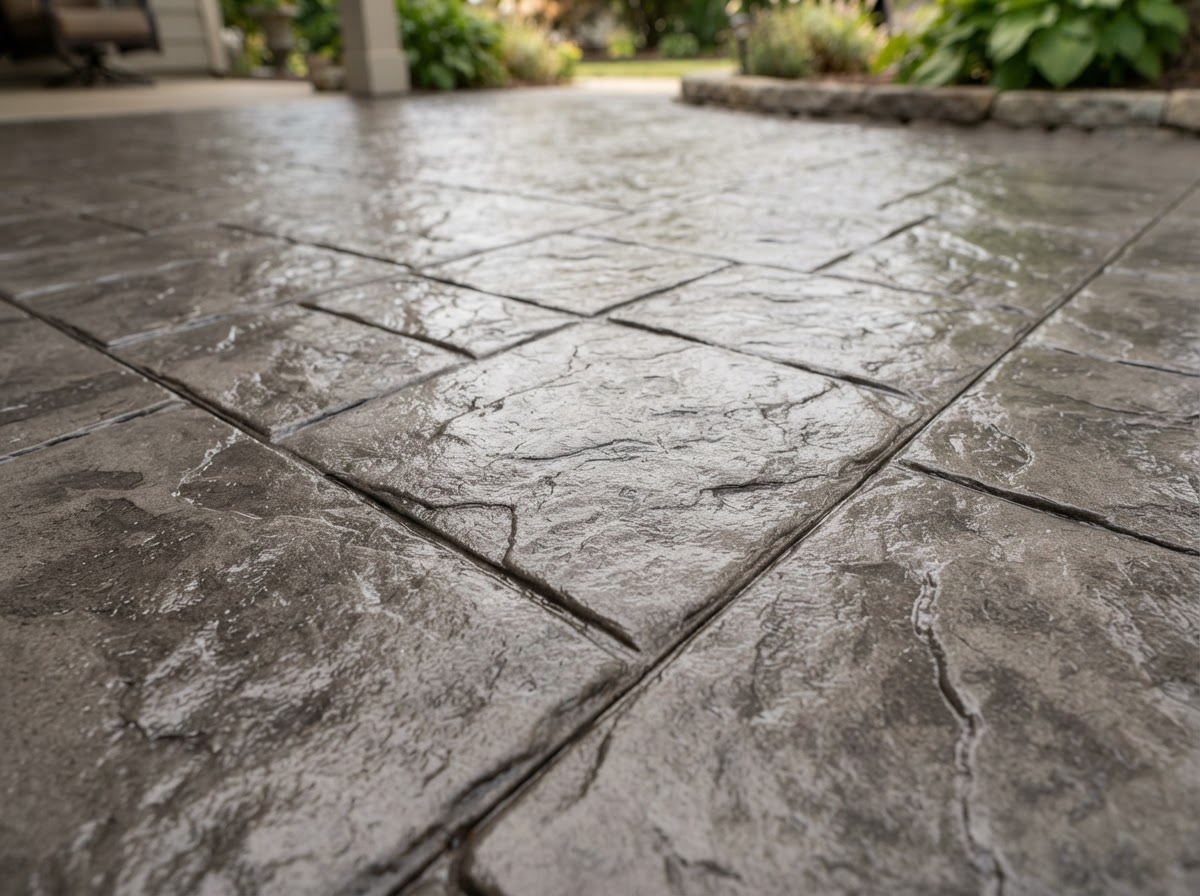
| Stamped accents | Stone, slate, or brick patterns | Higher | Sealing recommended to protect pattern |
| Exposed aggregate | Decorative stone texture | Higher | Sealing recommended; surface retreads over time |
| Colored concrete | Integral color throughout the slab | Moderate | Color may fade; sealing helps |
Not every finish suits every driveway. A heavily trafficked driveway may be better served by a durable broom finish than a delicate stamped pattern, while a decorative border can add curb appeal without the full cost of a stamped field. We help match the finish to how the driveway will actually be used.
Gaithersburg Driveway Conditions That Can Affect Scope
Maryland's climate puts real demands on a driveway. Freeze-thaw cycles through the winter mean moisture that enters the slab or sits beneath it can expand as it freezes, stressing the surface and any existing cracks. Deicing salts accelerate surface scaling, and the cumulative effect of years of traffic and weather eventually takes a toll on any exterior surface.
Slope and drainage are central to driveway performance in Gaithersburg. A driveway that sheds water toward the street or a designed drainage path lasts longer than one that pools or sends runoff toward the garage or foundation. Where a driveway meets the garage, the transition and elevation need to direct water away from the structure.
Existing settlement is common on older driveways — panels that have dropped below their neighbors create trip hazards and indicate base movement. Widening a driveway, replacing an apron, or connecting to a sidewalk all involve interfaces that may be subject to applicable requirements depending on the property and jurisdiction. We confirm what applies to a specific project rather than assume a universal rule.
How to Get a More Accurate Driveway Estimate
Information to Gather
- Measure the width and length of the driveway area
- Identify whether the existing driveway must be removed
- Photograph any cracking, settlement, or surface damage
- Identify drainage concerns or standing water
- Decide between a standard and decorative finish
- Note any widening needs alongside the existing slab
- Note the condition of the apron and any sidewalk interfaces
- Describe the vehicles the driveway will carry
For the broader pricing framework, see our overall concrete cost guide. For the driveway service itself, see our driveway installation and replacement page, and to request an estimate, visit our contact page.
Discuss Your Concrete Project
Have questions about scope, timing, or whether repair or replacement is the right call? We are happy to review your project and provide a clear, honest estimate.
Concrete Driveway Cost FAQs & Estimates
What affects concrete driveway cost the most?
Square footage, demolition of existing pavement, base preparation, slab thickness, reinforcement, drainage work, finish type, and site access are the largest drivers. Two driveways with the same area can cost meaningfully different amounts when these factors differ, which is why a site-specific estimate is more accurate than a flat rate.
Does driveway thickness affect price?
Yes. Thicker slabs use more concrete and may require more base preparation to support the added load. Thickness is matched to the vehicles the driveway will carry — a driveway built for trucks or an RV is typically thicker than one serving a single passenger car.
Does removing an old driveway cost more?
Yes. Replacement adds demolition, loading, haul-away, and disposal, plus base evaluation and recompaction before the new pour. A new driveway on open ground does not carry those removal costs, so replacement of the same size costs more than a new installation.
Does stamped concrete increase driveway cost?
Yes. Stamped and decorative finishes add labor, pattern mats, color, release agents, and sealing that a standard broom finish does not. Decorative borders and exposed aggregate also add scope, with complexity increasing with the detail of the pattern.
Can part of a driveway be replaced?
In some cases a single damaged section can be replaced, but matching the elevation, finish, and drainage of the surrounding slab can be difficult. When damage is widespread, full replacement often produces a more consistent, better-draining surface. We evaluate the condition before recommending a partial or full approach.
Is widening cheaper than replacing the whole driveway?
Often, when the existing driveway is structurally sound and only additional width is needed. Widening adds excavation, base, and a tied-in extension without the demolition and disposal of a full replacement. When the existing driveway is failing, replacement is usually the better long-term value.
How do I measure a driveway for an estimate?
Measure the width and length of the area to be poured or replaced, note any widening needs, and photograph the existing surface and any damage. The more accurate your dimensions and the more detail you provide on access and drainage, the more accurate the estimate.
How do I request a driveway estimate?
Call (240) 690-6035 or request a free estimate through our contact page. We review the site, dimensions, finish preferences, and any demolition or drainage needs, then provide a project-specific estimate.
Request a Concrete Driveway Estimate
Whether you need a new driveway, a replacement, or a widening extension, Gaithersburg Concrete will review your site, scope, and finish preferences, then provide a clear estimate. Call (240) 690-6035 or request a free estimate.
Keep Learning About Concrete in Gaithersburg
Concrete Cost Guide for Gaithersburg, MD
What affects concrete project costs in Gaithersburg — size, demolition, access, base, thickness, reinforcement, finish, grading and drainage.
Read the guideConcrete Patio Cost Guide for Gaithersburg, MD
What affects concrete patio cost in Gaithersburg — size, excavation, access, finish, decorative options and existing patio removal.
Read the guideConcrete Repair Cost Guide for Gaithersburg, MD
What affects concrete repair cost in Gaithersburg — crack type, spalling, settlement, repair size, access and replacement needs.
Read the guideRelated Concrete Services Near Gaithersburg
Concrete Driveway Installation & Replacement
Durable residential and light commercial concrete driveways built to withstand vehicular weight and Maryland freeze-thaw cycles.
Learn moreConcrete Driveway Widening & Extensions
Concrete driveway widening and extensions that add usable parking width to an existing driveway without a full replacement.
Learn moreConcrete Driveway Apron Installation & Replacement
Driveway apron installation and replacement at the street or garage transition, built for vehicle traffic and drainage.
Learn moreConcrete Demolition, Removal & Replacement
Concrete demolition, removal, haul-away, and replacement for driveways, patios, walkways, and slabs.
Learn moreStamped & Decorative Concrete
Premium slate, cobblestone, stone, and wood-plank patterns combined with integral colors and protective sealants.
Learn moreRequest a Concrete Driveway Estimate
Whether you need a new driveway, a replacement, or a widening extension, Gaithersburg Concrete will review your site, scope, and finish preferences, then provide a clear estimate. Call (240) 690-6035 or request a free estimate.
- Project-specific estimates — no obligation
- Residential and commercial concrete work
- Serving Gaithersburg and surrounding Montgomery County
Request a Free Estimate
Tell us about your concrete project in Gaithersburg or nearby.