Concrete Driveway Installation & Replacement in Gaithersburg, MD
A concrete driveway is one of the most used surfaces on a Gaithersburg property, and Gaithersburg Concrete installs and replaces them to handle daily vehicle traffic, Maryland freeze-thaw cycles, and the drainage demands of Montgomery County lots. Whether you need a brand-new driveway poured for a newly built home or a deteriorated driveway removed and replaced, we handle the full scope: demolition, excavation, base preparation, forming, concrete placement, finishing, control joints, and cleanup. Every driveway project starts with a site review so the layout, width, slope, and finish match how you actually use the property.
Concrete Driveway Installation in Gaithersburg
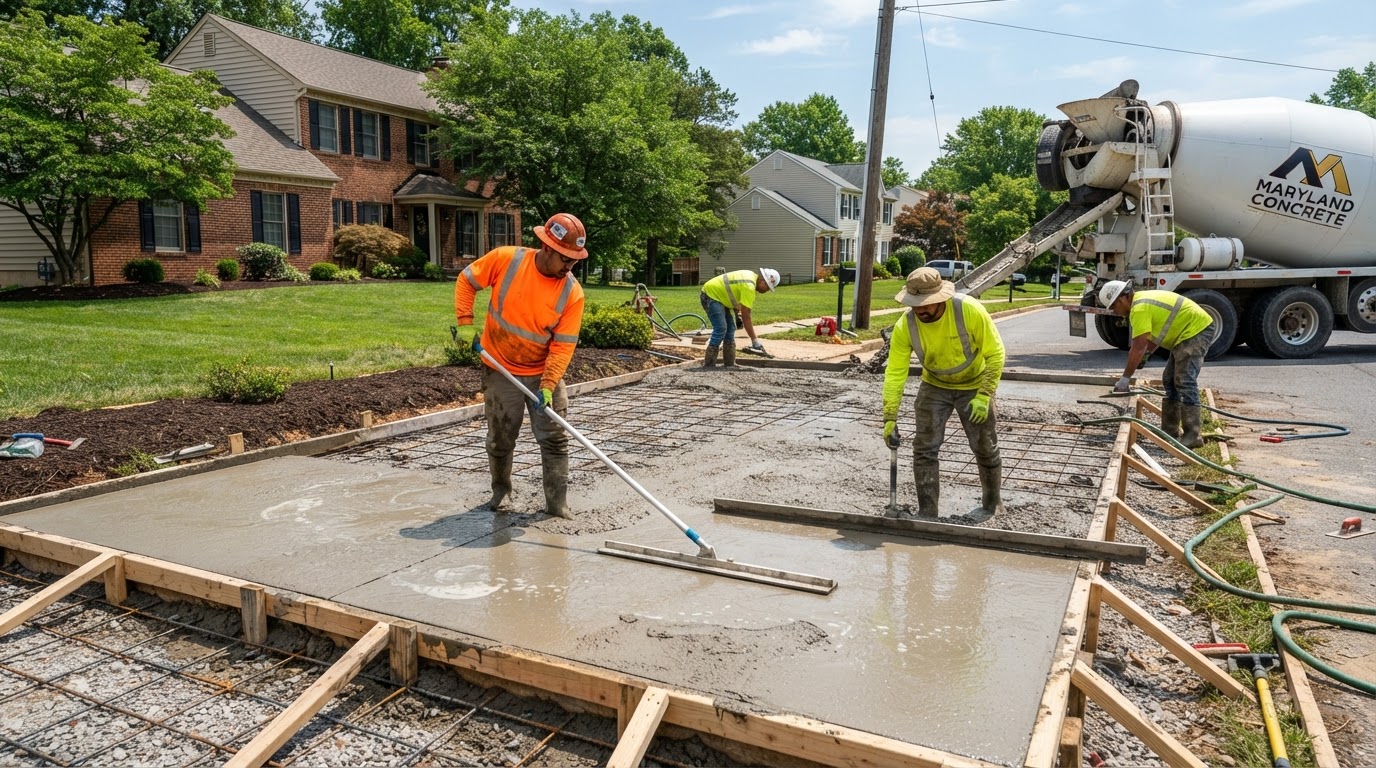
Concrete driveway installation involves building a durable vehicle surface from the ground up — preparing the subgrade, setting forms, placing and finishing concrete, and cutting control joints so the slab performs predictably for years. In Gaithersburg, where homes range from established Montgomery County neighborhoods to newer subdivisions along the I-270 corridor, a driveway is expected to hold up under daily passenger vehicles, occasional heavier loads, snow removal, and seasonal temperature swings.
Replacement is just as common as new installation. Many driveways in the area were poured decades ago and now show cracking, settlement, or surface deterioration that no longer responds to patching. Replacing an aging driveway gives you a clean, contiguous surface and a chance to correct drainage or width problems the original pour may have had. Whether the project is a new installation or a full replacement, the goal is the same: a flat, stable, well-drained surface that improves curb appeal and daily function.
Planning is where a good driveway starts. Before any concrete arrives we review the intended use, existing conditions, access points, and how the driveway connects to the street apron, walkways, and garage. That review shapes the dimensions, slope, and finish we recommend.
When a Concrete Driveway Should Be Repaired or Replaced
A concrete driveway may be a candidate for replacement when it has widespread cracking, significant settlement, extensive surface deterioration, or multiple damaged sections that make localized repairs impractical. Isolated issues — a single crack, one sunken panel, or a small spalled area — can often be repaired, but when problems appear across most of the slab, replacement usually delivers better long-term value.
Conditions We Evaluate
- Major cracks running across multiple panels or widening over time
- Heaving or settlement that creates trip hazards or uneven transitions
- Spalling and surface scaling where the top of the slab is flaking away
- Drainage problems that direct water toward the foundation or garage
- Broken sections, crumbling edges, and deteriorated control joints
- Uneven slabs where one panel has dropped below its neighbors
The right approach depends on the actual condition of the slab, not a one-size rule. A driveway with one settled panel and otherwise sound concrete may only need that section addressed, while a driveway with network cracking, widespread settlement, and a failed base is better replaced entirely. We assess the underlying cause — whether movement is ongoing — before recommending repair or replacement, because patching over an active problem rarely lasts.
Our Concrete Driveway Installation Process
A concrete driveway replacement follows a deliberate sequence. Each step affects how the finished surface performs, so we do not shortcut preparation to speed up the pour.
- 1Project review and measurement — confirm dimensions, slope, access, and finish before mobilizing.
- 2Existing concrete removal — break up and haul away the old driveway where replacement is required.
- 3Excavation and base preparation — grade the subgrade, add and compact base material for a stable foundation.
- 4Forming and grading — set forms to the correct width, thickness, and drainage slope.
- 5Reinforcement where appropriate — add reinforcement suited to the driveway's expected loads and conditions.
- 6Concrete placement — pour, spread, and screed the concrete to a consistent level.
- 7Finishing — apply the selected finish, such as a broom texture for traction.
- 8Control joints — cut or form joints to control where the slab cracks as it cures and moves.
- 9Curing and cleanup — allow the concrete to gain strength, then remove forms and clean the site.
Reinforcement is not identical on every driveway. The type and extent of reinforcement depends on the slab thickness, expected vehicle loads, soil conditions, and the specific project — we do not assume one method fits every property.
Concrete Driveway Finishes, Layouts & Design Options
Driveway finish and layout affect both appearance and performance. A standard broom finish provides a slip-resistant texture well suited to Maryland weather, while decorative borders and stamped accents can elevate curb appeal without changing the structural slab beneath.
Layout and Finish Considerations
- Broom finish for a practical, traction-friendly surface
- Decorative borders or stamped accents along the edges where desired
- Driveway width sized to vehicle count and turning clearance
- Smooth transitions to the street apron, walkways, and garage slab
- Drainage slope directed away from the house and garage
How the driveway ties into the rest of the property matters as much as the slab itself. Apron transitions, walkway connections, and garage transitions all need to line up so water sheds correctly and there are no awkward lips or trip points. For decorative options, see our stamped and decorative concrete services; for damaged aprons or connecting paths, our sidewalks and walkways work pairs naturally with a driveway project. Existing cracks or damage on a driveway still in fair shape can often be addressed through concrete repair before full replacement becomes necessary.
For the entrance transition specifically, see our concrete driveway apron installation and replacement services.
Concrete Driveways Built for Gaithersburg Properties
Maryland's climate puts real demands on exterior concrete. Freeze-thaw cycles through the winter mean moisture that enters the slab can expand as it freezes, stressing the surface and any existing cracks. Combined with summer heat, deicing salts, and the weight of vehicles, a driveway faces a combination of mechanical and environmental stress every year.
Good drainage is one of the most important factors in how long a driveway lasts in Gaithersburg. Water that pools on or runs beneath the slab contributes to settlement, cracking, and surface deterioration. Proper base preparation, slope, and joint placement help manage water so it moves off the surface rather than undermining it.
Snow and ice removal is part of life here, and the way a driveway is finished and maintained affects how it holds up under plows, shovels, and deicers. We do not promise a fixed lifespan — concrete performance depends on installation, soil conditions, drainage, and ongoing care — but a driveway built with proper preparation and drainage is far better positioned to handle Montgomery County winters than one poured over a poorly prepared base.
Discuss Your Concrete Project
Have questions about scope, timing, or whether repair or replacement is the right call? We are happy to review your project and provide a clear, honest estimate.
Concrete Driveway FAQs & Free Estimates
How much does a concrete driveway cost in Gaithersburg?
Concrete driveway pricing depends on square footage, demolition of existing concrete, excavation depth, base preparation, slab thickness, reinforcement, finish type, drainage work, and site access. Because every driveway differs, we provide project-specific estimates rather than fixed per-square-foot rates. Call (240) 690-6035 or request a free estimate to review your specific driveway.
How long does concrete driveway installation take?
Most residential driveway installations are completed over a few days of active work, including demolition, base preparation, forming, pouring, and finishing. The timeline varies with driveway size, site access, weather, and whether existing concrete must be removed. We outline a realistic schedule during your estimate.
When can vehicles drive on new concrete?
Vehicles generally require more curing time than foot traffic. Fresh concrete gains strength over days and weeks, and safe timing depends on the mix, weather, slab thickness, and application. We advise you on when it is safe to walk on and drive on your new driveway before we leave the site.
How thick should a concrete driveway be?
Driveway thickness depends on expected vehicle loads, soil and base conditions, and the specific project. Residential driveways commonly use a thicker slab than pedestrian surfaces, but there is no single universal thickness that fits every property. We recommend thickness based on how the driveway will be used.
Can a cracked driveway be repaired?
Yes, isolated cracks can often be repaired, especially when the surrounding slab is stable. However, widespread cracking, ongoing settlement, or a failed base typically make replacement the more durable option. We evaluate whether the underlying cause is still active before recommending repair or replacement.
Do you remove old driveways?
Yes. When replacing a driveway we remove the old concrete, evaluate and recompact the subgrade, and address drainage before forming and pouring the new surface. Proper removal and base preparation help prevent the same cracking and settlement from recurring.
What causes concrete driveways to sink?
Driveways sink when the soil or base beneath them compacts, erodes, or shifts over time. Poor drainage, water running beneath the slab, freeze-thaw cycles, and inadequately compacted subgrade all contribute to settlement. Where the slab is still sound, concrete leveling or lifting may restore it.
Get a Free Concrete Driveway Estimate
Whether you need a new driveway poured or an aging one removed and replaced, Gaithersburg Concrete will review your site, scope, and goals, then provide a clear estimate. Serving Gaithersburg and surrounding Montgomery County communities.
Related Concrete Services Near Gaithersburg
Concrete Repair & Crack Repair
Targeted structural crack filling, spalling remediation, and damaged section patching to extend concrete longevity.
Learn moreStamped & Decorative Concrete
Premium slate, cobblestone, stone, and wood-plank patterns combined with integral colors and protective sealants.
Learn moreConcrete Leveling, Lifting & Mudjacking
Cost-effective lifting of sunken, uneven concrete slabs to eliminate trip hazards and restore positive drainage.
Learn moreConcrete Sidewalks, Walkways & Paths
Safe, level pedestrian access ways, garden paths, front walkways, and commercial footpaths built for heavy foot traffic.
Learn moreGet a Free Concrete Driveway Estimate
Whether you need a new driveway poured or an aging one removed and replaced, Gaithersburg Concrete will review your site, scope, and goals, then provide a clear estimate. Serving Gaithersburg and surrounding Montgomery County communities.
- Project-specific estimates — no obligation
- Residential and commercial concrete work
- Serving Gaithersburg and surrounding Montgomery County
Request a Free Estimate
Tell us about your concrete project in Gaithersburg or nearby.