Concrete Parking Lot Installation & Replacement in Gaithersburg, MD
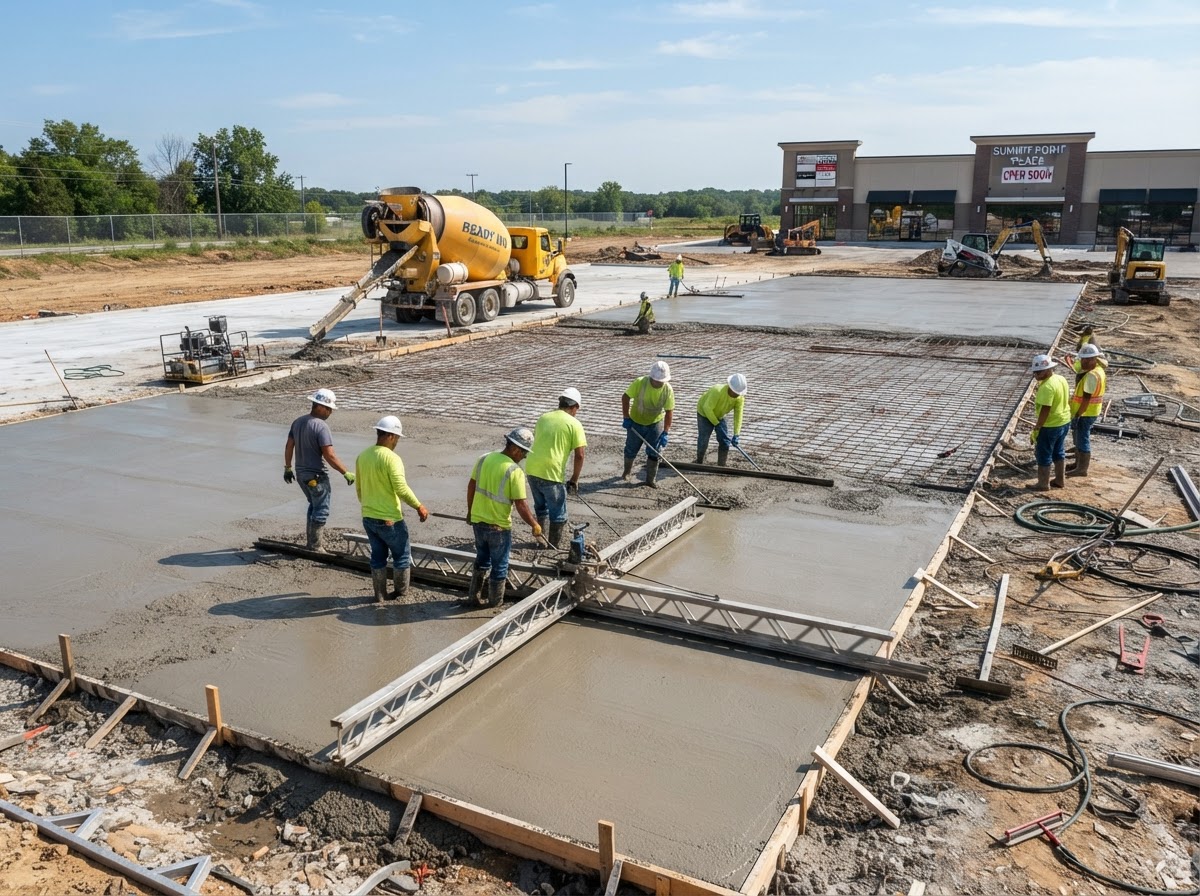
A concrete parking lot is a heavy-duty paved surface built for the vehicle traffic, drainage, and daily use that commercial and private parking areas demand. Gaithersburg Concrete installs and replaces concrete parking lots for commercial properties, private parking areas, and business facilities across Gaithersburg, Maryland and surrounding communities, planning the scope, drainage, joints, and traffic around how the lot will actually be used. This page focuses on concrete parking areas rather than asphalt paving — concrete parking pavement is a distinct application with its own load, drainage, and joint considerations. Every parking lot project starts with a scope review covering site access, phasing, traffic, and the loads the surface will carry, because a commercial parking lot faces heavier and more constant use than residential flatwork.
Request a Free Estimate
Tell us about your concrete project in Gaithersburg or nearby.
Concrete Parking Lots in Gaithersburg
A concrete parking lot is a paved surface engineered for the vehicle traffic a commercial or private parking area sees daily — passenger cars, delivery vehicles, service traffic, and the turning and maneuvering that comes with them. In Gaithersburg and along the I-270 corridor, concrete parking lots serve commercial properties, private parking areas, business facilities, multifamily and common areas where appropriate, and institutional properties that need a durable, heavy-duty paved surface.
Concrete parking pavement is a distinct application from asphalt paving. A concrete lot is built as poured panels with joints between them, designed to carry vehicle loads without rutting, and finished for traction and drainage. The thickness, reinforcement, joint layout, and drainage are all planned around the traffic the lot will carry — a lot for passenger vehicles is designed differently than one that sees delivery trucks or dumpster service.
This page focuses on concrete parking areas rather than asphalt paving. Where a project involves asphalt or a hybrid pavement, that is a separate scope — here the focus is the concrete parking lot, from new installation to full replacement of a lot that has reached the end of its service life.
When a Concrete Parking Area Needs Replacement
Concrete parking lots fail in recognizable ways, and the pattern of failure helps determine whether a repair will hold or whether the lot needs to come out and be repoured.
Signs a Lot May Need Replacement
- Widespread cracking across multiple panels or the whole lot
- Failed panels that have broken up or settled below their neighbors
- Major settlement that has created uneven driving or trip surfaces
- Extensive spalling and surface deterioration across the pavement
- Poor drainage that leaves water pooling on the surface
- Broken edges and deteriorated joints between panels
- Heavy vehicle wear that has broken down the surface
- Deteriorated joints that have opened up and broken down
- Repeated patch failures where repairs no longer hold
Localized repairs may be appropriate when the overall pavement remains serviceable — a single failed panel or a broken joint on an otherwise sound lot can often be addressed without replacing the whole surface. When damage spans most of the lot, replacement is usually the more durable and cost-effective path. We assess the condition before recommending repair or replacement.
Commercial Concrete Parking Lot Installation Process
A concrete parking lot follows a construction sequence built around the loads, drainage, and the need to keep a business operating around the work. Phasing and staging matter as much as the pour itself.
- 1Scope review — confirm the lot dimensions, traffic, loads, and drainage requirements.
- 2Demolition and removal — break up and haul away the existing pavement where replacing.
- 3Staging and phasing — sequence the work so the property can operate around it.
- 4Grading — set the slopes and drainage directions for the new surface.
- 5Subgrade — prepare and compact the soil beneath the base.
- 6Base — add and compact base material for a stable foundation.
- 7Forming — set forms to the panel layout, thickness, and edges.
- 8Reinforcement and specifications — add reinforcement per the project specifications.
- 9Concrete placement — pour and screed the concrete panel by panel.
- 10Finishing — apply a finish suited to vehicle traffic and traction.
- 11Joint layout — place control and expansion joints to manage cracking.
- 12Curing — allow the concrete to gain strength before traffic returns.
- 13Traffic reopening planning — coordinate when the lot can return to use.
We do not promise exact closure times. How long a lot must stay closed depends on the concrete mix, the weather, the panel size, and the traffic the surface will carry — we plan a realistic reopening schedule during the scope review rather than giving a generic timeline.
Parking Lot Loads, Drainage, Joints & Traffic Considerations
A concrete parking lot is designed around the traffic it will carry and the water it must shed. Passenger vehicles, delivery trucks, dumpster service, and loading zones each place different loads on the pavement, and the thickness, reinforcement, and joints are matched to that traffic.
Design Factors
- Passenger vehicles and the everyday traffic the lot serves
- Delivery vehicles and heavier loads where applicable
- Dumpster and service traffic that concentrates load
- Loading zones where heavier vehicles stop and turn
- Drainage — slope and water management across the lot
- Slopes that direct water to drains or perimeters
- Joints — control and expansion joints to manage cracking
- Curbs that define the parking area and manage edges
- Sidewalks and pedestrian interfaces where the lot meets walkways
- ADA and accessibility interfaces where applicable
- Striping coordination without claiming striping unless provided
We do not claim to provide striping unless it is part of the agreed scope. Where striping, signage, or accessibility layout is required, that work is coordinated with the project — our focus is the concrete pavement, the joints, the drainage, and the curbs that make up the lot.
For broader commercial flatwork, see our commercial concrete and flatwork page; for the curbs and edges, our concrete curb and gutter services. Existing pavement removal is handled through concrete demolition, accessible entries are covered in our ADA concrete ramps page, and surface drainage is addressed in our concrete trench drains and drainage channels services. For localized panel, joint, or surface repairs rather than complete replacement, see our commercial concrete parking lot repair page.
Concrete Parking Areas in Maryland Weather
A concrete parking lot in Gaithersburg faces freeze-thaw cycles, deicing salts, snowplows, and the constant traffic of a commercial property through every Maryland season. These surfaces see more wear than residential concrete because the use is heavier and more constant, and freeze-thaw cycles accelerate surface deterioration on slabs that are already under load.
Drainage and joint maintenance are recurring factors. Water that pools on the surface or runs beneath the panels contributes to scaling, settlement, and joint deterioration, and deicing salts break down the surface over repeated winter use. Snowplows stress the joints and edges, and edge damage from plows and traffic accumulates over the years.
Commercial traffic adds mechanical wear on top of the environmental stress. A lot that sees daily delivery vehicles, dumpster service, or heavy equipment places concentrated loads on the pavement that a residential driveway does not, and the joint layout and reinforcement are planned to distribute those loads rather than let them break the panels.
Concrete Parking Lot vs. Asphalt Parking Lot
Concrete and asphalt are both used for parking lots, and each has trade-offs. Concrete offers a rigid pavement with joints designed to carry vehicle loads without rutting, a lighter surface that reduces lighting demand, and a long service life when properly installed; asphalt offers a flexible pavement, a lower initial project scope in many cases, and a surface that can be resurfaced rather than replaced. The right choice depends on the initial project scope, maintenance expectations, loading, site requirements, and repair methods — we do not claim concrete is always superior. Both pavements have a place depending on the project.
Discuss Your Concrete Project
Have questions about scope, timing, or whether repair or replacement is the right call? We are happy to review your project and provide a clear, honest estimate.
Concrete Parking Lot FAQs & Estimates
How long does a concrete parking lot last?
A concrete parking lot's service life depends on the slab thickness, reinforcement, base preparation, drainage, joint layout, traffic loads, and ongoing maintenance. A well-built lot under appropriate traffic lasts longer than one poured thin over a poor base, but we do not promise a universal lifespan. Concrete performance depends on installation, site conditions, drainage, and care over time.
How thick should parking lot concrete be?
Parking lot concrete thickness depends on the traffic the lot will carry — passenger vehicles, delivery trucks, or heavier service traffic — the base conditions, and the project specifications. A lot for passenger cars is designed differently than one that sees dumpster or loading traffic. We recommend thickness based on the actual loads rather than a universal dimension.
Can a concrete parking lot be replaced in sections?
Yes. A concrete parking lot can often be replaced in sections — removing and repouring failed panels while the rest of the lot remains — when the overall pavement is still serviceable and only specific panels have failed. Where damage is widespread, full replacement is usually the more durable path. We assess the condition before recommending a phased or full approach.
Can damaged parking lot concrete be repaired?
Yes, damaged parking lot concrete can often be repaired when the damage is localized and the surrounding pavement is sound. Cracks, spalling, and broken panels on an otherwise serviceable lot can be treated to extend its life. Where damage is widespread or the base has failed, replacement is typically the better long-term option.
Do commercial concrete parking lots need reinforcement?
Most commercial concrete parking lots use reinforcement specified by the project requirements, traffic loads, and base conditions. The reinforcement schedule follows the loads the lot will carry — passenger traffic, delivery vehicles, or heavier service traffic. We place reinforcement per the project specifications rather than applying one schedule universally.
How is drainage handled in a concrete parking lot?
Drainage is handled through slope, grading, and drainage structures — trench drains, catch basins, or perimeter drainage — that move water off the surface and away from the pavement. The slopes and drainage are planned during the scope review so water does not pool on the surface or run beneath the panels. Proper drainage is central to how long the lot lasts.
What affects concrete parking lot cost?
Cost depends on the lot size, slab thickness, reinforcement, demolition of existing pavement, base preparation, drainage work, joint layout, phasing requirements, site access, and traffic control. A larger lot with heavier specifications and phasing costs more than a small private lot. We provide project-specific estimates based on the actual scope and site.
Request a Commercial Parking Lot Estimate
Whether you need a new concrete parking lot installed or a deteriorated one replaced, Gaithersburg Concrete will review the scope, drainage, traffic, and phasing, then provide a clear estimate. Serving Gaithersburg and surrounding Montgomery County communities.
Related Concrete Services Near Gaithersburg
Commercial Concrete & Concrete Flatwork
High-spec flatwork for commercial centers, retail plazas, loading docks, dumpster pads, and multi-family communities.
Learn moreConcrete Curb & Gutter Installation and Repair
Concrete curb and gutter installation, replacement, and repair for private and commercial sites.
Learn moreConcrete Demolition, Removal & Replacement
Concrete demolition, removal, haul-away, and replacement for driveways, patios, walkways, and slabs.
Learn moreADA Concrete Ramps & Accessible Ramp Installation
Accessible concrete ramp installation for residential and commercial entries and walkway transitions.
Learn moreConcrete Trench Drains & Drainage Channels
Concrete trench drains and drainage channels for driveways, patios, and flatwork that intercept surface water and direct it toward an appropriate discharge point.
Learn moreRequest a Commercial Parking Lot Estimate
Whether you need a new concrete parking lot installed or a deteriorated one replaced, Gaithersburg Concrete will review the scope, drainage, traffic, and phasing, then provide a clear estimate. Serving Gaithersburg and surrounding Montgomery County communities.
- Project-specific estimates — no obligation
- Residential and commercial concrete work
- Serving Gaithersburg and surrounding Montgomery County
Request a Free Estimate
Tell us about your concrete project in Gaithersburg or nearby.