Commercial Concrete Parking Lot Repair in Gaithersburg, MD
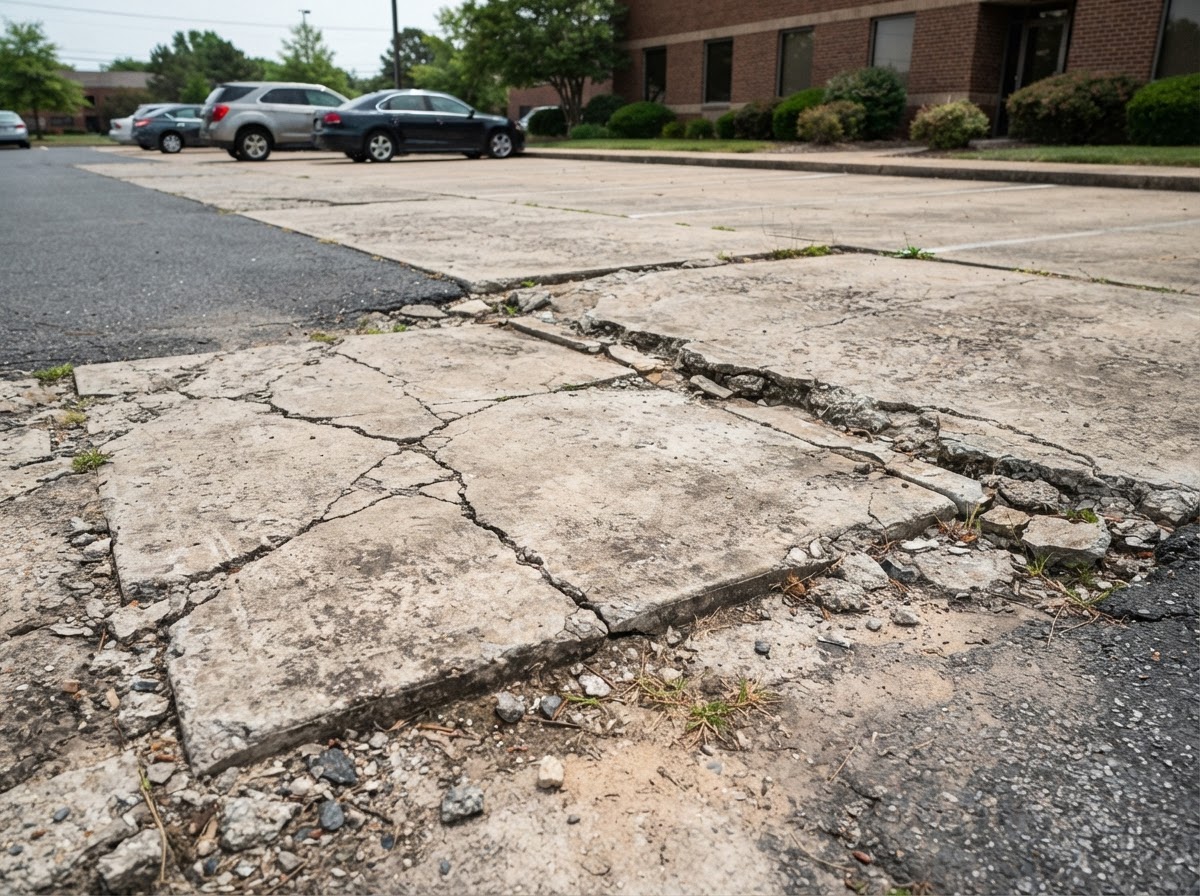
Commercial concrete parking areas can often be repaired when damage is limited to certain panels, joints, or localized sections. Repair may involve crack and joint work, spall repair, partial panel replacement, or other targeted restoration, while widespread slab failure may justify larger replacement work. In Gaithersburg and along the I-270 corridor, commercial parking pavement takes constant vehicle traffic, winter deicing exposure, and freeze-thaw stress, so the goal is to extend the service life of pavement that still has structural life left — and to be honest when replacement is the more durable call. Gaithersburg Concrete works with property managers, building owners, and facility operators to map the damage, define repair zones, and phase the work around a business that may need to stay open.
Request a Free Estimate
Tell us about your concrete project in Gaithersburg or nearby.
Commercial Concrete Parking Lot Repair in Gaithersburg
Commercial concrete parking lot repair is the targeted restoration of damaged panels, joints, and surface areas on an existing parking lot that still has serviceable pavement around the damage. Rather than removing and repouring the entire lot, repair addresses the specific sections that have failed — extending the life of the surrounding pavement and postponing the cost and disruption of full replacement.
Repair is not a substitute for replacement. It fits the middle ground: a lot where most of the pavement is still sound but certain panels have cracked, settled, spalled, or broken at the joints. Where the failure is widespread, the base has failed, or many connected panels have deteriorated together, full replacement is usually the more durable and economical path. We assess the condition across the whole lot before recommending a scope.
This page is written for the property managers, building owners, facility managers, retail and commercial property operators, contractors, and associations who are responsible for keeping a parking area safe and serviceable. Every commercial parking lot repair starts with a site walk to map the damage, identify traffic patterns, and plan access and phasing around a business that may need to keep operating through the work.
Common Commercial Parking Lot Damage
Concrete parking lots fail in recognizable patterns, and the pattern of failure helps determine whether a repair will hold or whether a panel needs to come out. Different damage types point toward different responses.
Cracked Panels
- Isolated cracks running through a single panel
- Intersecting cracks where multiple cracks meet
- Broken corners where a panel edge has fractured off
Joint Damage
- Deteriorated joint edges where the concrete has broken down at the seam
- Movement between panels that has opened joints over time
- Failed previous repairs where old joint filler or patching has broken out
Spalling
- Surface deterioration where the top layer is breaking away
- Edge breakdown at panel perimeters and joints
- Freeze-thaw and deicer exposure accelerating surface scaling
Settlement
- Uneven panels where one section has dropped below its neighbors
- Transitions between panels that have become trip or driving hazards
- Ponding areas where water collects because the slab no longer drains
Impact and Traffic Damage
- Repeated vehicle loading wearing down the surface
- Turning areas where steering stress breaks down panel edges
- Delivery zones where heavier vehicles concentrate load
We do not invent traffic or load specifications. The thickness, reinforcement, and joint layout that a lot needs depend on the traffic it actually carries — passenger vehicles, delivery trucks, dumpster service, or heavier commercial traffic — and those factors are evaluated for the specific property rather than applied as a universal number.
| Problem | Potential Direction |
|---|---|
| Localized crack | Repair evaluation |
| Broken panel edge | Localized repair |
| Settled panel | Leveling or replacement evaluation |
| Severely broken panel | Panel replacement |
| Widespread failure | Larger replacement scope |
Commercial Parking Lot Repair Process
A durable commercial repair depends on mapping the real condition across the lot and phasing the work around the property's operations. Repairing the wrong section, or patching over a failing base, does not last — so the process starts with understanding what is actually happening across the pavement.
- 1Site walk and damage mapping — walk the lot, photograph and mark damaged panels, joints, and surface areas.
- 2Identify traffic patterns — note where vehicles enter, turn, and concentrate load.
- 3Assess joints — evaluate which joints are sound and which have deteriorated edges or movement.
- 4Assess settlement — identify panels that have dropped and whether the base is contributing.
- 5Inspect drainage — check for ponding, failed drainage channels, and water movement beneath panels.
- 6Define repair zones — separate localized repairs from panels that need partial or full replacement.
- 7Plan access and phasing — sequence the work so the business can operate around it where possible.
- 8Remove unsound concrete — break out and haul away damaged material where replacement is needed.
- 9Prepare the repair or panel area — clean, compact the base, and set forms as the scope requires.
- 10Complete the repair or replacement — place repair material or pour replacement concrete.
- 11Finish, joint, and cure — apply the appropriate finish, place joints, and allow the concrete to gain strength.
- 12Reopen according to repair-system and project requirements — coordinate when traffic can return.
We do not promise zero downtime, overnight reopening, same-day reopening, or uninterrupted traffic unless the actual repair system supports it and the requirement is verified for the project. How long a repaired or replaced panel must stay closed depends on the concrete mix, the weather, the repair system selected, and the traffic the surface will carry — we plan a realistic reopening schedule during the scope review rather than giving a generic timeline.
Repair vs. Panel Replacement vs. Full Replacement
Commercial parking lot work spans a range of scopes, and the right one depends on how much of the pavement is still serviceable and what is happening beneath it. Each option addresses a different condition:
When Each Approach Makes Sense
- Localized repair — isolated damage: a single crack, one broken joint edge, or a small spalled area on an otherwise sound lot.
- Partial panel replacement — one or more severely damaged individual panels where the surrounding pavement is still serviceable.
- Leveling — certain settled slabs that are otherwise suitable and can be lifted back toward grade.
- Full replacement — failures are widespread, base or subgrade problems are extensive, many connected panels have failed, or the site layout requires major changes.
Repair extends the life of pavement that still has structural life left. It does not stop base failure, correct widespread settlement, or make a failing lot sound — it addresses the specific sections that have failed while the rest remains serviceable. Where the failure is structural or widespread, replacement is the more durable call, and we will say so rather than patch a lot that needs to come out.
For broader commercial flatwork, see our commercial concrete and flatwork page; for full parking lot construction, our concrete parking lot installation and replacement page. Joint and warehouse floor repair is covered in our commercial joint and warehouse floor repair services, general crack and surface repair in our concrete repair page, settled slabs in our concrete leveling services, and pavement removal in our concrete demolition and replacement page.
Commercial Traffic, Drainage & Maryland Conditions
A commercial parking lot in Gaithersburg faces a combination of constant vehicle traffic, winter snow and ice, deicing materials, and freeze-thaw cycles that few residential surfaces experience. Delivery areas and turning zones concentrate load in ways that break down panel edges and joints faster than straight-through traffic, and the heavier and more constant the use, the faster the surface deteriorates.
Water drainage is a recurring factor in commercial pavement failure. Low areas that pond, failed drainage channels, and water running beneath panels all contribute to base erosion, settlement, and joint deterioration. A repair that ignores drainage will often fail again — where water management is the underlying issue, addressing it is part of the scope, not separate from it. Joint deterioration compounds the problem, because open joints let water and debris beneath the slab and accelerate the breakdown of adjacent panels.
Commercial repair planning should consider business access, traffic routing, repair sequencing, and cure and reopening requirements together. Phasing a project so one section is repaired while the rest of the lot stays in service is often the practical path for a property that cannot close entirely. We do not claim OSHA, ADA, or code compliance unless specifically verified for the project — where accessible parking transitions or ramps are part of the scope, our ADA concrete ramp service addresses accessible entries where genuinely relevant.
For broader planning, see our concrete repair cost guide for the factors that shape repair estimates, our repair vs. replacement guide to weigh targeted repair against full panel or lot replacement, our drainage and water management guide for the water issues that drive pavement failure, and our Maryland freeze-thaw and deicing guide for the winter exposure that ages commercial pavement.
Need to repair damaged parking-lot concrete without automatically replacing the entire area? Request a commercial evaluation and we will map the damage and define a realistic repair scope.
Discuss Your Concrete Project
Have questions about scope, timing, or whether repair or replacement is the right call? We are happy to review your project and provide a clear, honest estimate.
Commercial Parking Lot Repair FAQs & Estimates
Can individual concrete parking lot panels be repaired?
Yes. Individual panels can often be repaired when the damage is localized — a crack, a broken corner, or a spalled area — and the surrounding pavement is still serviceable. The loose material is removed, the area is prepared, and the repair is completed to match the surrounding surface. Where a panel has failed structurally, partial or full panel replacement may be more durable than patching. We assess each panel before recommending a scope.
Can damaged parking-lot joints be repaired?
Yes, deteriorated joint edges can often be repaired by removing the broken material, restoring the joint, and resealing it to keep water and debris out. Joint repair is common on commercial lots where traffic and freeze-thaw exposure break down joint edges over time. Where the movement between panels is ongoing or the joint has opened widely, repair alone may not hold and replacement of the affected panels may be needed. We evaluate the joint condition before recommending an approach.
Can a sunken parking-lot panel be leveled?
Sometimes. A settled but otherwise suitable panel may be a leveling candidate if the slab is intact and the underlying conditions support lifting. Heavily cracked, broken, or spalling slabs — or those with a failed base — are usually better replaced than leveled. We assess whether the panel is a leveling candidate or whether replacement is the more durable call based on its actual condition.
When should a concrete panel be replaced?
A panel is typically a replacement candidate when it is severely broken, has widespread cracking, has settled significantly with base involvement, or has deteriorated past what repair will hold. Replacement involves removing the damaged panel, preparing the base, and pouring a new panel that matches the surrounding elevation, joints, and finish. We recommend replacement where repair would not deliver a durable result.
Can commercial parking-lot repairs be completed in phases?
Yes. On properties that must remain open, parking-lot repair can often be phased — completing one section or panel at a time so the business can continue operating around the work. Phasing is planned during the scope review based on site access, traffic routing, and the property's operations. We sequence the work to minimize disruption where the lot cannot close entirely.
How does winter deicing affect concrete parking lots?
Deicing materials and freeze-thaw cycles accelerate surface deterioration on commercial parking pavement. Moisture that enters the surface or sits at joints expands as it freezes, stressing the concrete and contributing to scaling and spalling. Deicing salts break down the surface over repeated winter use. Drainage, joint maintenance, and sealing where appropriate help manage that exposure, but we do not promise a maintenance-free or deicer-proof surface.
What affects commercial parking-lot repair cost?
Repair cost depends on the repair area, the number of damaged sections, demolition and removal, site access, traffic control, surface preparation, the extent of settlement or spalling, joint damage, drainage work, finish, phased work requirements, curing requirements, and overall project complexity. Because every lot differs, we provide project-specific estimates rather than fixed per-square-foot rates.
Request a Commercial Concrete Parking Lot Repair Estimate
Have damaged panels, joints, or surface areas on your commercial parking lot? Gaithersburg Concrete will map the damage, define a realistic repair scope, and phase the work around your operations. Call (240) 690-6035 or request a free estimate.
Related Concrete Services Near Gaithersburg
Commercial Concrete & Concrete Flatwork
High-spec flatwork for commercial centers, retail plazas, loading docks, dumpster pads, and multi-family communities.
Learn moreConcrete Parking Lot Installation & Replacement
Concrete parking lot installation and replacement for commercial properties, private parking areas, and heavy-duty paved surfaces with drainage and joint planning.
Learn moreCommercial Concrete Joint & Warehouse Floor Repair
Repair of damaged joints, joint edges, cracks, spalling and localized slab failures in commercial and warehouse concrete floors subject to forklift and industrial traffic.
Learn moreConcrete Repair & Crack Repair
Targeted structural crack filling, spalling remediation, and damaged section patching to extend concrete longevity.
Learn moreConcrete Leveling, Lifting & Mudjacking
Cost-effective lifting of sunken, uneven concrete slabs to eliminate trip hazards and restore positive drainage.
Learn moreConcrete Demolition, Removal & Replacement
Concrete demolition, removal, haul-away, and replacement for driveways, patios, walkways, and slabs.
Learn moreRequest a Commercial Concrete Parking Lot Repair Estimate
Have damaged panels, joints, or surface areas on your commercial parking lot? Gaithersburg Concrete will map the damage, define a realistic repair scope, and phase the work around your operations. Call (240) 690-6035 or request a free estimate.
- Project-specific estimates — no obligation
- Residential and commercial concrete work
- Serving Gaithersburg and surrounding Montgomery County
Request a Free Estimate
Tell us about your concrete project in Gaithersburg or nearby.