Commercial Concrete Joint & Warehouse Floor Repair in Gaithersburg, MD
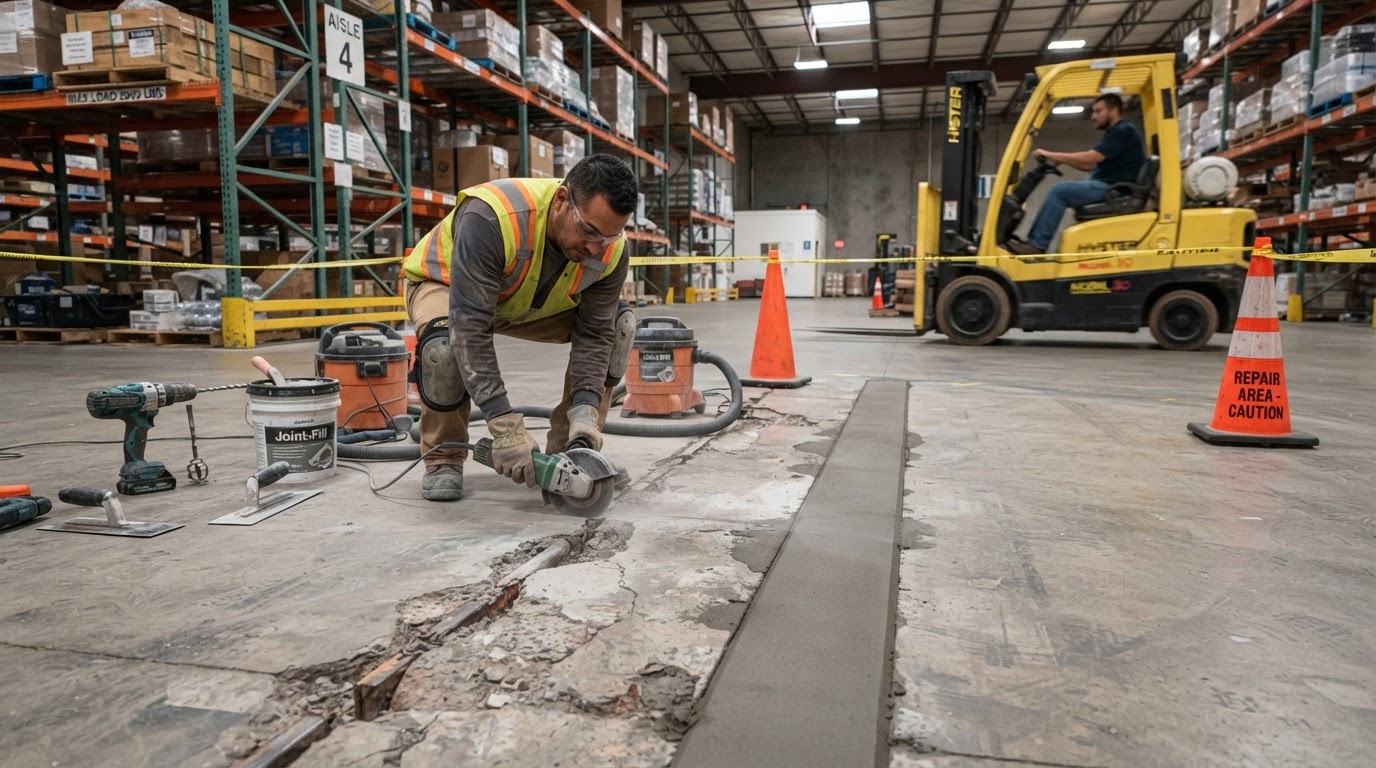
Commercial and warehouse concrete floors take a different kind of abuse than residential slabs. Forklift traffic, pallet jacks, rack aisles, loading zones, and repeated wheel crossings stress joints, edges, and slab panels in ways that turn small defects into operational problems. Gaithersburg Concrete repairs damaged joints, joint edges, cracks, spalling, impact damage, and localized slab failures in commercial and warehouse floors across Gaithersburg, Maryland and surrounding communities. This page targets localized commercial floor repair — not warehouse slab installation or replacement, which is covered on our warehouse floors page, and not broad concrete repair, which is covered on our repair page. Every commercial repair starts with an operational and site review, because the right repair depends on how the floor is used, what traffic it sees, and whether the damage is localized or structural.
Request a Free Estimate
Tell us about your concrete project in Gaithersburg or nearby.
Warehouse Concrete Floor Repair in Gaithersburg
Commercial and warehouse concrete floors develop a predictable set of problems under industrial traffic: damaged joints, broken joint edges, cracks, spalling, impact damage, forklift wear, localized settlement, damaged transitions, and failed patches. Each of these can start small and become operationally important when wheels cross it repeatedly.
This page is about localized commercial floor repair — fixing the damaged joints, edges, cracks, and panels in an existing warehouse or commercial slab. It is distinct from our warehouse floors page, which covers warehouse slab installation and replacement, and from our repair page, which covers broader concrete repair. Where a slab panel has substantially failed, the repair may involve partial or full panel replacement, which links to our demolition page.
We do not diagnose structural slab failure from appearance alone. Where the damage pattern suggests movement, subgrade failure, or a structural issue rather than surface wear, we say so and refer you to the appropriate evaluation rather than patching over a problem that will return.
Common Commercial Floor Problems
The problems that bring commercial and warehouse floors in for repair tend to share a cause: repeated, concentrated traffic crossing the same joints and edges. Common issues include joint-edge deterioration, wheel impact, forklift and pallet-jack traffic, rack and equipment loads, repeated loads, curling and joint movement where relevant, cracks, patch failures, spalling, surface deterioration, and uneven transitions between slabs or surfaces.
Why Small Defects Matter in Industrial Use
On a residential patio, a chipped joint edge is cosmetic. In a warehouse aisle that sees forklift traffic all day, the same defect transmits shock into the slab and the equipment every time a wheel crosses it, accelerates deterioration of the adjacent concrete, and can create a trip or a wheel-damage hazard. Industrial traffic makes small defects operationally important, which is why commercial floor repair is a distinct service from broad residential repair.
We do not diagnose structural slab failure from appearance alone. A pattern of cracking, settlement, or panel movement can indicate a subgrade or structural issue that patching will not solve, and we tell you when that is what the floor is showing.
Commercial Joint & Slab Repair Process
A sound commercial repair follows the floor's condition and the facility's operations. The damaged areas are identified, the movement is evaluated, and the repair is scoped to the actual damage — not a blanket patch over the whole floor.
- 1Operational and site review — assess how the floor is used, what traffic it sees, and what access is available.
- 2Identify damaged areas — map the joints, edges, cracks, spalls, and panels that need repair.
- 3Evaluate movement — determine whether cracks are active and whether settlement or structural movement is involved.
- 4Determine repair limits — decide what can be repaired locally and what needs panel replacement.
- 5Remove unsound material — cut out deteriorated concrete and failed patch material.
- 6Prepare the joint or repair edges — clean and shape the repair area for the selected material.
- 7Repair material selection — choose a material suited to the traffic, the joint type, and the cure time available.
- 8Rebuild edges and patch areas — place and finish the repair material to the intended elevation.
- 9Finish — match the surrounding surface profile as appropriate to the use.
- 10Cure and reopening according to the material and system — allow the repair to reach the strength the traffic demands before the area returns to service.
- 11Phased work where needed — sequence the repair so the facility can keep operating around the work.
We do not promise zero downtime. Most commercial repairs are phased so the floor stays in service, but the cure and reopening time depends on the repair material, the traffic, and the conditions. We plan the phasing around your operations.
Joint Repair, Spall Repair, Crack Repair & Panel Replacement
Commercial floor repair is not one technique — it is a set of distinct repair types selected for the specific damage. Using the wrong repair for the defect is how patches fail within weeks.
Repair Types
- Joint repair — addresses damaged joint filler, sealant, or the joint itself where the joint has deteriorated.
- Joint-edge repair — rebuilds broken or spalled edges along construction or control joints that forklift wheels cross.
- Crack repair — addresses suitable localized cracking where the crack is stable and the surrounding slab is sound.
- Spall repair — removes and replaces deteriorated surface areas where the concrete has spalled or scaled.
- Partial panel replacement — used where a section of a slab panel is too damaged for localized repair but the rest of the panel is sound.
- Full panel replacement — used where a slab panel has substantially failed and localized repair will not hold.
The distinction between a localized repair and a panel replacement is driven by how much of the panel is damaged and whether the surrounding concrete is sound. We scope the repair to the actual damage rather than defaulting to the most expensive option.
For warehouse slab installation and replacement, see our warehouse and industrial floor slabs page; for broader concrete repair, our concrete repair and crack and joint repair pages; for spalling, our spalling repair page; and for panel removal, our concrete demolition page.
Forklift Traffic, Loads & Operational Considerations
The repair has to fit the operation, not just the concrete. Hard wheels, repetitive crossings, rack aisles, loading zones, floor joints, and threshold transitions all affect which repair will hold and how the work should be phased so the facility keeps running.
Operational Factors
- Hard forklift and pallet-jack wheels that concentrate load on joint edges
- Repetitive crossings at the same aisles and doorways
- Rack aisles and equipment layouts that fix the traffic pattern
- Loading zones and staging areas that see concentrated, repeated loads
- Floor joints condition and how wheels cross the joints
- Threshold transitions between slabs, surfaces, or buildings
- Repair phasing and facility access during the work
- Cure and reopening requirements before traffic resumes
- Heavy equipment that may require a higher-strength repair material
Direct Answer: Why Do Warehouse Floor Joints Break Down?
Warehouse floor joints break down through a combination of factors rather than one single cause. Repeated wheel impact across the joint, movement between slabs, weak or deteriorated joint edges, previous repairs that failed, and high traffic all contribute. A joint that sees hard forklift wheels cross it thousands of times will deteriorate faster than one that sees only foot traffic, and a joint whose edges were damaged early will keep breaking down until the edges are rebuilt. We do not claim one single cause — the repair is scoped to the actual combination of factors on your floor.
For the cost factors behind commercial repair, see our repair cost guide, and for the broader repair-vs-replacement decision, our repair vs. replacement guide. For entry and exterior transition damage related to Maryland conditions, see our freeze-thaw and deicing guide.
Discuss Your Concrete Project
Have questions about scope, timing, or whether repair or replacement is the right call? We are happy to review your project and provide a clear, honest estimate.
Commercial Concrete Floor Repair FAQs & Estimates
Why do warehouse floor joints deteriorate?
Warehouse floor joints deteriorate through a combination of repeated wheel impact, movement between slabs, weak or deteriorated joint edges, previous repairs that failed, and high traffic — not one single cause. Hard forklift wheels crossing a joint thousands of times break down the edges until they are rebuilt. We scope the repair to the actual combination of factors on the floor.
Can broken joint edges be repaired?
Yes. Broken or spalled joint edges can often be rebuilt by removing the unsound material, preparing the edge, and placing a repair material suited to the traffic the joint sees. The repair is selected for the wheel loads and the cure time available so the rebuilt edge holds under forklift traffic.
Can warehouse cracks be repaired?
Suitable, stable cracks can often be repaired where the surrounding slab is sound. Active movement, structural cracking, or a pattern that suggests subgrade failure may require a different approach — including panel replacement. We evaluate whether the crack is stable before recommending a localized repair.
Can repairs be completed in phases?
Yes. Most commercial and warehouse floor repairs are phased so the facility keeps operating around the work. The phasing is planned around your operations, the cure time of the repair material, and the traffic that has to resume. We do not promise zero downtime, but we sequence the work to minimize disruption.
When should a slab panel be replaced?
A slab panel should be replaced where it has substantially failed — widespread cracking, structural movement, or damage too extensive for localized repair — and the surrounding concrete is not sound enough to support a patch. Where only a section is damaged, partial panel replacement may be appropriate. We scope the repair to the actual damage rather than defaulting to full replacement.
Can forklift traffic damage concrete joints?
Yes. Hard forklift and pallet-jack wheels concentrate load on joint edges, and repeated crossings break down the edges over time. The damage is accelerated where the edges were already weak or previously repaired. Rebuilding the edges with a material suited to the traffic is how the joint is restored to service.
What affects commercial floor repair cost?
Cost depends on the damage type, the repair volume, the traffic the floor sees, the repair material, facility access, the phasing required, the cure and reopening requirements, and whether panel replacement is needed. A localized joint-edge repair costs less than a full panel replacement. We provide project-specific estimates based on the actual floor and operations.
Request a Commercial Floor Repair Evaluation
If your warehouse or commercial floor has damaged joints, edges, cracks, or localized slab failures, Gaithersburg Concrete will review the floor, evaluate the movement, scope the repair to the actual damage, and provide a clear estimate. Serving Gaithersburg and surrounding Montgomery County communities.
Related Concrete Services Near Gaithersburg
Warehouse & Industrial Concrete Floor Slabs
Warehouse and industrial concrete floor slabs planned around rack loads, forklift traffic, joint layout, and the finish a facility's operations require.
Learn moreConcrete Repair & Crack Repair
Targeted structural crack filling, spalling remediation, and damaged section patching to extend concrete longevity.
Learn moreConcrete Crack Repair & Expansion Joint Repair
Repair of concrete cracks, control joints, expansion joints, and gaps between slabs on driveways, patios, and walkways.
Learn moreSpalling, Flaking & Crumbling Concrete Repair
Repair of spalling, flaking, scaling, and crumbling concrete surfaces on driveways, patios, and walkways.
Learn moreConcrete Demolition, Removal & Replacement
Concrete demolition, removal, haul-away, and replacement for driveways, patios, walkways, and slabs.
Learn moreRequest a Commercial Floor Repair Evaluation
If your warehouse or commercial floor has damaged joints, edges, cracks, or localized slab failures, Gaithersburg Concrete will review the floor, evaluate the movement, scope the repair to the actual damage, and provide a clear estimate. Serving Gaithersburg and surrounding Montgomery County communities.
- Project-specific estimates — no obligation
- Residential and commercial concrete work
- Serving Gaithersburg and surrounding Montgomery County
Request a Free Estimate
Tell us about your concrete project in Gaithersburg or nearby.