Concrete Crack Repair & Expansion Joint Repair in Gaithersburg, MD
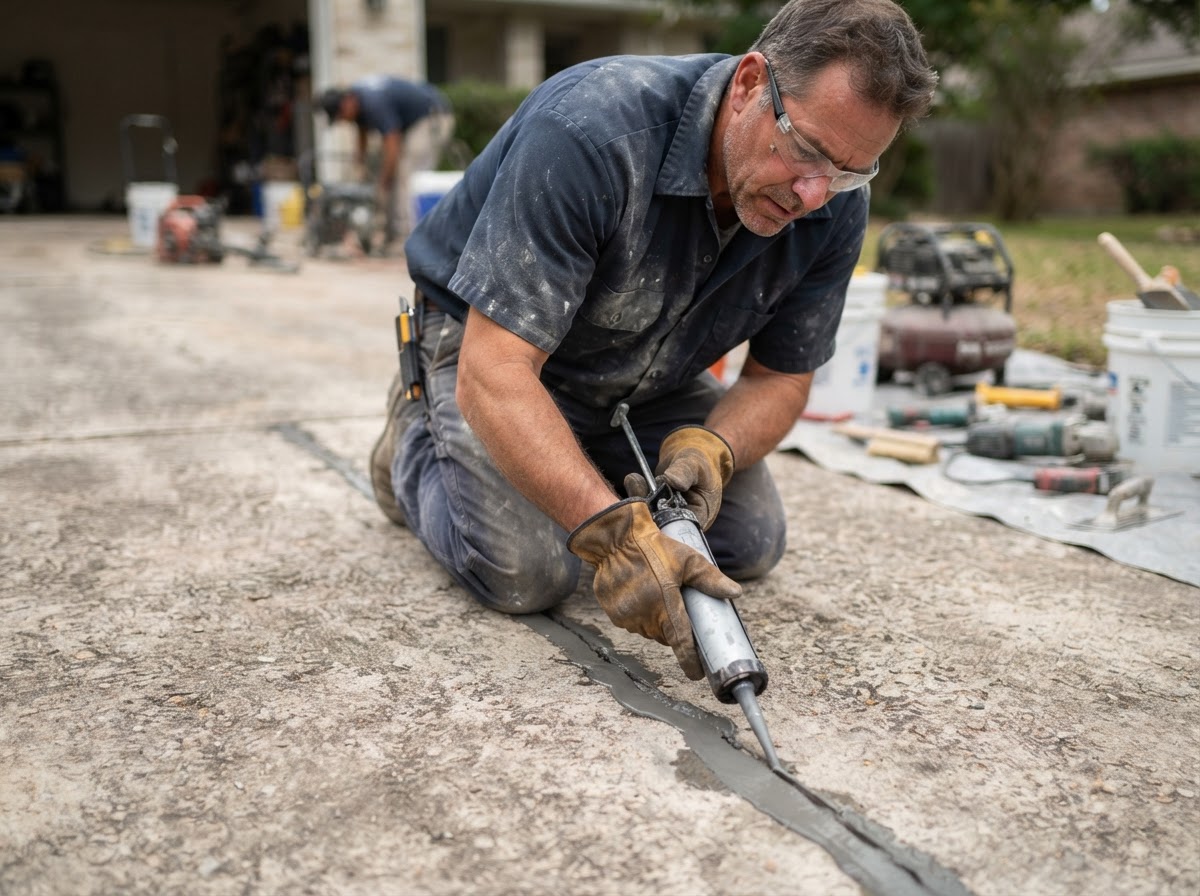
Concrete cracks and expansion joints serve different purposes, and Gaithersburg Concrete provides crack repair and expansion joint repair for driveways, patios, walkways, garage slabs, and other concrete surfaces in Gaithersburg, Maryland and surrounding service areas. Not every crack has the same cause or the same repair method — a hairline shrinkage crack near a control joint is a very different problem than a wide, working crack running across a driveway. The right approach depends on the crack type, whether the slab is still moving, and whether a planned joint has failed or a gap has opened between two sections. Every project starts with an inspection of the crack or joint, the surrounding concrete, and the conditions that may have caused it.
Concrete Crack Repair in Gaithersburg
Concrete crack repair addresses breaks in a slab, while expansion joint repair restores the planned gaps that let concrete expand and contract without cracking. The two are related but distinct. A crack is an unplanned break; a joint is an intentional gap designed to control where cracking happens. When either one fails, water, debris, and freeze-thaw stress can work their way into the slab and accelerate deterioration.
Surface cracks, working cracks, joint deterioration, open control joints, and gaps between slabs each call for a different repair approach. Some can be sealed with a flexible material, others need rigid patching, and a few signal movement serious enough to consider replacement. The appropriate method depends on the crack type, width, depth, and whether the slab is still moving.
Gaithersburg Concrete evaluates each crack and joint individually before recommending a repair. The goal is to address the specific problem in front of us rather than applying a single product to every surface.
Common Concrete Crack & Joint Problems
Concrete cracks and joints fail for a range of reasons, and identifying the type of problem is the first step toward a repair that holds.
Conditions We Evaluate
- Shrinkage cracking from the curing process, often hairline and near joints
- Settlement-related cracks where the base has shifted beneath the slab
- Joint deterioration where a planned control or expansion joint has broken down
- Failed joint filler that has pulled away, crumbled, or lost adhesion
- Open gaps between adjacent slabs or at transitions to other surfaces
- Water entry through cracks and joints that accelerates freeze-thaw damage
- Edge breakdown where the concrete has chipped away along a joint line
- Vegetation or debris intrusion into open joints
- Cracks running through driveways, patios, walkways, garage slabs, and steps
Cracking may be cosmetic, movement-related, or a symptom of underlying slab conditions. A surface crack that has not widened in years is different from a crack that opens a little more each season. We look at the pattern, the width, and whether the two sides of the crack sit at the same elevation before recommending a path forward.
How Concrete Cracks & Joints Are Repaired
Crack and joint repair follows a deliberate sequence, with each step affecting how well the repair performs over time.
- 1Inspection — evaluate the crack or joint, its width, and whether the slab is still moving.
- 2Cleaning — remove debris, vegetation, and loose material from the crack or joint.
- 3Removing failed materials — take out old joint filler or crumbling repair product.
- 4Opening or preparing the crack where appropriate — widen narrow cracks slightly so repair material bonds well.
- 5Repair material selection — choose flexible sealant for moving joints or rigid material for stable cracks.
- 6Application — place the repair material, fill the void, and tool it to the surface.
- 7Finishing — blend the repair with the surrounding concrete where possible.
- 8Curing — allow the repair material to set before the surface sees traffic.
Flexible joint sealants are used where movement is expected, while rigid repair materials suit stable, non-moving cracks. We do not imply that one repair material works for all cracks — the selection depends on whether the joint or crack is designed to move and what the surrounding concrete is doing.
Crack Repair vs. Joint Repair vs. Slab Replacement
Understanding the difference between a crack, a joint, and a slab that needs replacement helps property owners choose the right service rather than over- or under-repairing the surface.
How the Options Differ
- Crack repair — addresses suitable localized cracks where the slab is otherwise sound and stable.
- Joint repair — restores damaged planned joints or gaps so they function as intended.
- Replacement — may be appropriate for heavily broken, unstable, or extensively cracked slabs.
A driveway with one wide working crack may benefit from crack repair combined with our concrete repair services, while widespread surface deterioration may point toward spalling and crumbling concrete repair instead. Where settlement is the root cause, concrete leveling may address the movement before any crack or joint work. For broader driveway surface concerns, concrete driveway installation and replacement covers full removal and repour.
Why Concrete Cracks & Joints Deteriorate in Maryland
Maryland's seasonal climate puts real stress on concrete joints and cracks. Freeze-thaw cycles mean moisture that enters a crack or joint can expand as it freezes, widening the gap and breaking down the surrounding concrete. Thermal movement through hot summers and cold winters causes slabs to expand and contract, which is exactly why planned joints exist — but when those joints fail, the movement shows up as cracking instead.
Moisture, settlement, and traffic all contribute to joint and crack deterioration. Water running beneath a slab can erode the base and cause settlement cracks. Deicing materials tracked onto a driveway or walkway can enter open joints and accelerate breakdown. Joint aging, shrinkage, and the loads placed on a surface all play a role.
We do not promise that crack repairs can prevent every future crack. Concrete is a material that moves, and joints and cracks are how it manages that movement. What repair can do is address existing damage, reduce water entry, and extend the usable life of a slab that is otherwise in good condition.
Discuss Your Concrete Project
Have questions about scope, timing, or whether repair or replacement is the right call? We are happy to review your project and provide a clear, honest estimate.
Concrete Crack & Expansion Joint FAQs
Can all concrete cracks be repaired?
Many cracks can be repaired, but not every crack should be. Hairline and stable cracks are good candidates for sealing or filling, while wide, working cracks that reflect ongoing movement may return unless the underlying cause is addressed. We evaluate whether the slab is still moving before recommending a repair.
What is the difference between a crack and an expansion joint?
A crack is an unplanned break in the concrete, while an expansion joint (or control joint) is an intentional gap designed to manage where the slab moves as it expands and contracts. Cracks happen on their own; joints are planned. Both can fail and need repair, but the approach differs.
Should concrete joints be sealed?
Sealing joints can help reduce water, debris, and vegetation intrusion, which in turn can slow deterioration. Not every joint needs sealing, and the right product depends on whether the joint is designed to move. We recommend sealing where it suits the joint type and surface conditions.
Can driveway cracks be repaired?
Yes, many driveway cracks can be repaired with crack filler or rigid patching material, depending on the crack width and whether the slab is moving. Widespread cracking or significant settlement may point toward replacement instead. We assess the driveway as a whole before recommending a path.
Why do repaired cracks sometimes reopen?
A repaired crack can reopen when the underlying movement that caused it is still active. If the base continues to settle, the slab keeps shifting, or freeze-thaw stress persists, the repair material may separate from the concrete. Addressing the cause, not just the crack, gives the repair a better chance of holding.
When should cracked concrete be replaced?
Replacement may make sense when cracking is widespread, the slab is moving or settling significantly, or the concrete is extensively deteriorated. A single stable crack rarely warrants replacement, but a slab with network cracking, major settlement, or structural failure is often better replaced than repaired.
What affects concrete crack repair cost?
Crack repair cost depends on the number and length of cracks, the crack type, whether joints need repair or replacement, the repair material used, surface preparation, and site access. A single hairline crack costs less to address than a network of wide working joints. We provide project-specific estimates based on the actual scope.
Request a Concrete Crack Repair Estimate
If you have cracks, failed joints, or open gaps in your concrete, Gaithersburg Concrete will inspect the surface, explain what is happening, and provide a clear estimate for repair. Serving Gaithersburg and surrounding Montgomery County communities.
Related Concrete Services Near Gaithersburg
Concrete Repair & Crack Repair
Targeted structural crack filling, spalling remediation, and damaged section patching to extend concrete longevity.
Learn moreSpalling, Flaking & Crumbling Concrete Repair
Repair of spalling, flaking, scaling, and crumbling concrete surfaces on driveways, patios, and walkways.
Learn moreConcrete Leveling, Lifting & Mudjacking
Cost-effective lifting of sunken, uneven concrete slabs to eliminate trip hazards and restore positive drainage.
Learn moreConcrete Driveway Installation & Replacement
Durable residential and light commercial concrete driveways built to withstand vehicular weight and Maryland freeze-thaw cycles.
Learn moreRequest a Concrete Crack Repair Estimate
If you have cracks, failed joints, or open gaps in your concrete, Gaithersburg Concrete will inspect the surface, explain what is happening, and provide a clear estimate for repair. Serving Gaithersburg and surrounding Montgomery County communities.
- Project-specific estimates — no obligation
- Residential and commercial concrete work
- Serving Gaithersburg and surrounding Montgomery County
Request a Free Estimate
Tell us about your concrete project in Gaithersburg or nearby.