Concrete Sidewalk Repair & Replacement in Gaithersburg, MD
Yes — damaged concrete sidewalks can often be repaired when defects are localized and the surrounding panels remain sound, while badly cracked, severely displaced, or deteriorated panels may need replacement. In Gaithersburg, sidewalk damage commonly shows up as cracked panels, sunken sections, raised edges that create trip hazards, and surface spalling from freeze-thaw exposure. Gaithersburg Concrete evaluates each walkway panel before recommending repair, leveling, or panel replacement, and we are straightforward about when a section has reached the point where replacement delivers better value than another patch.
Request a Free Estimate
Tell us about your concrete project in Gaithersburg or nearby.
Concrete Sidewalk Repair & Replacement in Gaithersburg
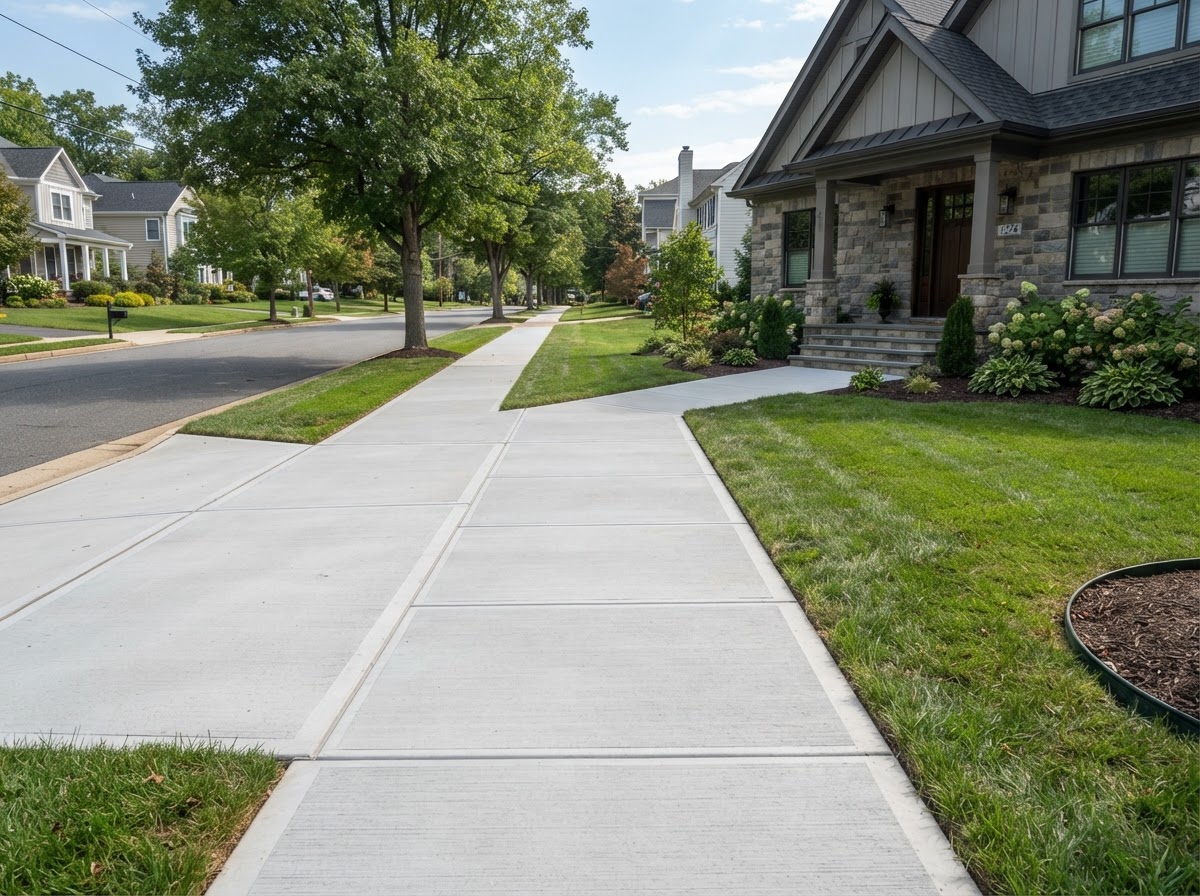
Concrete sidewalk repair addresses the specific panels where a walkway has failed — a crack across a panel, a section that has settled below its neighbors, a raised edge that creates a trip hazard, or a surface that has spalled and scaled. The goal is to restore safe, level pedestrian passage without replacing the entire walkway when the damage is contained.
Replacement becomes the better choice when a panel is badly cracked, severely displaced, or deteriorated to the point that patching will not hold. A single settled panel on an otherwise sound walkway may be a leveling candidate rather than a replacement — concrete leveling can lift the settled section back toward grade. We evaluate each panel individually before recommending repair, leveling, or replacement.
Work that touches the public right-of-way may involve separate approvals or permits. We do not assume responsibility for public sidewalks or municipal right-of-way requirements; permit and approval requirements depend on project type, property jurisdiction, and scope, and should be verified with the applicable authority before construction.
Common Sidewalk & Walkway Problems We Evaluate
Sidewalk defects fall into a few categories, and each points toward a different solution. Some are surface-level; others indicate base movement or drainage failure that patching alone will not solve.
Sidewalk Defects We Assess
- Cracked panels — hairline or structural cracks across a single panel
- Sunken sections — panels that have dropped below their original grade
- Raised sections — panels lifted above their neighbors, creating a trip edge
- Trip hazards — elevation differences between adjacent panels
- Spalling and crumbling edges — surface concrete breaking away
- Failed joints — deteriorated expansion or control joints allowing water entry
- Drainage issues — water pooling on or running beneath the walkway
Raised panels can have several causes — settlement of an adjacent panel, base movement, tree root growth, or freeze-thaw heave. We do not assume roots are the cause without inspection. Where a single panel has settled but the rest is sound, leveling may restore it; where cracking or deterioration is widespread, panel replacement is usually the cleaner solution.
For new walkway installation, see our concrete sidewalks, walkways and paths page. For settled but intact slabs, see concrete leveling and mudjacking.
How Sidewalk Repair & Panel Replacement Works
A sidewalk repair or panel replacement follows a sequence built around safety, drainage, and matching the surrounding walkway. Skipping preparation leads to repairs that fail early.
- 1Damage evaluation — assess each panel for cracks, settlement, displacement, and surface condition.
- 2Ownership and jurisdiction review — determine whether the walkway is private or public right-of-way where relevant.
- 3Elevation and trip-hazard measurement — quantify the height difference between adjacent panels.
- 4Drainage inspection — check whether water is pooling or running beneath the walkway.
- 5Leveling feasibility — determine whether a settled panel can be lifted or needs replacement.
- 6Panel definition — mark the specific panels or areas requiring removal.
- 7Removal of damaged concrete — break out and haul away panels designated for replacement.
- 8Base preparation — recompact and grade the base beneath the removed panels.
- 9Forming and placement — set forms to match the surrounding elevation and pour replacement concrete.
- 10Finishing, jointing, and curing — match the texture, place joints, and allow the concrete to gain strength before foot traffic returns.
We do not prescribe municipal sidewalk specifications without verified official requirements. Where a project touches the public right-of-way, the applicable authority sets the slope, width, joint, and finish standards.
Repair, Leveling, or Panel Replacement?
The right approach depends on the condition of the panel and the surrounding walkway:
When Each Approach Makes Sense
- Repair — localized cracks, edge damage, or small spalled areas on an otherwise sound panel.
- Leveling — a settled but intact panel that can be lifted back toward grade without replacement.
- Panel replacement — a single panel that is badly cracked, severely displaced, or deteriorated beyond patching.
- Full walkway replacement — multiple connected sections have failed, drainage is poor throughout, or the layout is changing.
A replaced panel will not perfectly match older, weathered surrounding concrete in color or texture. Where a seamless appearance matters, full walkway replacement may deliver a more consistent finish than a single-panel swap. We are straightforward about that trade-off.
Comparing options? See our repair vs. replacement guide and leveling vs. replacement guide.
Trip Hazards, Drainage & Right-of-Way Considerations
Trip hazards are the most important safety concern on any sidewalk. A settled or raised panel that someone could catch a foot on is worth fixing promptly, especially on front walks and routes used daily. In Gaithersburg, freeze-thaw cycles and deicing salts accelerate the surface scaling and joint deterioration that create these edges over time.
Drainage affects both safety and durability. A walkway that sheds water stays cleaner and resists the scaling that freeze-thaw and deicers cause. Where water pools on the surface or runs beneath the slab, addressing the drainage is often part of a lasting repair — not just the crack or the panel.
For sidewalk work that touches the public right-of-way, permit or approval requirements depend on project type, property jurisdiction, and scope. We do not invent local sidewalk requirements; verify current requirements with the applicable authority before construction. For grade changes that require a ramp, see our ADA concrete ramps and accessible ramp installation page.
Related resources: drainage and water management guide and Maryland freeze-thaw and deicing guide.
Discuss Your Concrete Project
Have questions about scope, timing, or whether repair or replacement is the right call? We are happy to review your project and provide a clear, honest estimate.
Concrete Sidewalk Repair FAQs & Estimates
Can cracked sidewalks be repaired?
Yes, many cracked sidewalk panels can be repaired when the damage is localized and the surrounding concrete is stable. Hairline and surface cracks are often good repair candidates, while wider structural cracks or panels with ongoing settlement may need replacement. We evaluate the crack type and whether the cause is still active before recommending a repair method.
Can uneven sidewalk panels be leveled?
Often, yes. A settled but intact panel can frequently be lifted by concrete leveling when the slab is suitable for lifting and the underlying conditions support it. Heavily cracked, broken, or spalling slabs — or those with a failed base — may be better replaced. We assess whether your walkway is a leveling candidate before recommending it.
What causes sidewalk trip hazards?
Trip hazards usually come from elevation differences between adjacent panels, caused by settlement, base movement, freeze-thaw heave, or tree root growth. not all raised sidewalks are caused by roots. We evaluate the actual condition rather than assuming a single cause, because the right fix depends on what is actually moving the slab.
When does a sidewalk panel need replacement?
A panel typically needs replacement when it is badly cracked, severely displaced, spalled across most of its surface, or deteriorated to the point that patching will not hold. Where one panel has failed but the rest of the walkway is sound, a single-panel replacement is often more economical than replacing the entire walkway.
Can root-lifted concrete be repaired?
Sometimes. If the slab is intact and the lift is modest, leveling may restore safe passage without replacement. Where the slab has cracked or the root is still actively lifting, repair or replacement may be needed, and the root may require management by a qualified arborist. We evaluate the slab condition before recommending an approach.
Do sidewalk projects require permits?
Permit or approval requirements depend on project type, property jurisdiction, and whether the work affects the public right-of-way. Private walkway work on your own property may not require the same review as work that touches a public sidewalk. Verify current requirements with the applicable authority before construction.
What affects sidewalk repair or replacement cost?
Cost depends on the number and size of panels affected, whether panels can be repaired or must be replaced, whether leveling is feasible, site access, drainage work, and whether the project touches the public right-of-way. Because every walkway differs, we provide project-specific estimates rather than fixed rates.
Request a Sidewalk Repair or Replacement Estimate
Whether you need a cracked panel repaired, a settled section leveled, or a damaged walkway panel replaced, Gaithersburg Concrete will assess the condition and provide a clear estimate. Call (240) 690-6035 or request a free estimate.
Related Concrete Services Near Gaithersburg
Concrete Sidewalks, Walkways & Paths
Safe, level pedestrian access ways, garden paths, front walkways, and commercial footpaths built for heavy foot traffic.
Learn moreConcrete Leveling, Lifting & Mudjacking
Cost-effective lifting of sunken, uneven concrete slabs to eliminate trip hazards and restore positive drainage.
Learn moreConcrete Repair & Crack Repair
Targeted structural crack filling, spalling remediation, and damaged section patching to extend concrete longevity.
Learn moreConcrete Steps, Stairs & Stoops
Solid poured entry stairs, replacement porch stoops, and grade-transition steps built for safety and architectural appeal.
Learn moreRequest a Sidewalk Repair or Replacement Estimate
Whether you need a cracked panel repaired, a settled section leveled, or a damaged walkway panel replaced, Gaithersburg Concrete will assess the condition and provide a clear estimate. Call (240) 690-6035 or request a free estimate.
- Project-specific estimates — no obligation
- Residential and commercial concrete work
- Serving Gaithersburg and surrounding Montgomery County
Request a Free Estimate
Tell us about your concrete project in Gaithersburg or nearby.