Concrete Leveling vs. Replacement in Gaithersburg, MD
Concrete leveling may be a practical option when a slab has settled but remains largely intact and structurally suitable for lifting. Replacement may be more appropriate when the slab is severely cracked, broken, extensively deteriorated, or unsuitable for lifting. This guide from Gaithersburg Concrete helps homeowners and property managers in Gaithersburg, Maryland tell the two apart — what leveling does, what it cannot do, why slabs sink in Maryland conditions, and when replacement is the more durable answer. The goal is a clear framework so you can move from understanding why your concrete settled to the right service — whether that is lifting, targeted repair, or a full new pour.
Request a Free Estimate
Tell us about your concrete project in Gaithersburg or nearby.
Should Sunken Concrete Be Leveled or Replaced?
Concrete leveling may be a practical option when a slab has settled but remains largely intact and structurally suitable for lifting. Replacement may be more appropriate when the slab is severely cracked, broken, extensively deteriorated, or unsuitable for lifting. The right choice depends on whether the slab is still sound — leveling raises a settled but intact panel, while replacement rebuilds a slab that has cracked through or can no longer be lifted reliably.
Leveling May Make Sense When
- The slab is intact and not cracked through
- Settlement is the main problem, not widespread damage
- The surface remains serviceable aside from the elevation drop
- A trip hazard is caused by the elevation difference
- Cracking is limited and the panel is still a single piece
Replacement May Make Sense When
- The slab is badly broken or cracked through
- Severe spalling or deterioration is present
- The slab is structurally compromised
- A layout or drainage change requires reconstruction
- The base has failed and the slab cannot be lifted reliably
The dividing line is slab integrity. An intact, settled panel is a leveling candidate; a broken or deteriorated panel is a replacement project. Leveling is the lighter scope when the concrete itself is still good, while replacement is the more complete fix when the slab has failed along with the base beneath it.
What Is Concrete Leveling?
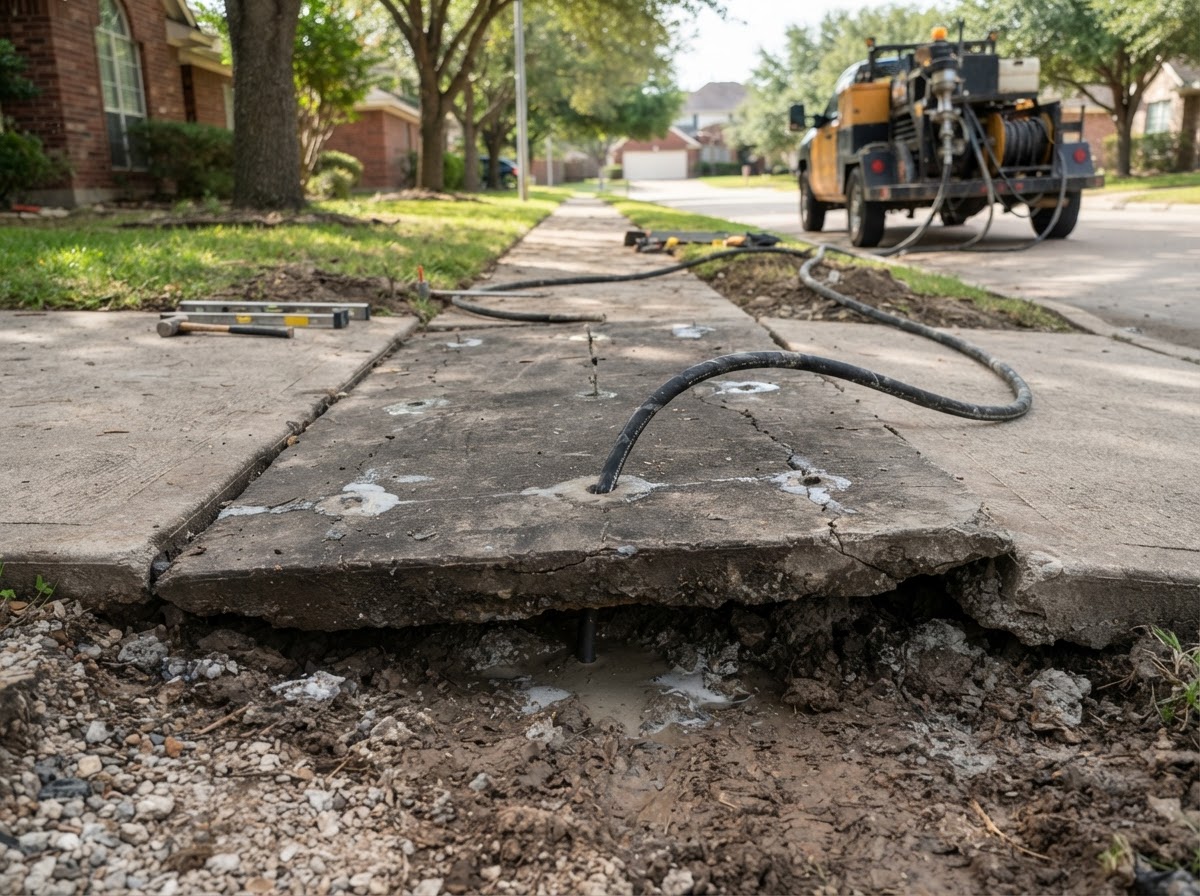
Concrete leveling raises a settled slab back toward its original elevation by filling the void beneath it and lifting the panel. It is a repair aimed at the cause of the drop — missing or compacted support under the slab — rather than at the surface itself.
What Leveling Addresses
- Correcting elevation differences and trip hazards
- Filling voids beneath a settled slab
- Mudjacking and lifting methods where appropriate
- Restoring drainage in some cases by re-establishing slope
- Reducing the unevenness between adjacent panels
What Leveling Does Not Do
- Restore missing or severely deteriorated concrete
- Repair a slab that is cracked through or broken
- Rebuild a failed base from scratch
- Change the layout, thickness, or finish of the slab
- Guarantee against future settlement if the underlying cause continues
Leveling is a targeted repair for intact, settled slabs. For the service itself, see our concrete leveling, lifting and mudjacking page and our sunken slab and trip hazard repair overview.
What Does Concrete Replacement Solve?
Replacement removes the settled or damaged slab and builds a new one in its place. It is the heavier scope, but it is the option that lets you address the underlying base, drainage, and layout problems that leveling cannot — which is why it is often the better long-term value when the slab itself has failed.
Problems Replacement Addresses
- Severe cracking and broken panels
- Poor or failed substrate beneath the slab
- Widespread deterioration and spalling
- Layout changes that require reconstruction
- Failed joints and deteriorated edges
- Significant reconstruction after base failure
Replacement Process in Brief
- Demolition and removal of the failed slab
- Haul-away and disposal
- Subgrade review, recompaction, and base preparation
- Forming, layout, and grading
- New concrete placement, finishing, and jointing
- Curing before the surface returns to use
Because replacement rebuilds the slab from the base up, it corrects the support and drainage problems that caused the settlement in the first place — rather than just lifting the slab back to where it was before it sank.
Leveling vs. Replacement Comparison
The table below maps common slab conditions to the scope that typically fits. It is a starting point — the actual recommendation depends on a hands-on assessment — but it shows how the condition of the concrete drives the choice between lifting and replacing.
| Condition | Leveling | Replacement |
|---|---|---|
| Intact settled slab | Often a good fit | More scope than needed |
| Cracked-through slab | Not suitable — cannot lift reliably | Usually the better option |
| Severe spalling | Does not restore the surface | Rebuilds the surface |
| Settlement | Corrects elevation if intact | Re-establishes grade and base |
| Poor drainage | Limited — keeps existing slope | Can re-grade and correct |
| Failed base | May not hold if base is unsound | Rebuilds the base |
| Aesthetic consistency | Keeps existing finish | New, consistent finish |
| Project disruption | Lighter, shorter scope | Longer, heavier scope |
| Old/new concrete match | Keeps existing slab | New pour may differ from adjacent |
| Access | Equipment access to slab | Demolition and pour access |
Can Cracked Concrete Still Be Leveled?
Usually not when the slab is cracked through. Leveling relies on lifting a single, intact panel; a cracked-through or broken slab will not lift evenly and may break further. When cracking is limited and the panel is still a single piece, leveling may still work — but widespread or structural cracking points toward replacement.
Can a Sinking Driveway Be Lifted?
Often, when the driveway slab is intact and only settled. Leveling raises the settled panel and fills the void beneath it. When the driveway has cracked through, broken apart, or the base has failed, replacement is usually the more durable option because lifting cannot rebuild a failed slab.
Can a Sidewalk Trip Hazard Be Leveled?
Frequently, when the trip hazard is an elevation difference between intact panels. Leveling raises the lower panel to reduce the trip hazard. When a panel is cracked through or badly deteriorated, replacing that section is usually the better fix.
Why Concrete Sinks in Maryland
Concrete settles when the material beneath it compacts, erodes, or shifts — and Maryland conditions accelerate several of those causes. Understanding why a slab sank helps decide whether leveling will hold or whether the underlying cause needs to be addressed through replacement.
- Erosion — water washing soil or base material out from under the slab
- Water movement beneath the surface creating or widening voids
- Poorly compacted base settling over time after the pour
- Freeze-thaw cycles expanding and contracting soil and base material
- Soil and base settlement from saturated or shifting ground
- Drainage problems letting water run beneath the slab
- Downspout runoff directed at or near the slab
If the cause of the settlement is not considered, movement may continue even after the slab is lifted. Leveling fills the void and raises the panel, but it does not rebuild a failed base or stop ongoing erosion on its own. That is why the condition of the slab and the cause of the settlement both matter — and why, when the base has failed or the slab is broken, replacement is often the more durable answer.
Leveling does not permanently eliminate all settlement. A lifted slab can settle again if the underlying cause — drainage, erosion, or an unsound base — is still active. Addressing the cause is part of deciding between leveling and replacement.
How to Decide Whether to Level or Replace
Ask These Questions
- Is the slab intact, or is it cracked through?
- How severe is the cracking — limited or widespread?
- Is the surface deteriorated, or just settled?
- How much settlement is present, and is it still moving?
- Is drainage contributing to the settlement?
- Are the edges broken or deteriorated?
- Has the slab been repaired or lifted before?
- Does the layout or drainage need to change?
- Is matching the adjacent concrete important?
If the answers point to an intact, settled slab, leveling is likely the right path. If they point to a cracked-through, broken, or failed-base slab, replacement is usually the more durable long-term value. The checklist is a starting point — a hands-on assessment confirms which scope fits a specific slab.
For the leveling service, see our concrete leveling and sunken slab repair pages. For the broader repair decision, see our repair vs. replacement guide and our repair cost guide.
Discuss Your Concrete Project
Have questions about scope, timing, or whether repair or replacement is the right call? We are happy to review your project and provide a clear, honest estimate.
Concrete Leveling vs. Replacement FAQs & Estimates
Can cracked concrete be lifted?
Usually not when the slab is cracked through. Leveling relies on lifting a single, intact panel; a cracked-through or broken slab will not lift evenly and may break further. When cracking is limited and the panel is still one piece, leveling may still work — but widespread or structural cracking points toward replacement.
Is mudjacking cheaper than replacement?
Leveling is typically a lighter scope than demolition and a new pour, so it can be the lower-cost option when the slab is intact and only settled. The trade-off is that leveling only makes sense when the slab is suitable for lifting; a cracked-through or failed-base slab is not a leveling candidate, and replacement is the more durable choice.
When is concrete too damaged to level?
Concrete is typically too damaged to level when it is cracked through, badly broken, severely spalled, or resting on a failed base. In those cases the slab cannot be lifted reliably, and replacement — which rebuilds the slab and the base — is the more durable option.
Can a driveway be leveled?
Often, when the driveway slab is intact and only settled. Leveling raises the settled panel and fills the void beneath it. When the driveway has cracked through, broken apart, or the base has failed, replacement is usually the better long-term value because lifting cannot rebuild a failed slab.
Can sidewalk trip hazards be lifted?
Frequently, when the trip hazard is an elevation difference between intact panels. Leveling raises the lower panel to reduce the trip hazard. When a panel is cracked through or badly deteriorated, replacing that section is usually the better fix.
Does leveling fix drainage problems?
It can help in some cases by re-establishing slope on an intact settled slab, but it does not rebuild a failed base or correct the underlying cause of water movement. If drainage is contributing to the settlement, the cause needs to be addressed — which may point toward replacement rather than leveling alone.
Can leveled concrete settle again?
Yes. A lifted slab can settle again if the underlying cause — drainage, erosion, or an unsound base — is still active. Leveling fills the void and raises the panel, but it does not permanently eliminate all settlement. Addressing the cause is part of deciding between leveling and replacement.
How do I know whether my slab can be lifted?
A hands-on assessment is the reliable way to tell. We look at whether the slab is intact or cracked through, how much it has settled, whether movement is still active, the condition of the base, and whether drainage is contributing. Call (240) 690-6035 or request a free estimate to have your slab evaluated.
Request a Concrete Leveling Evaluation
Not sure whether your settled concrete can be lifted or needs to be replaced? Gaithersburg Concrete will assess the slab, identify the cause of the settlement, and recommend the right scope. Call (240) 690-6035 or request a free estimate.
Keep Learning About Concrete in Gaithersburg
Concrete Repair vs. Replacement: How to Decide
A decision framework for repairing or replacing damaged concrete in Gaithersburg — cracking, settlement, spalling, movement and slab condition.
Read the guideConcrete Repair Cost Guide for Gaithersburg, MD
What affects concrete repair cost in Gaithersburg — crack type, spalling, settlement, repair size, access and replacement needs.
Read the guideConcrete Cost Guide for Gaithersburg, MD
What affects concrete project costs in Gaithersburg — size, demolition, access, base, thickness, reinforcement, finish, grading and drainage.
Read the guideRelated Concrete Services Near Gaithersburg
Concrete Leveling, Lifting & Mudjacking
Cost-effective lifting of sunken, uneven concrete slabs to eliminate trip hazards and restore positive drainage.
Learn moreSunken Concrete Slab Leveling & Trip Hazard Repair
Leveling of sunken, uneven concrete slabs and trip hazard repair for sidewalks, patios, and driveways.
Learn moreConcrete Repair & Crack Repair
Targeted structural crack filling, spalling remediation, and damaged section patching to extend concrete longevity.
Learn moreConcrete Demolition, Removal & Replacement
Concrete demolition, removal, haul-away, and replacement for driveways, patios, walkways, and slabs.
Learn moreRequest a Concrete Leveling Evaluation
Not sure whether your settled concrete can be lifted or needs to be replaced? Gaithersburg Concrete will assess the slab, identify the cause of the settlement, and recommend the right scope. Call (240) 690-6035 or request a free estimate.
- Project-specific estimates — no obligation
- Residential and commercial concrete work
- Serving Gaithersburg and surrounding Montgomery County
Request a Free Estimate
Tell us about your concrete project in Gaithersburg or nearby.