Concrete Outdoor Kitchen & Grill Pads in Gaithersburg, MD
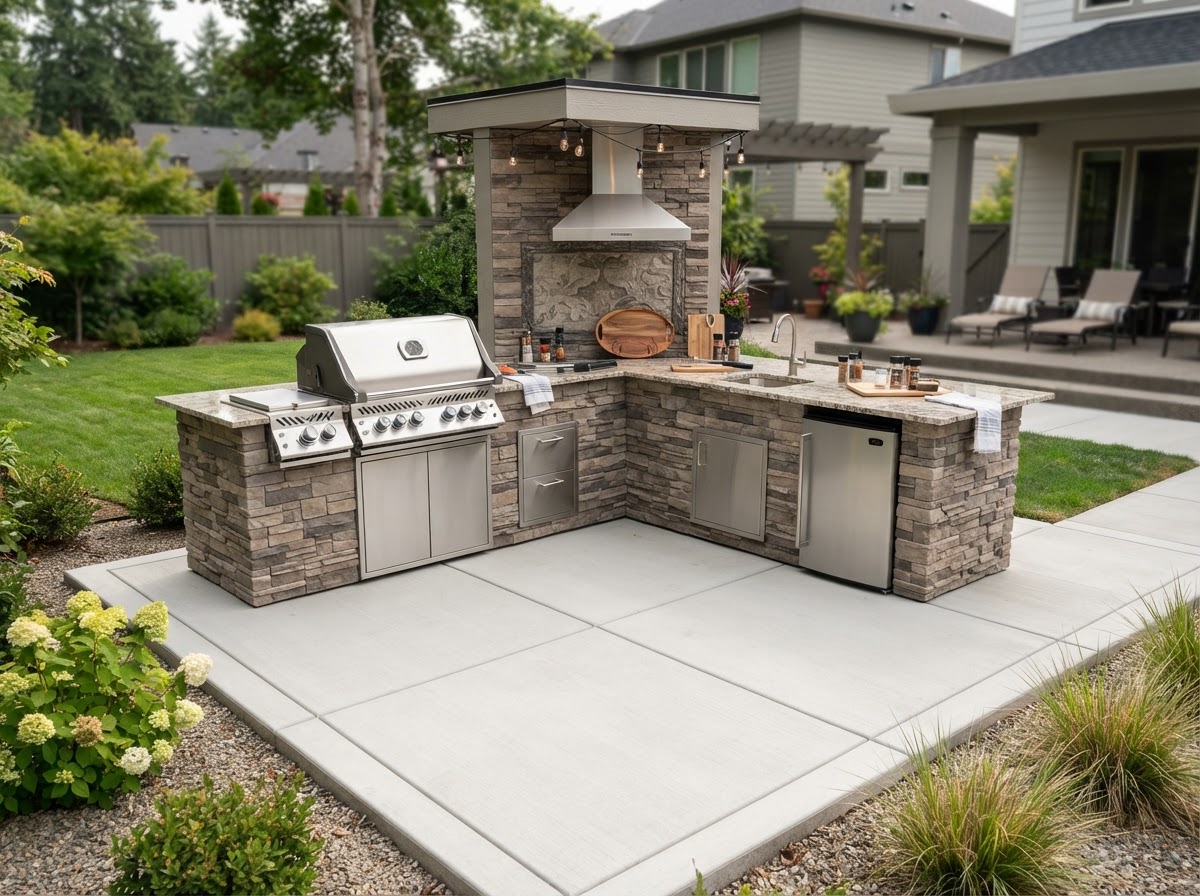
A concrete pad gives an outdoor kitchen, grill station, or BBQ area a stable, level base that carries the weight of appliances, cabinetry, and countertops without settling or cracking. Gaithersburg Concrete pours outdoor kitchen pads and grill pads sized to the equipment layout, with drainage, finish, and utility penetrations planned around the cooking zone. Because an outdoor kitchen combines heavy equipment, foot traffic, furniture, and full outdoor exposure, the slab under it has to carry all four. Every outdoor kitchen pad starts with a review of the equipment, dimensions, access, and how the pad integrates with the surrounding patio.
Request a Free Estimate
Tell us about your concrete project in Gaithersburg or nearby.
Concrete Pads for Outdoor Kitchens in Gaithersburg
An outdoor kitchen pad is the concrete slab that supports a grill station, BBQ area, outdoor counter, or full cooking zone. In Gaithersburg, where outdoor living has become a common extension of the home, a poured pad gives the cooking area a flat, stable foundation that holds up under appliance weight, foot traffic, furniture, and year-round weather — something gravel or pavers do not reliably do under a loaded grill counter.
These pads take a few forms. A standalone grill pad is a smaller slab built for a single grill or BBQ. A full outdoor kitchen pad is larger, sized to carry a grill, side burners, refrigeration, cabinetry, and countertop. And an outdoor kitchen can also be integrated with a larger concrete patio, where the cooking zone is part of one continuous slab rather than a separate pad.
Either way, the pad is planned around the equipment it will carry and the people who will use the space. A grill pad that settles throws the whole counter out of level; a kitchen pad without drainage traps water around the appliances. That is why the slab — not just the appliances — is where an outdoor kitchen starts.
Why Outdoor Kitchens Need a Stable Concrete Base
An outdoor kitchen puts more demand on its base than almost any other backyard slab. The concrete has to carry the dead weight of the appliances and cabinetry, stay level so countertops and grills sit true, hold up under foot traffic and furniture around the cooking zone, and survive full outdoor exposure to moisture, grease, and temperature swings.
What the Base Carries
- Appliance weight from grills, side burners, refrigerators, and other outdoor equipment
- Cabinetry and the countertop that spans it, which need a level base to sit true
- Countertops that crack or telegraph movement if the slab beneath settles
- Stable, level support so doors, drawers, and lids align over time
- Heat-resistant surrounding surfaces around the cooking zone
- Foot traffic and furniture in the cooking and seating area
- Full outdoor exposure to rain, snow, grease, and freeze-thaw
We are honest about one limit: concrete alone does not make an outdoor kitchen fire-safe. The slab provides a stable, noncombustible base, but clearances to combustibles, fire protection around the grill, and the appliance installation itself are governed by the equipment manufacturer's requirements and applicable requirements — not by the concrete pour. We build the base the kitchen rests on; the fire-safe installation of the appliances is a separate scope.
Outdoor Kitchen Concrete Installation Process
An outdoor kitchen pad is poured like other flatwork, with the layout, utility penetrations, and finish planned around the equipment that will sit on it. Because appliances, counters, and utilities all have to land in the right spot, the planning up front matters as much as the pour.
- 1Equipment layout — confirm the grill, counters, appliances, and their locations on the pad.
- 2Dimensions — size the pad to the cooking zone and any seating area it connects to.
- 3Access — confirm equipment and concrete delivery can reach the pad location.
- 4Excavation — remove soil to the depth needed for base and slab.
- 5Base preparation — add and compact base material for a stable foundation.
- 6Forming — set forms to the pad dimensions, thickness, and edges.
- 7Utilities coordination — plan penetrations and locations for any utilities that pass through the slab.
- 8Reinforcement where appropriate — add reinforcement suited to the appliance loads and conditions.
- 9Concrete placement — pour and screed the concrete to a consistent level.
- 10Finish — apply a finish suited to the cooking area, from broom to decorative.
- 11Joints — place control joints so the slab cracks where intended.
- 12Curing — allow the concrete to gain strength before appliances or traffic use the pad.
We do not imply that gas, plumbing, or electrical work is included. Any gas line to a grill, water supply to an outdoor sink, or electrical run to refrigeration or lighting is performed by the appropriate licensed trade and coordinated with the applicable requirements. Our scope is the concrete pad — the base, thickness, finish, drainage, and the penetrations and layout that let those utilities pass through the slab where the kitchen design calls for them.
Outdoor Kitchen Pad Size, Finish & Utility Planning
An outdoor kitchen pad is sized and finished around the equipment and the people it serves. The grill dimensions set the minimum depth, counters and refrigeration add width, sinks and other utilities dictate penetrations, and the walk and seating zones around the cooking area determine how much total slab the project needs.
Size, Finish & Utility Planning
- Grill dimensions and the clearance the appliance requires
- Counters and the countertop area the slab needs to support
- Refrigerators, side burners, and other appliances and their footprints
- Sinks where applicable and the plumbing penetrations they require
- Walk zones so the cook has room to work around the equipment
- Seating zones and how the pad connects to the larger patio
- Utility penetrations for gas, water, or electrical runs through the slab
- Drainage so water sheds away from appliances and the cooking area
- Decorative finish — stamped concrete, exposed aggregate, or a broom texture
For the larger patio an outdoor kitchen often connects to, see our concrete patio installation services; for decorative cooking-area surfaces, our stamped and decorative concrete and exposed aggregate concrete pages. General-purpose slabs are covered in our concrete slabs, pads and foundations work.
Outdoor Cooking Areas & Maryland Weather
An outdoor kitchen pad in Gaithersburg lives outside year-round, which means it takes the full combination of freeze-thaw, moisture, grease and food exposure, and the cleaning that follows. Moisture that enters the slab expands as it freezes; grease and food spills sit on the surface and work into any pores or cracks; and the cleaning an outdoor kitchen needs — pressure washing, degreasing — has to happen on a slab that can take it.
Drainage is what keeps the area usable. A pad that traps water around the appliances lets moisture wick into cabinetry and refrigeration; a pad that sheds water keeps the cooking zone dry between uses. Slope is planned so runoff moves away from the equipment and the house, and so the cleaning water drains off rather than pooling. Sealing where appropriate helps the surface resist grease and staining and makes the cleaning easier.
Snow and freeze-thaw affect the pad the way they affect any exterior concrete in Montgomery County, and the integration with the patio surfaces matters too. An outdoor kitchen pad that sits at a different elevation than the surrounding patio creates a lip and a drainage trap at the seam, and the cooking area should flow into the patio as one surface where the design allows. A pad built for the actual equipment, the actual weather, and the actual patio it connects to is what holds up — and that is what we plan.
Outdoor Kitchen Pad vs. Full Concrete Patio
A dedicated outdoor kitchen pad is enough when the cooking zone is the project — a grill station and counter on a stable slab, with the surrounding yard left as-is. A full concrete patio makes more sense when the cooking area is part of a larger outdoor living space that also needs a flat, durable surface for seating, dining, and foot traffic. Some projects combine both — a full patio with the kitchen integrated into one pour. We help you decide which fits the scope rather than pouring more concrete than the project needs.
Discuss Your Concrete Project
Have questions about scope, timing, or whether repair or replacement is the right call? We are happy to review your project and provide a clear, honest estimate.
Outdoor Kitchen & Grill Pad FAQs & Free Estimates
Do outdoor kitchens need a concrete slab?
A concrete slab is the most stable base for an outdoor kitchen because it carries appliance and countertop weight without settling, stays level so doors and lids align, and holds up under full outdoor exposure. Gravel or pavers can shift under a loaded grill counter. Whether a full slab is required depends on the equipment and the design, but for a permanent outdoor kitchen, a poured pad is the reliable choice.
How thick should an outdoor kitchen pad be?
Outdoor kitchen pad thickness depends on the appliance and countertop loads, the cabinetry, the base conditions, and whether the pad also carries foot traffic. A pad loaded with refrigeration and stone counters needs more thickness than a simple grill pad. We recommend thickness based on the specific equipment and use rather than a universal dimension.
Can an outdoor kitchen be built on an existing patio?
Often yes, if the existing patio slab is sound, level, and thick enough to carry the appliance and countertop loads. A patio that has settled, cracked, or was poured thin may need reinforcement, repair, or replacement before it can support a kitchen. We assess the existing slab's condition and capacity before recommending building on it or pouring a new pad.
Can utilities run through a concrete pad?
Yes. Gas, water, and electrical runs can pass through a concrete pad via sleeves or penetrations planned into the pour, but the utility work itself — the gas line, water supply, electrical — is performed by the appropriate licensed trade and coordinated with applicable requirements. We handle the concrete and the penetrations; the licensed trades handle the utilities.
Can the concrete be stamped or colored?
Yes. An outdoor kitchen pad can be finished with a broom texture for a practical cooking surface, or with stamped, colored, or exposed-aggregate concrete for a decorative look that integrates with the patio. Decorative finishes are coordinated with the surrounding surfaces so the cooking zone reads as part of the outdoor living space. See our stamped and decorative concrete services for the options.
How large should a grill pad be?
Grill pad size depends on the grill dimensions, the clearance the appliance requires, and whether the pad also carries counters, side burners, or a walk zone. A pad for a single freestanding grill is smaller than one for a full built-in cooking station. We size the pad to the actual equipment plus reasonable working room rather than a fixed dimension.
What affects outdoor kitchen concrete cost?
Cost depends on the pad dimensions, slab thickness, reinforcement, finish type, utility penetrations, drainage work, excavation and base preparation, site access, and any demolition. A larger decorative pad with utility coordination costs more than a small plain grill pad. We provide project-specific estimates based on the actual equipment and scope.
Request an Outdoor Kitchen Concrete Estimate
If you are planning an outdoor kitchen, grill station, or BBQ area in Gaithersburg, Gaithersburg Concrete will review the equipment, dimensions, drainage, and patio integration, then provide a clear estimate for the pad. Serving Gaithersburg and surrounding Montgomery County communities.
Related Concrete Services Near Gaithersburg
Concrete Patio Installation & Replacement
Custom concrete backyard patios engineered for outdoor living, cookouts, and year-round family entertainment.
Learn moreStamped & Decorative Concrete
Premium slate, cobblestone, stone, and wood-plank patterns combined with integral colors and protective sealants.
Learn moreExposed Aggregate Concrete
Decorative exposed aggregate concrete for patios, walkways, driveways, and outdoor living areas.
Learn moreConcrete Slabs, Pads & Foundations
Heavy-duty concrete pads for backyard sheds, hot tubs, HVAC units, backup generators, and residential accessory structures.
Learn moreRequest an Outdoor Kitchen Concrete Estimate
If you are planning an outdoor kitchen, grill station, or BBQ area in Gaithersburg, Gaithersburg Concrete will review the equipment, dimensions, drainage, and patio integration, then provide a clear estimate for the pad. Serving Gaithersburg and surrounding Montgomery County communities.
- Project-specific estimates — no obligation
- Residential and commercial concrete work
- Serving Gaithersburg and surrounding Montgomery County
Request a Free Estimate
Tell us about your concrete project in Gaithersburg or nearby.