
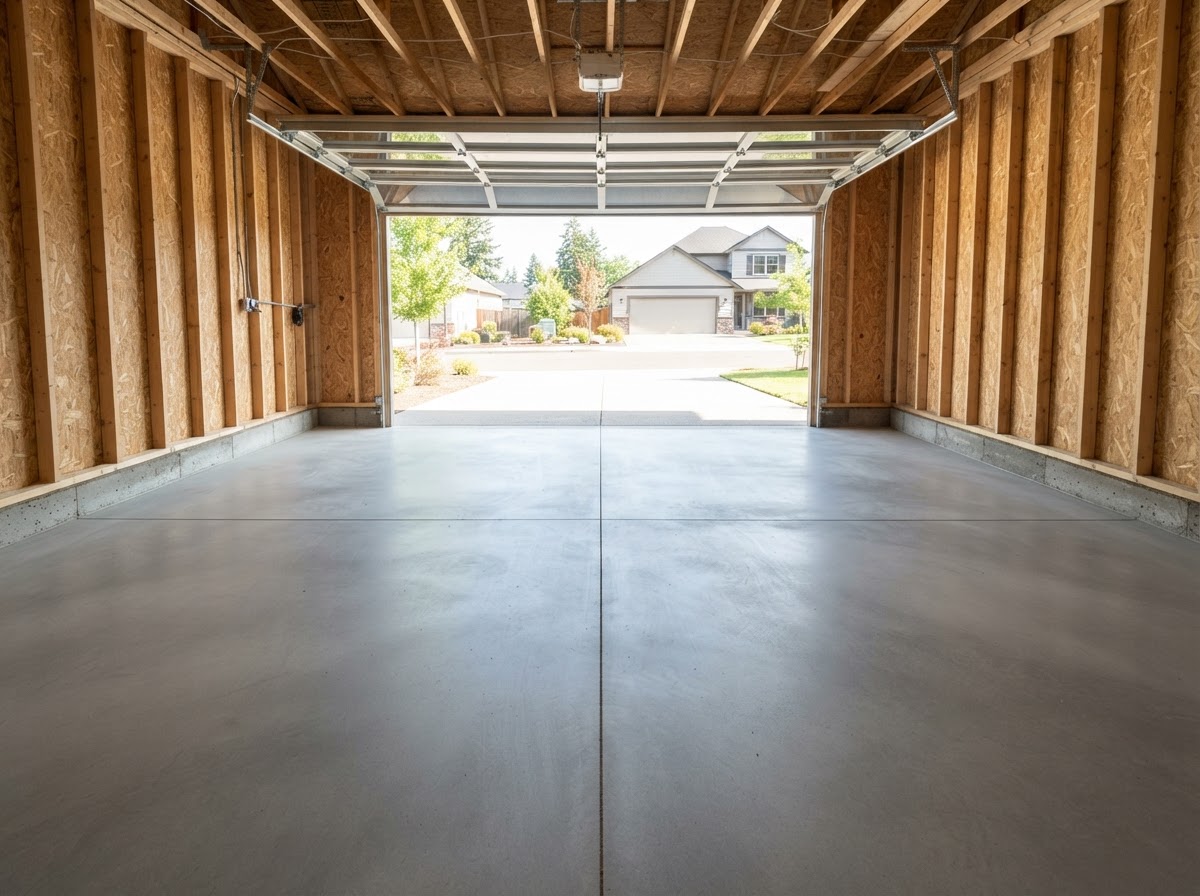
Concrete Garage Floors & Garage Slabs in Gaithersburg, MD
A concrete garage floor carries vehicles, stored items, and workshop activity every day, and Gaithersburg Concrete pours new garage slabs and replaces deteriorated garage floors for properties in Gaithersburg, Maryland and surrounding service areas. Garage slab requirements depend on the intended loads, dimensions, base conditions, and project specifications — there is no single universal thickness that fits every garage. Whether you need a slab for a newly built garage or an aging, cracked floor removed and repoured, every project starts with a review of how the garage is used, the existing conditions, and the transitions to the driveway and garage-door approach. The goal is a flat, stable, durable surface built to handle vehicle traffic and Maryland freeze-thaw exposure.
Concrete Garage Floors in Gaithersburg
A garage slab is the poured concrete floor that supports vehicles, storage, and workshop use inside a residential or light commercial garage. Unlike a patio or walkway built primarily for foot traffic, a garage floor is expected to hold the weight of parked vehicles, resist surface wear from tires and foot traffic, and stand up to the moisture, road salt, and temperature swings that come through the garage door throughout a Maryland year.
New garage slabs are poured as part of new construction or when a garage is added to a property. Replacement garage floors become necessary when an existing slab has cracked, settled, spalled, or deteriorated to the point where patching no longer holds. In both cases, the planning phase — load, dimensions, base, reinforcement, and finish — determines how well the floor performs over time.
Garage slab requirements depend on the intended loads, dimensions, base conditions, and project specifications. A garage used to park passenger vehicles has different demands than one used as a workshop or for heavier storage, and the slab is planned around those specific needs rather than a one-size-fits-all approach.
When a Garage Floor Needs Replacement or Repair
A garage floor may be a candidate for replacement when it has widespread cracking, significant settlement, extensive surface deterioration, or broken sections that make localized repair impractical. Isolated issues — a single crack or one spalled area — can sometimes be repaired, but when problems span most of the slab, replacement usually delivers a more durable surface.
Conditions We Evaluate
- Cracks running across the slab or widening over time
- Settlement that leaves the floor uneven or sloped
- Spalling and surface scaling where the top layer is flaking
- Broken edges and crumbling concrete at the slab perimeter
- Uneven slabs where one section has dropped below another
- Surface wear from years of vehicle traffic and tire abrasion
- Moisture concerns related to drainage or slab elevation
- Failed sections that no longer respond to patching
The right approach depends on the actual condition of the slab. A floor with one settled corner and otherwise sound concrete may only need that section addressed, while a floor with network cracking, widespread settlement, and a failed base is better replaced entirely. We assess whether the underlying cause is ongoing before recommending repair or full replacement.
How Concrete Garage Slabs Are Installed
A garage slab pour follows a deliberate sequence, with each step affecting how the finished floor performs under load.
- 1Removal where necessary — break up and haul away the old garage floor when replacing.
- 2Excavation — grade the area to the depth needed for base and slab.
- 3Subgrade preparation — compact the soil to a stable, uniform surface.
- 4Base preparation — add and compact base material where appropriate.
- 5Forms — set forms to the garage dimensions and finished elevation.
- 6Reinforcement where appropriate — add reinforcement suited to the expected loads.
- 7Concrete placement — pour, spread, and screed the concrete to a consistent level.
- 8Finishing — apply a finish suited to garage use, such as a smooth or lightly textured surface.
- 9Joints — place control joints to manage cracking as the slab cures and moves.
- 10Curing — allow the concrete to gain strength before vehicles are parked on it.
We do not state one universal slab thickness for every garage. The thickness, reinforcement, and base preparation depend on the expected vehicle loads, soil conditions, and the specific project requirements.
Garage Slab Thickness, Finish & Load Considerations
Garage slab design centers on load, finish, and transitions. The thickness and reinforcement are matched to what the floor will carry, while the finish affects both appearance and how the surface holds up under tires and foot traffic.
Design Considerations
- Vehicle loads — passenger vehicles, heavier vehicles, or storage loads
- Storage and workshop use that may add weight or wear
- Surface finish — smooth trowel or lightly textured for garage use
- Garage-door transitions that line up cleanly with the slab
- Driveway transition so the apron and garage floor meet without a lip
- Joint layout to control where the slab cracks over time
How the garage floor ties into the rest of the property matters as much as the slab itself. The transition to the driveway and the garage-door approach need to line up so water sheds correctly and vehicles enter smoothly. For broader slab projects, our concrete slabs, pads, and foundations services cover general-purpose pours, and concrete driveway installation handles the connecting vehicle surface. Existing garage floor damage on an otherwise sound slab can often be addressed through concrete repair, and commercial concrete flatwork covers heavier-use applications.
Planning a Garage Floor for Long-Term Use
A garage floor in Gaithersburg faces a specific combination of stresses. Vehicles bring in water, snow, and road salt through the winter, and that moisture sits on or runs across the slab near the entrance. Freeze-thaw cycles mean moisture that enters the concrete or collects at the surface can expand as it freezes, stressing the slab and any existing cracks.
Drainage and slab elevation are central to how well a garage floor performs. A slab that slopes toward the interior or sits too low at the entrance allows water to pool inside the garage, contributing to surface wear and deterioration over time. Proper slope, base preparation, and joint placement help manage water so it moves out rather than collecting on the floor.
Surface wear accumulates from tire abrasion, foot traffic, and winter exposure. We do not make coating claims unless coatings are actually offered as part of the scope — a well-poured, well-finished slab with proper drainage is the foundation for long-term performance, and any surface treatment would be discussed as a separate consideration. We build the slab to handle Maryland conditions as well as the site and scope allow.
Discuss Your Concrete Project
Have questions about scope, timing, or whether repair or replacement is the right call? We are happy to review your project and provide a clear, honest estimate.
Garage Floor & Garage Slab FAQs
How thick should a concrete garage floor be?
Garage slab thickness depends on the expected vehicle loads, soil and base conditions, and the specific project. A floor built for passenger vehicles commonly uses a different thickness than one designed for heavier storage or workshop use. We recommend thickness based on how the garage will be used rather than applying one dimension to every project.
Can a cracked garage floor be replaced?
Yes. When a garage floor has widespread cracking, settlement, or deterioration, the old slab can be removed and a new one poured in its place. Replacement includes removing the damaged concrete, preparing the base, and pouring a new floor planned for the garage's intended use.
Does a garage slab need reinforcement?
Reinforcement is specified based on the expected loads, slab thickness, and project conditions. Many garage slabs benefit from reinforcement to manage cracking and carry vehicle loads, but the type and extent depend on the specific project. We recommend reinforcement where appropriate to the application.
Can you replace a garage slab without replacing the driveway?
In many cases, yes. A garage slab can be replaced independently of the driveway when the transition between the two is planned to match. We review the elevation and connection so the new floor and the existing driveway align cleanly without a lip or trip point.
Why does a garage floor crack?
Garage floors crack for a combination of reasons, including shrinkage during curing, base settlement, freeze-thaw stress, and the loads placed on the surface. Poor drainage and inadequate base preparation contribute to cracking over time. Control joints help manage where cracks appear, but they do not prevent all cracking.
How long before vehicles can be parked on new concrete?
Vehicles generally require more curing time than foot traffic. Fresh concrete gains strength over days and weeks, and safe timing depends on the mix, weather, slab thickness, and application. We advise when it is safe to park vehicles on the new garage floor before we finish the project.
What affects the cost of a garage slab?
Garage slab cost depends on dimensions, thickness, reinforcement, demolition of existing concrete, excavation and base work, site access, and finish. A replacement that requires removal of an old floor costs more than a new pour on prepared ground. We provide project-specific estimates based on the actual scope.
Request a Garage Slab Estimate
Whether you need a new garage floor poured or an aging one removed and replaced, Gaithersburg Concrete will review the loads, dimensions, and site, then provide a clear estimate. Serving Gaithersburg and surrounding Montgomery County communities.
Related Concrete Services Near Gaithersburg
Concrete Slabs, Pads & Foundations
Heavy-duty concrete pads for backyard sheds, hot tubs, HVAC units, backup generators, and residential accessory structures.
Learn moreConcrete Driveway Installation & Replacement
Durable residential and light commercial concrete driveways built to withstand vehicular weight and Maryland freeze-thaw cycles.
Learn moreConcrete Repair & Crack Repair
Targeted structural crack filling, spalling remediation, and damaged section patching to extend concrete longevity.
Learn moreCommercial Concrete & Concrete Flatwork
High-spec flatwork for commercial centers, retail plazas, loading docks, dumpster pads, and multi-family communities.
Learn moreRequest a Garage Slab Estimate
Whether you need a new garage floor poured or an aging one removed and replaced, Gaithersburg Concrete will review the loads, dimensions, and site, then provide a clear estimate. Serving Gaithersburg and surrounding Montgomery County communities.
- Project-specific estimates — no obligation
- Residential and commercial concrete work
- Serving Gaithersburg and surrounding Montgomery County
Request a Free Estimate
Tell us about your concrete project in Gaithersburg or nearby.