Epoxy Garage & Commercial Floor Coatings in Gaithersburg, MD
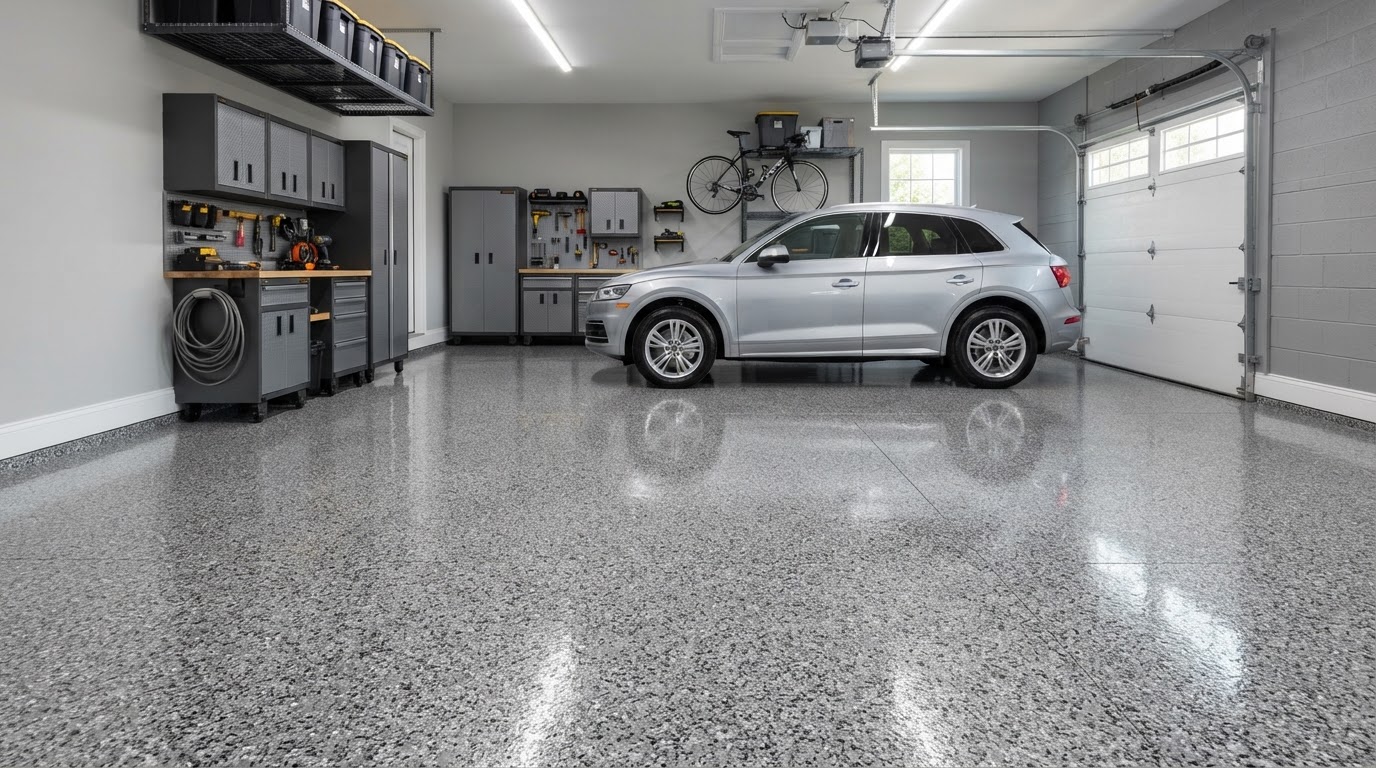
Epoxy flooring is a resin-based coating system applied over properly prepared concrete to create a bonded finished surface. Gaithersburg Concrete installs epoxy floor coatings for suitable residential garages, workshops, utility areas, commercial floors, service areas, and storage spaces across Gaithersburg, Maryland and surrounding communities. Epoxy is a coating over the concrete — not the structural slab itself — and it is distinct from both polished concrete and grind and seal finishes. This page targets coating an existing or new suitable concrete floor, while our garage slabs page covers the actual structural garage floor installation and replacement. Every epoxy project starts with a slab evaluation and moisture review, because a coating only performs when the concrete beneath it is stable, dry enough, and properly prepared.
Request a Free Estimate
Tell us about your concrete project in Gaithersburg or nearby.
Epoxy Concrete Floor Coatings in Gaithersburg
Epoxy flooring is a resin-based coating system applied over properly prepared concrete to create a bonded finished surface. The coating creates a seamless, cleanable, decorative surface that protects the concrete beneath it. It is a coating — not a structural repair — and it depends entirely on the slab's condition and the quality of surface preparation for its performance.
In Gaithersburg and across Montgomery County, epoxy coatings are considered for residential garages, workshops, utility areas, commercial floors, service areas, and storage spaces. The coating is chosen for its appearance, its cleanability, and the surface protection it provides depending on the system.
We do not call every resin floor epoxy if another chemistry is used. Where a different resin system is more appropriate for the use, we say so. This page is about epoxy coatings applied over suitable concrete — for the structural garage slab itself, see our garage floors page, and for mechanically refined or sealed finishes, see our polished concrete and grind and seal pages.
When an Epoxy Floor Coating May Make Sense
An epoxy coating may make sense when the goal is an easier-to-clean finished surface, a decorative appearance, or surface protection on a suitable slab. Common uses include residential garages, workshops, utility areas, commercial floors, service areas, and storage spaces where the concrete is stable and the surface can be properly prepared.
What Epoxy Does Not Fix
An epoxy coating should not be presented as a fix for structural problems. It will not correct:
- Structural cracking or slab movement
- Slab settlement or uneven floors
- Active moisture transmission through the concrete
- Major spalling or severely deteriorated concrete
- Unstable or failing slab conditions
These conditions may require concrete repair or replacement before a coating is applied. A coating over an unstable or wet slab can fail to bond, blister, or peel. We evaluate the slab and the moisture conditions before recommending epoxy.
Epoxy Floor Preparation & Installation
A durable epoxy coating depends on preparation. The concrete is evaluated, cleaned, and mechanically profiled so the coating bonds to the surface rather than sitting on top of contamination.
- 1Slab evaluation — assess the concrete condition, cracks, and surface.
- 2Moisture review — check for vapor or moisture conditions that could affect bonding.
- 3Cleaning — remove dirt, oil, grease, and contamination from the surface.
- 4Mechanical surface preparation — profile the concrete so the coating bonds.
- 5Crack and joint assessment — review how existing cracks and joints will be treated.
- 6Localized repair — address spalls, small cracks, or surface defects before coating.
- 7Dust removal — clean the prepared surface so nothing interferes with adhesion.
- 8Primer where applicable — apply a primer suited to the system and the slab.
- 9Coating application — apply the epoxy coating over the prepared floor.
- 10Decorative broadcast and flakes where offered — add color flakes where part of the system.
- 11Topcoat where part of the selected system — apply a protective topcoat for the intended use.
- 12Curing before use — allow the system to cure before the floor returns to service.
We do not provide DIY chemical recipes or specify proprietary systems. The preparation steps, the number of coats, and the cure time depend on the selected system and the slab conditions.
Epoxy Finish Options & Performance Considerations
Epoxy finish options range from solid-color systems to decorative flake finishes, and the right choice depends on how the floor will be used. A garage floor that sees vehicle traffic and tire contact is planned differently than a commercial floor or a workshop.
Finish & Performance Variables
- Solid-color systems for a clean, uniform appearance
- Decorative flakes where offered to add texture and visual variation
- Gloss or satin sheen depending on the selected system
- Traction additives where appropriate for floors that see foot or vehicle traffic
- Topcoat selection based on the wear the floor will see
- Vehicle traffic and tire contact considerations for garage floors
- Abrasion resistance depending on the system and the floor's use
- Chemical exposure considerations — we do not claim resistance to specific chemicals unless supported by the actual product system
Coating selection should reflect the intended use. A floor that sees hot tires, dropped tools, or heavy traffic needs a system planned for that duty. We do not claim resistance to specific chemicals, abrasion ratings, or warranty periods unless supported by the actual product system used.
How Epoxy Differs From Other Finishes
Epoxy is a coating over the concrete. Polished concrete is a mechanically refined surface with no coating layer. Grind and seal is ground concrete with an applied sealer or topcoat. A garage slab is the actual structural concrete floor. Each solves a different need, and the right choice depends on the slab, the use, and the desired look.
For the structural garage floor itself, see our concrete garage floors and slabs page. Compare epoxy with our polished concrete and grind and seal pages, and for slab repairs before coating, our concrete repair and crack repair pages.
Moisture, Cracks & Garage Floor Conditions
An epoxy coating's performance is driven by the slab conditions beneath it. Moisture vapor, cracks, joints, oil contamination, old coatings, spalling, and surface laitance all affect whether the coating bonds and how long it lasts.
Condition Factors
- Moisture vapor moving through the slab that can cause coating failure
- Cracks and joints that remain under the coating and may telegraph
- Oil contamination from vehicles that must be removed before coating
- Old coatings or sealers that must be fully stripped for adhesion
- Spalling or surface deterioration that must be repaired first
- Surface laitance or weak surface paste that interferes with bonding
- Winter road salts tracked onto garage floors
- Vehicle moisture and hot-tire exposure as a system consideration
- Preparation quality, which drives how well the coating performs
Direct Answer: Can Epoxy Be Applied Over Cracked Concrete?
Some stable cracks can often be prepared and repaired before coating, but active movement, widespread cracking, or structural slab problems may require additional concrete repair or replacement. A coating should not be presented as a structural repair — it protects and decorates a stable surface; it does not stabilize a failing one.
In Maryland, garage floors see winter road salts, vehicle moisture, and hot-tire exposure that affect coating performance over time. Proper preparation and a system suited to the use help the coating hold up. For the broader repair decision, see our repair vs. replacement guide, and for new concrete receiving a finish, our concrete curing guide.
Discuss Your Concrete Project
Have questions about scope, timing, or whether repair or replacement is the right call? We are happy to review your project and provide a clear, honest estimate.
Epoxy Floor Coating FAQs & Estimates
How is concrete prepared for epoxy?
Concrete is prepared for epoxy by evaluating the slab, checking moisture, cleaning the surface, mechanically profiling the concrete so the coating bonds, assessing and repairing cracks, removing dust, and applying a primer where the system calls for one. Proper preparation is what drives adhesion and long-term performance.
Can old garage concrete be coated?
Yes, some older garage concrete can be coated when the slab is stable, the surface can be properly prepared, and moisture is manageable. Oil contamination, old sealers, spalling, and cracks must be addressed first. We evaluate the floor before recommending an epoxy coating.
Can epoxy cover concrete cracks?
Some stable cracks can be repaired before coating so they do not telegraph through the finish, but active movement, widespread cracking, or structural problems may require concrete repair or replacement first. Epoxy is a coating, not a structural repair, and it should not be presented as a fix for a failing slab.
Does a garage floor need grinding first?
Yes, mechanical surface preparation is typically required so the epoxy bonds to the concrete rather than to contamination or a weak surface layer. The concrete is profiled, cleaned, and dried before the coating is applied. We do not recommend applying epoxy over an unprepared surface.
How long before a coated floor can be used?
Cure and use times depend on the selected epoxy system, the temperature, the humidity, and the number of coats. Foot traffic is generally acceptable sooner than vehicle traffic, which requires additional curing. We provide system-specific guidance rather than a universal cure time.
Can commercial concrete floors be epoxy coated?
Yes, suitable commercial concrete floors can be epoxy coated when the slab is stable, properly prepared, and the system is selected for the traffic and use the floor will see. We do not claim chemical-resistance or abrasion ratings unless supported by the actual product system used.
What affects epoxy floor coating cost?
Cost depends on the square footage, the floor condition, existing coatings or oil that must be removed, the extent of surface preparation, crack repair, the number of coating layers, decorative options such as flakes, and access. A floor that needs extensive preparation costs more than a clean, suitable slab. We provide project-specific estimates.
Request a Concrete Floor Coating Evaluation
If you want to coat a suitable garage, workshop, or commercial concrete floor, Gaithersburg Concrete will evaluate the slab, check moisture, plan the preparation, and provide a clear estimate. Serving Gaithersburg and surrounding Montgomery County communities.
Related Concrete Services Near Gaithersburg
Concrete Garage Floors & Garage Slabs
New garage slab pours and replacement garage floors built for vehicle loads, storage, and workshop use.
Learn moreBasement & Interior Concrete Floor Installation
Basement and interior concrete floor installation and replacement for utility and work spaces.
Learn moreGrind & Seal Concrete Floors
Grind and seal concrete floors that mechanically prepare and refine a surface, then apply a compatible sealer or protective finish over the prepared floor.
Learn morePolished Concrete Floors
Mechanically refined polished concrete floors for suitable commercial interiors, warehouses, and basements where the slab condition supports polishing.
Learn moreRequest a Concrete Floor Coating Evaluation
If you want to coat a suitable garage, workshop, or commercial concrete floor, Gaithersburg Concrete will evaluate the slab, check moisture, plan the preparation, and provide a clear estimate. Serving Gaithersburg and surrounding Montgomery County communities.
- Project-specific estimates — no obligation
- Residential and commercial concrete work
- Serving Gaithersburg and surrounding Montgomery County
Request a Free Estimate
Tell us about your concrete project in Gaithersburg or nearby.