Polished Concrete Floors in Gaithersburg, MD
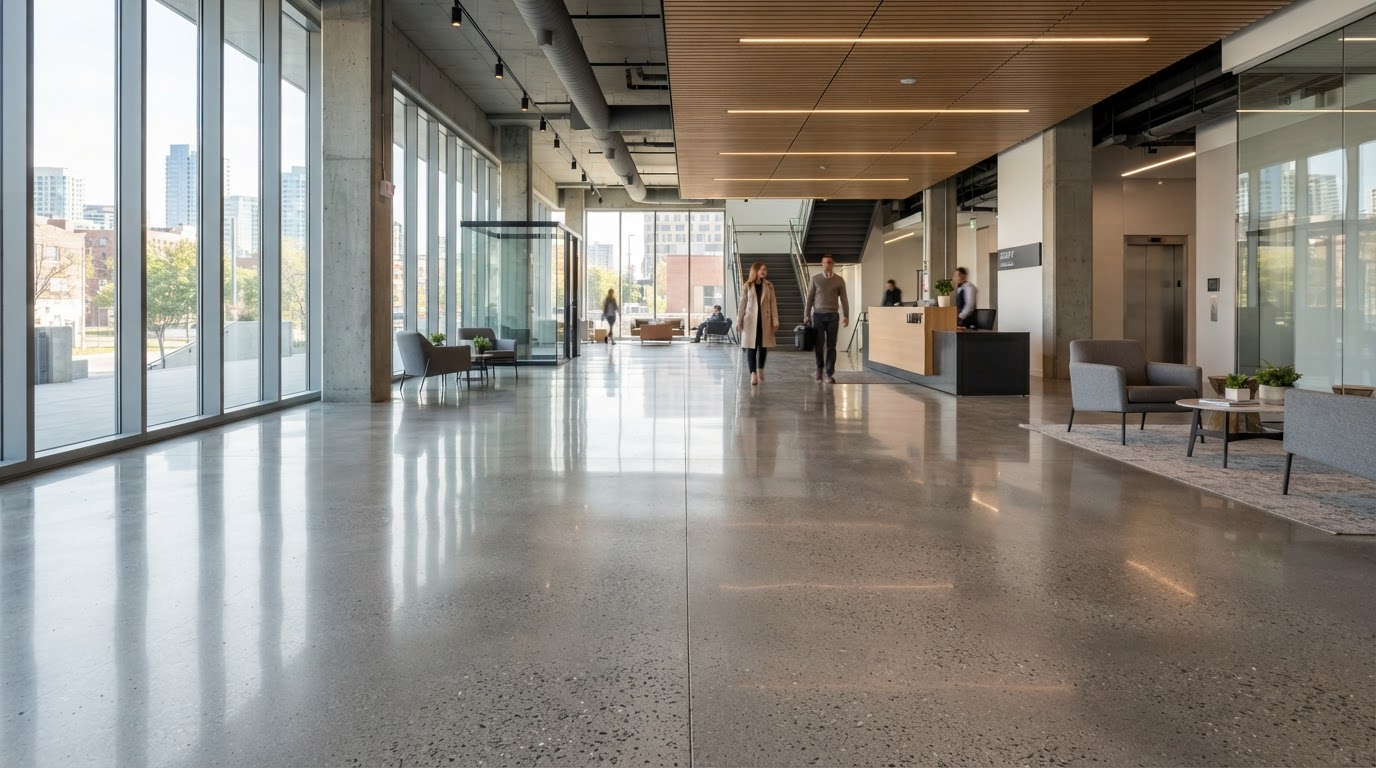
Polished concrete is produced by mechanically grinding and refining a suitable concrete surface through progressively finer abrasive steps until the intended finish is achieved. Gaithersburg Concrete finishes polished concrete floors for suitable commercial interiors, warehouses, retail and support spaces, and basements where the slab condition supports polishing across Gaithersburg, Maryland and surrounding communities. Polishing is a mechanical refinement of the concrete itself — not a coating — so the slab's condition, hardness, and history determine what the finished floor can look like. Every polished concrete project starts with a floor assessment to confirm the surface is suitable and to set realistic expectations for aggregate exposure, sheen, and the visibility of existing cracks or patches.
Request a Free Estimate
Tell us about your concrete project in Gaithersburg or nearby.
Polished Concrete Floors in Gaithersburg
Polished concrete is a mechanically refined floor surface. The concrete is ground with progressively finer abrasives until the intended level of refinement and sheen is reached, then treated with a densifier where applicable to the selected system and finished with a protective treatment where appropriate. The result is a hard, reflective surface that uses the concrete itself as the finished floor — there is no applied coating layer.
In Gaithersburg and across Montgomery County, polished concrete is most often considered for commercial interiors, warehouses, retail and support spaces, finished basements where the slab is suitable, workshops, utility and interior spaces, and offices with an exposed-concrete design aesthetic. Both existing slabs and newly installed interior floors can be candidates when their condition supports polishing.
Not every slab can be polished successfully. The finished appearance depends on the concrete's hardness, the aggregate in the mix, the surface condition, and the slab's history of repairs, coatings, or contamination. We assess the floor before recommending polishing and set expectations for what the process will and will not change.
Where Polished Concrete Works Well
Polished concrete is best suited to interior slabs that are structurally sound and reasonably flat. Open commercial floors, warehouse areas, finished basements, workspaces, showrooms where appropriate, utility areas, offices with exposed-concrete design, and industrial support spaces are common candidates.
Slab Condition Matters
Slab condition is the single biggest factor in whether polishing is the right finish. Surfaces that may limit a successful polish include:
- Deep cracks that telegraph through the finished surface
- Extensive patching or multiple repair areas with different hardness
- Previous coatings, sealers, or curing compounds that must be removed first
- Adhesives from prior floor coverings that affect the surface
- Surface contamination from oil, grease, or chemicals
- Major elevation changes or heavily damaged concrete
Existing repairs and aggregate exposure affect the final appearance. Polishing reveals the slab's history — patches, cracks, and variations in the concrete are part of the finished look rather than hidden by it. Where the slab is too damaged or inconsistent, a different approach such as a coating or a new slab may be more appropriate.
How Concrete Polishing Works
Concrete polishing is a staged mechanical process. The floor is assessed, prepared, then refined through progressively finer steps until the intended finish is reached.
- 1Floor assessment — evaluate the slab condition, hardness, coatings, and suitability for polishing.
- 2Removal of coatings and adhesives where required — strip old sealers, paint, or glue that would interfere with polishing.
- 3Initial grinding — open the surface with coarse abrasives to remove minor irregularities and begin refinement.
- 4Crack and joint assessment — review how existing cracks and joints will appear in the finished floor.
- 5Repair preparation where appropriate — treat cracks or spalls that can be addressed before polishing continues.
- 6Progressive refinement — move through finer abrasive steps to build the intended smoothness and sheen.
- 7Densification where applicable to the selected system — treat the surface to harden it and improve refinement.
- 8Finer polishing stages — refine the surface toward the selected sheen level.
- 9Cleaning — remove dust and residue between and after the polishing stages.
- 10Final protective treatment where appropriate — apply a guard or protective treatment suited to the polished surface.
We do not specify proprietary products or claim a fixed number of polishing passes. The number of steps and the abrasives used depend on the slab, the desired sheen, and the aggregate exposure selected.
Polish Levels, Aggregate Exposure & Appearance
Polished concrete appearance is defined by two main choices: the level of aggregate exposure and the sheen. Both depend on what the slab will allow.
Appearance Variables
- Low-sheen versus higher-sheen finishes, depending on the selected refinement level
- A cream finish where the surface allows, keeping the top paste intact for a soft, consistent look
- Salt-and-pepper exposure that lightly reveals the sand and fine aggregate near the surface
- Greater aggregate exposure that cuts deeper to reveal larger stone in the mix
- Natural color variation from the cement, aggregate, and any integral color in the slab
- Patches, cracks, and the slab's repair history, which remain visible in the finished floor
- Lighting reflection that changes with the sheen level and the room's light
Polished concrete does not make existing patchwork or cracks disappear automatically. The process refines the surface; it does not erase the slab's history. Where a uniform, flawless appearance is the priority, the slab condition has to support that result or a different finish may be the better choice.
How the Floor Finishes Differ
Polished concrete is a mechanically refined surface with no coating layer. Grind and seal combines mechanical grinding with an applied sealer or topcoat. Epoxy is a resinous coating bonded over prepared concrete. Each finish solves a different need, and the right choice depends on the slab, the use, and the desired look.
Compare polished concrete with our grind and seal floors, concrete staining and coloring, and epoxy floor coatings pages. For interior slab installation, see our basement and interior concrete floors page, and for large commercial interiors, our warehouse and industrial floor slabs page.
Maintenance & Existing Floor Considerations
A polished concrete floor is a working surface, and its performance depends on how it is maintained. Routine cleaning, managing abrasive dirt, addressing spills promptly, and considering traction where the floor sees traffic all affect how the finish holds up over time.
Maintenance Factors
- Routine cleaning suited to a polished surface to avoid abrasive wear
- Abrasive dirt and grit that can dull the finish if tracked in
- Spills addressed promptly to limit staining on the surface
- Traction considerations where the floor is walked or driven on
- Existing coatings or prior treatments that affect future refinishing
- Moisture conditions beneath or through the slab
- Cracks and joints that remain part of the finished surface
- Heavy traffic areas and how the floor is actually used
Polished floors are not maintenance-free. In Maryland, the main exposure for an interior polished floor is salt and water tracked in through entries, winter moisture, and commercial entry traffic. Keeping entries clean and addressing tracked-in deicing material helps protect the finish. Where the floor connects to exterior slabs, the transition areas see the most seasonal exposure.
For floors with significant deterioration or where the existing slab is unstable, polishing may not be the right path. See our concrete repair vs. replacement guide and our concrete thickness, base and reinforcement guide for the factors that drive slab condition before a finish is chosen.
Discuss Your Concrete Project
Have questions about scope, timing, or whether repair or replacement is the right call? We are happy to review your project and provide a clear, honest estimate.
Polished Concrete FAQs & Estimates
What is polished concrete?
Polished concrete is a mechanically refined floor surface. The concrete is ground with progressively finer abrasives until the intended sheen and aggregate exposure are reached, then treated with a densifier where applicable and finished with a protective treatment where appropriate. It is a refinement of the concrete itself, not an applied coating.
Can any concrete floor be polished?
No. Polishing depends on the slab's condition, hardness, surface contamination, coatings, and repair history. Floors with deep cracks, extensive patching, severe damage, or major elevation changes may not be good candidates. We assess the floor before recommending polishing and set realistic expectations for the finished appearance.
Can basement floors be polished?
Some basement floors can be polished when the slab is suitable, reasonably flat, and free of conditions that would interfere with polishing. Moisture, existing coatings, adhesives, and surface condition all affect whether a basement slab is a candidate. We evaluate the floor before recommending polishing for a basement.
Does polished concrete need sealer?
Polished concrete is typically finished with a protective treatment or guard suited to the polished surface rather than a film-forming sealer. The specific treatment depends on the selected system and the floor's use. We do not claim a universal product or a one-size-fits-all treatment for every polished floor.
Will polishing remove concrete cracks?
No. Polishing refines the surface but does not erase existing cracks, patches, or the slab's repair history. Cracks and patches remain visible in the finished floor. Where cracks are active or the slab is unstable, repair or a different approach may be more appropriate than polishing.
How shiny can polished concrete become?
The sheen level depends on how far the surface is refined, from a low-sheen matte finish to a higher-sheen reflective surface. The achievable sheen is limited by the slab's condition, hardness, and aggregate. We set expectations based on what the actual floor will support rather than promising a specific gloss level.
What affects polished concrete floor cost?
Cost depends on the floor condition, existing coatings or adhesives that must be removed, crack and repair preparation, square footage, the selected sheen and aggregate exposure level, and the number of refinement stages required. A floor that needs extensive preparation costs more than a clean, suitable slab. We provide project-specific estimates based on the actual floor.
Discuss a Polished Concrete Floor
If you have a suitable interior slab and want to explore polished concrete, Gaithersburg Concrete will assess the floor, set realistic expectations for sheen and appearance, and provide a clear estimate. Serving Gaithersburg and surrounding Montgomery County communities.
Related Concrete Services Near Gaithersburg
Basement & Interior Concrete Floor Installation
Basement and interior concrete floor installation and replacement for utility and work spaces.
Learn moreWarehouse & Industrial Concrete Floor Slabs
Warehouse and industrial concrete floor slabs planned around rack loads, forklift traffic, joint layout, and the finish a facility's operations require.
Learn moreGrind & Seal Concrete Floors
Grind and seal concrete floors that mechanically prepare and refine a surface, then apply a compatible sealer or protective finish over the prepared floor.
Learn moreEpoxy Garage & Commercial Floor Coatings
Epoxy floor coatings applied over properly prepared concrete for suitable residential garages, workshops, and commercial floors, with preparation and repair planned first.
Learn moreDiscuss a Polished Concrete Floor
If you have a suitable interior slab and want to explore polished concrete, Gaithersburg Concrete will assess the floor, set realistic expectations for sheen and appearance, and provide a clear estimate. Serving Gaithersburg and surrounding Montgomery County communities.
- Project-specific estimates — no obligation
- Residential and commercial concrete work
- Serving Gaithersburg and surrounding Montgomery County
Request a Free Estimate
Tell us about your concrete project in Gaithersburg or nearby.