Concrete Staining & Coloring in Gaithersburg, MD
Concrete can be colored through several methods depending on whether the slab is new or existing, interior or exterior, and whether the goal is a decorative patio, a colored basement floor, or a renewed interior surface. Gaithersburg Concrete applies concrete staining and coloring for suitable floors, patios, walkways, and decorative concrete surfaces across Gaithersburg, Maryland and surrounding communities. Staining and coloring are decorative surface treatments — not structural repairs — and the final result depends on the surface condition, the concrete's absorption, and the system used. Every project starts with a condition evaluation to confirm the surface is suitable and to set realistic expectations for color variation, since concrete staining often creates variation rather than a perfectly uniform painted appearance.
Request a Free Estimate
Tell us about your concrete project in Gaithersburg or nearby.
Concrete Staining & Coloring in Gaithersburg
Concrete staining and coloring are decorative treatments that add color and character to a suitable concrete surface. The method depends on whether the concrete is new or existing, interior or exterior, and what look is desired. Integral color is incorporated into fresh concrete where offered; topical or surface color is applied to the surface of an existing slab; and stains are reactive or non-reactive decorative treatments depending on the system.
In Gaithersburg and across Montgomery County, staining and coloring are considered for patios, basement floors, interior concrete floors, walkways, decorative entries, stamped concrete, resurfaced concrete, and commercial interiors. The right approach depends on the surface, the condition, and whether the concrete is being poured fresh or already exists.
Stain and color results depend heavily on surface condition and system type. We do not claim all coloring techniques are offered in every situation — the available options depend on the slab, the environment, and what the surface will support. We evaluate the concrete before recommending a staining or coloring approach.
Where Colored or Stained Concrete Can Be Used
Colored and stained concrete is used across a range of surfaces where a decorative finish is desired. Potential applications include patios, basement floors, interior concrete floors, walkways, decorative entries, stamped concrete, resurfaced concrete, and commercial interiors.
Existing Concrete Limitations
Existing concrete can carry conditions that limit or complicate staining. Surfaces may have:
- Patches and repair areas that absorb stain differently than the surrounding slab
- Curing compounds that block stain penetration and must be removed
- Oils, grease, or chemical contamination that affect color uptake
- Existing sealers that must be stripped before staining
- Adhesive residue from removed floor coverings
- Discoloration or uneven absorption that shows through the stain
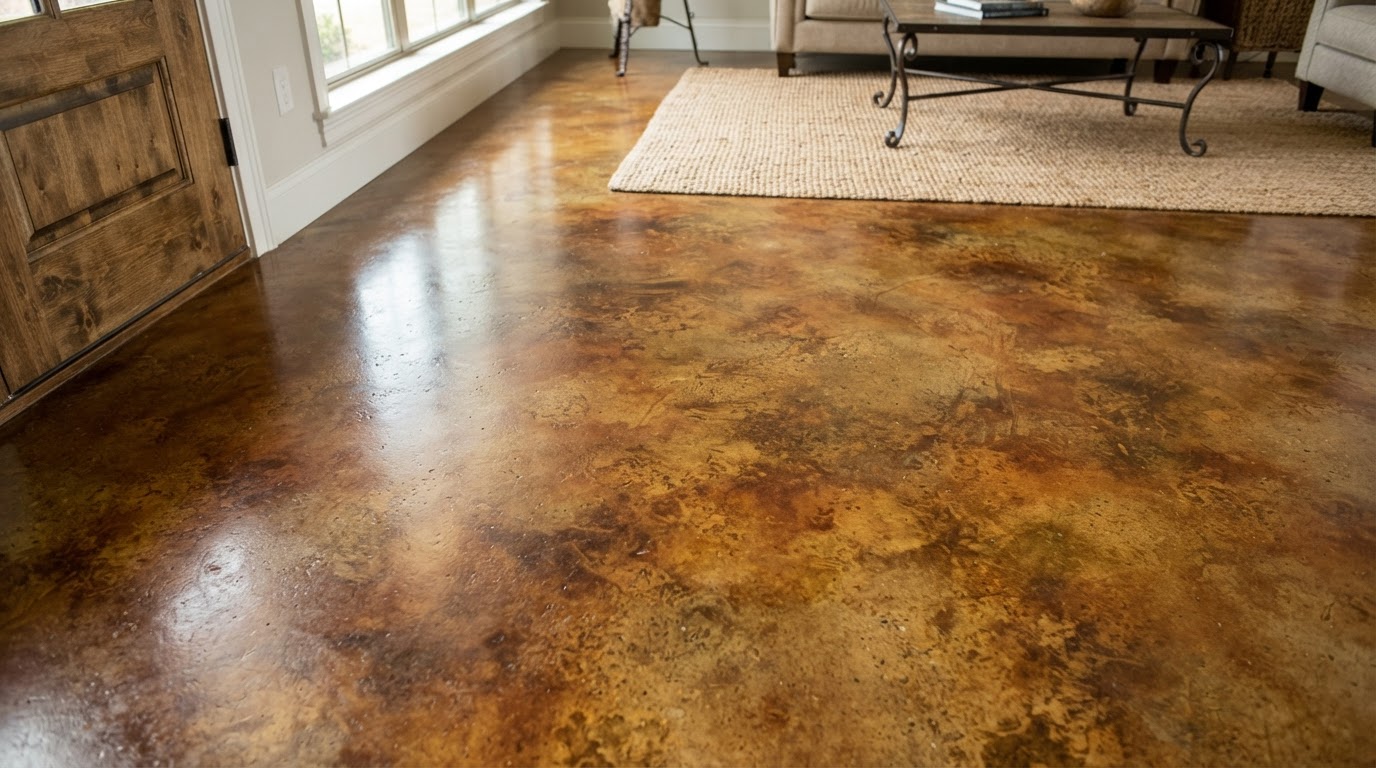
Because stain interacts with the concrete's chemistry and absorption, the final color is often mottled or varied rather than uniform. Where a perfectly consistent, painted appearance is the goal, staining may not be the right choice. We test and set expectations before applying stain across a full surface.
Concrete Staining & Coloring Process
A staining or coloring project follows a preparation and application sequence built around the surface condition and the selected system.
- 1Condition evaluation — assess the slab, existing coatings, contamination, and absorption.
- 2Cleaning — remove dirt, oil, and loose material that would interfere with color uptake.
- 3Surface preparation — profile the surface so the stain or color can take evenly.
- 4Removal of incompatible coatings where possible — strip sealers, curing compounds, or adhesives that block the stain.
- 5Testing and sample area where appropriate — apply stain to a small test area to confirm the color and absorption.
- 6Stain and color application — apply the selected stain or coloring system across the surface.
- 7Drying and reaction depending on system — allow reactive stains to develop their color.
- 8Cleaning and neutralization if the system requires it — stop the reaction and remove residue.
- 9Sealing and protection where appropriate — apply a sealer suited to the stained surface and its use.
We do not give product-specific chemical directions. The preparation, application, and cleanup depend on the stain system selected and the surface it is applied to.
Concrete Color & Finish Options
Concrete color and finish options span a range of looks, from subtle earth tones to more pronounced decorative effects. The achievable result is shaped by the concrete itself and the system used.
Color & Finish Variables
- Earth tones — warm browns, tans, and natural stone-inspired shades
- Gray tones — from light to darker charcoal effects depending on the slab
- Darker or lighter effects driven by the stain and the concrete's absorption
- Mottled, variegated appearance that reactive stains often produce
- More uniform color systems where the surface and system allow
- Decorative borders and accents that frame a field of color
- Stamped patterns combined with color for a textured, decorative surface
- Exposed aggregate combinations where color complements the stone reveal
- Interior decorative effects suited to basements and commercial floors
Concrete staining often creates variation rather than a perfectly uniform painted color. The concrete's absorption, age, and condition all influence how the stain develops. We do not promise exact color matching — stain interacts with the slab, and the result is part chemistry and part surface condition.
For decorative outdoor surfaces, see our stamped and decorative concrete and exposed aggregate pages, and our concrete patios page. For renewing a suitable existing surface, see our concrete resurfacing and concrete sealing pages, and for a mechanically refined interior finish, our polished concrete floors page.
Existing Concrete Condition & Maintenance
The performance of a stained or colored concrete surface depends on the condition it started from and how it is maintained. Previous sealers, oil, repairs, cracks, patching, and moisture all affect how the stain takes and how the color wears over time.
Condition & Maintenance Factors
- Previous sealers or coatings that must be removed before staining
- Oil and grease contamination that affects color uptake
- Repairs and patches that absorb stain differently than the surrounding slab
- Cracks that remain visible through the stain
- Moisture conditions that can affect the stain and the sealer
- UV exposure outdoors that can fade some color systems over time
- Freeze-thaw exposure on exterior stained surfaces in Maryland
- Resealing where applicable to protect the stained surface
- Cleaning practices suited to the stained and sealed finish
Outdoors, Maryland freeze-thaw cycles, UV exposure, and deicing materials can affect a stained surface over time, and resealing may be needed periodically depending on the system. Indoors, the main concerns are moisture, cleaning practices, and wear from use. Where the existing concrete is heavily damaged, staining may not be the right path — see our resurfacing and repair vs. replacement pages for alternatives.
Direct Answer: Can Old Concrete Be Stained?
Yes, some existing concrete can be stained or colored if the surface is suitable and properly prepared, but prior coatings, contamination, patchwork, and uneven absorption can affect the final appearance. We evaluate the slab before recommending staining for an existing surface.
Discuss Your Concrete Project
Have questions about scope, timing, or whether repair or replacement is the right call? We are happy to review your project and provide a clear, honest estimate.
Concrete Staining FAQs & Estimates
Can old concrete be stained?
Yes, some existing concrete can be stained if the surface is suitable and properly prepared. Prior coatings, sealers, curing compounds, oil contamination, patchwork, and uneven absorption can all affect how the stain takes and the final appearance. We evaluate the slab before recommending staining for an existing surface.
Can a concrete patio be stained?
Yes, a suitable concrete patio can be stained or colored when the surface is in good condition and properly prepared. Outdoor staining should account for UV exposure, freeze-thaw cycles, and the need for resealing over time. We assess the patio before recommending a staining approach.
Can basement concrete floors be colored?
Some basement floors can be colored or stained when the slab is suitable and moisture is manageable. Basement slabs often have moisture considerations and may carry adhesives or previous sealers that affect the result. We evaluate the floor before recommending a coloring system.
Will concrete stain hide cracks?
No. Stain adds color to the surface but does not hide existing cracks, patches, or the slab's repair history. Cracks remain visible and often absorb stain differently than the surrounding concrete, which can make them more apparent rather than less.
Can stained concrete be sealed?
Yes, stained concrete is typically sealed with a sealer suited to the stained surface and its use to protect the color and the concrete. The sealer choice depends on whether the surface is interior or exterior and how it will be used. We do not claim a single universal sealer for every stained floor.
Does stained concrete fade?
Exterior stained concrete can fade over time with UV exposure, and color systems vary in their lightfastness. Resealing periodically can help protect the color. Interior stained surfaces generally see less fading but can wear with traffic. We set expectations based on the system and the exposure.
What affects the cost of concrete staining?
Cost depends on the surface condition, existing coatings or contamination that must be removed, the square footage, the selected stain or color system, the number of applications, testing and sample areas, and the sealer. A surface that needs extensive preparation costs more than a clean, suitable slab. We provide project-specific estimates.
Discuss a Decorative Concrete Finish
If you want to add color and character to a suitable patio, basement, or interior floor, Gaithersburg Concrete will evaluate the surface, set realistic expectations for color variation, and provide a clear estimate. Serving Gaithersburg and surrounding Montgomery County communities.
Related Concrete Services Near Gaithersburg
Stamped & Decorative Concrete
Premium slate, cobblestone, stone, and wood-plank patterns combined with integral colors and protective sealants.
Learn moreConcrete Patio Installation & Replacement
Custom concrete backyard patios engineered for outdoor living, cookouts, and year-round family entertainment.
Learn moreExposed Aggregate Concrete
Decorative exposed aggregate concrete for patios, walkways, driveways, and outdoor living areas.
Learn moreConcrete Resurfacing & Concrete Overlays
Restorative polymer-modified micro-toppings and decorative cement overlays for structurally sound yet worn concrete.
Learn moreDiscuss a Decorative Concrete Finish
If you want to add color and character to a suitable patio, basement, or interior floor, Gaithersburg Concrete will evaluate the surface, set realistic expectations for color variation, and provide a clear estimate. Serving Gaithersburg and surrounding Montgomery County communities.
- Project-specific estimates — no obligation
- Residential and commercial concrete work
- Serving Gaithersburg and surrounding Montgomery County
Request a Free Estimate
Tell us about your concrete project in Gaithersburg or nearby.