Self-Leveling Concrete & Cementitious Underlayment in Gaithersburg, MD
Self-leveling cementitious underlayment is a flowable cement-based material used over a properly prepared substrate to improve surface flatness or create a suitable surface for subsequent flooring systems. Gaithersburg Concrete installs self-leveling underlayment for suitable basements, renovations, commercial interiors, residential interiors, flooring transitions, and uneven but stable slabs across Gaithersburg, Maryland and surrounding communities. This page is about cementitious underlayment for interior flatness — not structural concrete, and not slab lifting. Self-leveling material is not structural concrete, it does not fix foundation settlement, and it is distinct from our concrete leveling page, which raises a settled slab as a structural unit. Every underlayment project starts with a substrate assessment and moisture review, because the material only performs over a stable, properly prepared substrate.
Request a Free Estimate
Tell us about your concrete project in Gaithersburg or nearby.
Self-Leveling Floor Underlayment in Gaithersburg
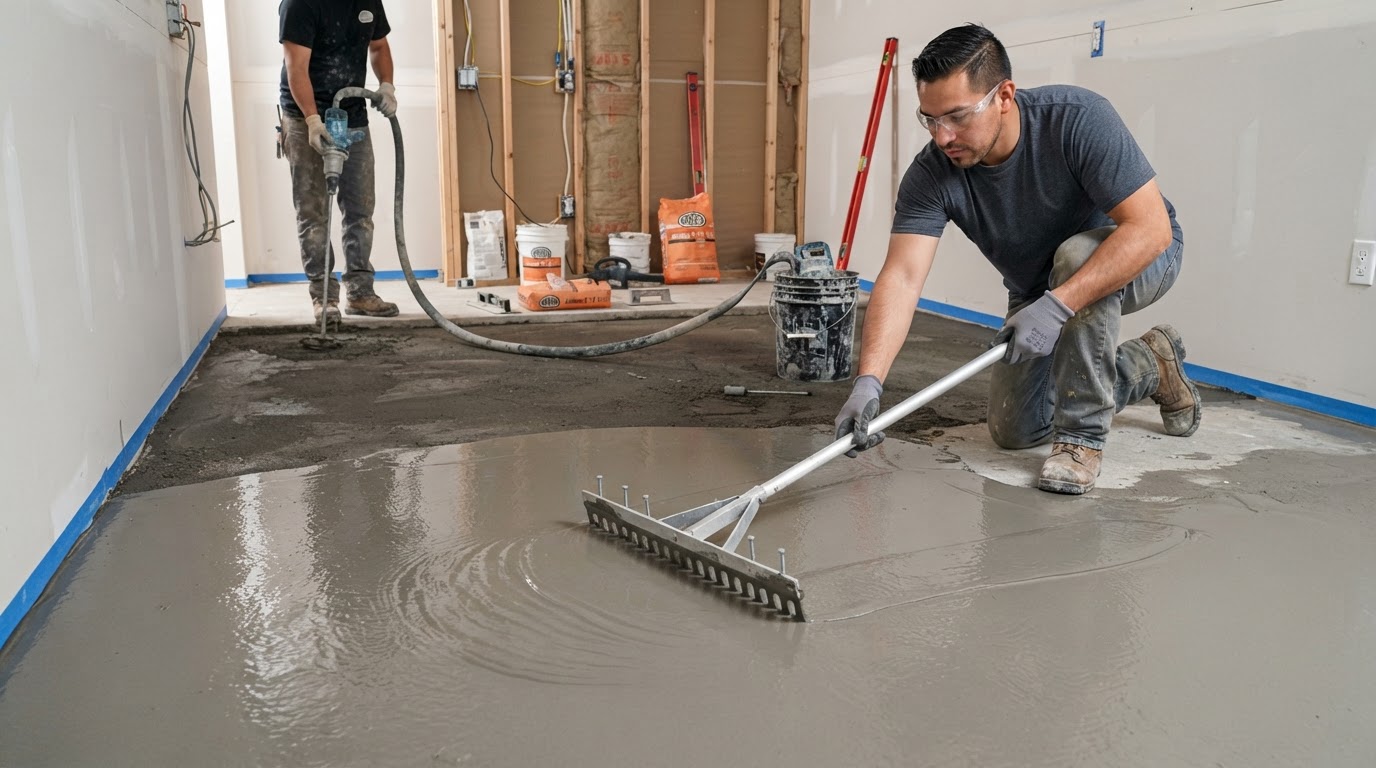
Self-leveling cementitious underlayment is a flowable cement-based material used over a properly prepared substrate to improve surface flatness or create a suitable surface for subsequent flooring systems. It is poured or pumped and spread to a relatively uniform thickness, then allowed to flow and level before it sets.
In Gaithersburg and across Montgomery County, self-leveling underlayment is used in basements, renovations, commercial interiors, residential interiors, flooring transitions, and over uneven but stable slabs where the goal is a flatter surface for a finished floor — tile, resilient flooring, coatings, carpet, or other finished floors where relevant.
We do not imply that self-leveling material is structural concrete, and we do not call every cementitious underlayment concrete. The accurate wording is self-leveling cementitious underlayment or self-leveling floor underlayment where appropriate. It improves flatness over a suitable substrate; it does not carry structural loads and it does not correct foundation settlement.
When Self-Leveling Underlayment Is Used
Self-leveling underlayment is used to address surface irregularities, small elevation differences, low areas, and the floor preparation needed before a finished flooring system. It is common in renovation projects and in transitions between surfaces where a flatter substrate is required for the final floor.
What Self-Leveling Underlayment Is Not Intended to Solve
Self-leveling underlayment is not a solution for:
- Slab settlement caused by failed subgrade or base
- Structural movement or foundation issues
- Major cracking or structural slab failure
- Severe moisture problems beneath or through the slab
- A slab that needs to be raised as a structural unit
Where the slab has settled structurally, the appropriate service is concrete leveling or replacement — not underlayment. Where moisture is unresolved, no cementitious material will perform reliably over the slab. We assess the substrate before recommending underlayment and tell you plainly when a different service is the better fit.
Self-Leveling Underlayment Installation Process
A dependable underlayment installation follows the substrate's condition. The floor is assessed, prepared, primed, and then the flowable material is mixed, placed, and gauged to the intended thickness for the selected system.
- 1Substrate assessment — evaluate the concrete condition, flatness, and existing materials.
- 2Moisture review — check for vapor or moisture conditions that could affect the underlayment or the finished floor.
- 3Removal of coatings and contaminants — strip incompatible sealers, adhesives, or contamination where required.
- 4Mechanical preparation where required — profile the substrate so the underlayment bonds.
- 5Crack and joint review — assess how existing cracks and joints will be treated.
- 6Primer according to the selected system — apply the primer the product requires for adhesion.
- 7Perimeter and transition preparation — address edges, transitions, and containment for the flowable material.
- 8Mixing — prepare the underlayment to the selected system's requirements.
- 9Placement — pour or pump the material over the prepared substrate.
- 10Spreading and gauging — spread and gauge the material to the intended uniform thickness.
- 11Curing and drying — allow the underlayment to cure and dry according to the system before the finished floor is installed.
- 12Preparation for the final floor system — confirm readiness for tile, resilient flooring, coatings, carpet, or other finished floors where relevant.
We do not provide DIY mix ratios. The mixing, placement, primer, and cure requirements depend on the selected product system and the substrate conditions.
Thickness, Substrate & Finished Flooring Considerations
Application thickness depends on the selected product system and the floor conditions. We do not invent universal thickness ranges — the right thickness is the one the selected system specifies for the substrate, the variation being corrected, and the finished floor that will follow.
Substrate & Finished-Floor Variables
- A concrete substrate, which is the primary focus of this service
- Wood substrates only where the actual selected system permits and where the work is offered
- Tile preparation where the finished floor will be tile
- Resilient flooring preparation where the finished floor will be vinyl or similar
- Coatings where the finished surface will be a coating rather than a floor covering
- Carpet or other finished floors where relevant to the project
- The finished floor system's own flatness requirements, which drive the underlayment specification
The underlayment is selected to match the finished floor that will follow. A floor that will receive tile has different flatness requirements than one that will receive a coating or carpet. We focus mainly on concrete substrates and select the system to suit the substrate and the finished floor.
For the surface preparation that often precedes underlayment, see our concrete floor grinding and surface preparation page, and for interior slab installation, our basement and interior concrete floors page. For slab repairs before underlayment, see our concrete repair page.
Self-Leveling Underlayment vs. Concrete Slab Leveling
Self-leveling underlayment and concrete slab leveling solve different problems, and the distinction matters. Underlayment improves surface flatness on a suitable, stable interior substrate. Slab leveling — lifting — raises a settled slab as a structural unit. They are not interchangeable, and using one where the other is needed leads to a floor that does not perform.
Underlayment vs. Slab Leveling vs. Replacement
| Problem | Self-Leveling Underlayment | Slab Leveling | Replacement |
|---|---|---|---|
| Surface irregularity | Often suitable — improves flatness over a stable slab | Not the right tool | More than needed |
| Settled slab | Not structural — will not raise the slab | Often suitable — lifts the slab as a unit | Suitable where the slab has failed |
| Broken slab | Not suitable | Not suitable | The appropriate path |
| Flooring prep | Often suitable for a flatter substrate | Not the right tool | More than needed unless the slab is replaced |
| Major elevation change | Not suitable for structural movement | Suitable where the slab can be lifted | Suitable where the slab must be rebuilt |
Where the problem is a settled or broken slab, the right service is concrete leveling or replacement — not underlayment. We assess the substrate and refer you to the appropriate service rather than applying underlayment over a slab that needs structural work.
For raising a settled slab, see our concrete leveling page and our leveling vs. replacement guide, and for the broader repair decision, our repair vs. replacement guide.
Discuss Your Concrete Project
Have questions about scope, timing, or whether repair or replacement is the right call? We are happy to review your project and provide a clear, honest estimate.
Self-Leveling Floor FAQs & Estimates
What is self-leveling concrete?
Self-leveling concrete — more accurately, self-leveling cementitious underlayment — is a flowable cement-based material used over a properly prepared interior substrate to improve surface flatness or create a suitable surface for a finished flooring system. It is not structural concrete, and it does not carry structural loads.
Is self-leveling underlayment structural?
No. Self-leveling underlayment is a cementitious floor-finishing material, not structural concrete. It improves flatness over a stable substrate; it does not carry structural loads, it does not replace a structural slab, and it does not correct foundation settlement or structural movement.
Can it fix a sunken slab?
No. Self-leveling underlayment will not raise a slab that has settled structurally. For a settled slab, the appropriate service is concrete leveling or replacement — underlayment improves surface flatness over a stable substrate, it does not lift a slab as a structural unit.
Can self-leveling material go over old concrete?
Yes, some existing concrete can receive self-leveling underlayment when the substrate is stable, properly prepared, and compatible with the selected system. Prior coatings, contamination, moisture, and the substrate's condition all affect suitability. We assess the floor before recommending underlayment.
Does the floor need grinding first?
Often yes. The substrate typically requires mechanical preparation so the underlayment bonds to the concrete rather than to contamination or a weak surface layer, and the selected system's primer is applied over a prepared surface. The preparation depends on the substrate and the product system.
Can it be used in basements?
Yes, self-leveling underlayment can be used in basements where the substrate is stable, properly prepared, and moisture is manageable. Moisture conditions are particularly important in basements, and we review them before recommending underlayment for a basement floor.
What affects self-leveling floor cost?
Cost depends on the floor area, the depth and variation being corrected, the preparation required, the primer, the substrate condition, and the finished-floor requirements. A floor that needs extensive preparation or a deeper underlayment costs more than a clean, lightly varied slab. We provide project-specific estimates based on the actual floor.
Request an Interior Floor Evaluation
If you need a flatter interior surface for a finished floor, Gaithersburg Concrete will assess the substrate, check moisture, confirm the underlayment is suitable, and provide a clear estimate. Serving Gaithersburg and surrounding Montgomery County communities.
Related Concrete Services Near Gaithersburg
Basement & Interior Concrete Floor Installation
Basement and interior concrete floor installation and replacement for utility and work spaces.
Learn moreConcrete Floor Grinding & Surface Preparation
Mechanical concrete floor grinding and surface preparation that removes coatings, adhesives, contaminants and irregularities to create a suitable profile for coatings, sealers, overlays or repairs.
Learn moreConcrete Repair & Crack Repair
Targeted structural crack filling, spalling remediation, and damaged section patching to extend concrete longevity.
Learn moreConcrete Leveling, Lifting & Mudjacking
Cost-effective lifting of sunken, uneven concrete slabs to eliminate trip hazards and restore positive drainage.
Learn moreRequest an Interior Floor Evaluation
If you need a flatter interior surface for a finished floor, Gaithersburg Concrete will assess the substrate, check moisture, confirm the underlayment is suitable, and provide a clear estimate. Serving Gaithersburg and surrounding Montgomery County communities.
- Project-specific estimates — no obligation
- Residential and commercial concrete work
- Serving Gaithersburg and surrounding Montgomery County
Request a Free Estimate
Tell us about your concrete project in Gaithersburg or nearby.