Industrial Equipment Foundations & Machine Pads in Gaithersburg, MD
An industrial equipment foundation is a concrete base built to carry a specific piece of machinery — its static weight, its dynamic loads, its anchoring, and the alignment the equipment needs to run. Gaithersburg Concrete installs equipment foundations and machine pads for commercial and industrial facilities across Gaithersburg, Maryland and surrounding communities, planning the slab, reinforcement, anchors, and elevation around the equipment specifications and the project requirements. A machine foundation is a distinct application from a general equipment pad — it may need to support static loads, dynamic loads, or equipment anchorage depending on the machine, and the dimensions, reinforcement, and anchor layout follow the manufacturer specifications and approved plans. This page focuses on the concrete foundation itself; we do not claim to provide structural engineering services or to install the machinery.
Request a Free Estimate
Tell us about your concrete project in Gaithersburg or nearby.
Industrial Equipment Foundations in Gaithersburg
An industrial equipment foundation is the concrete base a piece of machinery sits on and anchors to. In Gaithersburg and across Montgomery County, these foundations serve machinery, mechanical equipment, production equipment, pumps and compressors where applicable, large generators, processing and support equipment, and the commercial installations that need a dedicated, load-specific base.
What makes an equipment foundation different from a general pad is the load. A machine foundation may need to support static loads — the weight of the equipment — dynamic loads from moving parts, vibration, or the anchorage the equipment requires to stay aligned. The slab, the reinforcement, the anchors, and the elevation are all planned around those requirements.
This page focuses on the concrete equipment foundation and machine pad. We do not claim to provide structural engineering services, and we do not invent machine-foundation dimensions, reinforcement schedules, vibration-isolation systems, anchor-bolt layouts, concrete strength specifications, or structural design requirements. Equipment foundations must follow applicable manufacturer specifications, plans, engineered requirements, or project specifications where required.
When Equipment Needs a Dedicated Concrete Foundation
Not every machine needs its own foundation. Whether a piece of equipment needs a dedicated base depends on the loads, the anchoring, the alignment requirements, and what the surrounding floor can carry.
When a Dedicated Foundation Comes Up
- Concentrated loads that exceed what the surrounding slab is built to carry
- Vibration from rotating or reciprocating equipment that needs isolation or support
- Anchoring requirements that need embedded bolts or a specific base
- Equipment alignment that needs a precise, stable elevation
- Elevated bases that raise equipment above the surrounding floor
- Separation from the surrounding slab where the equipment needs isolation
- Replacement equipment that needs a new or different base
- Facility upgrades that add machinery to an existing space
- Equipment relocation that requires a new foundation at the new location
We do not state that every machine needs an isolated foundation. Lighter equipment can often sit on a suitable existing slab, while heavier, concentrated, dynamic, or specially anchored equipment may need a dedicated base. The decision depends on the equipment loads, the manufacturer requirements, and the condition and design of the surrounding floor.
Equipment Foundation Construction Process
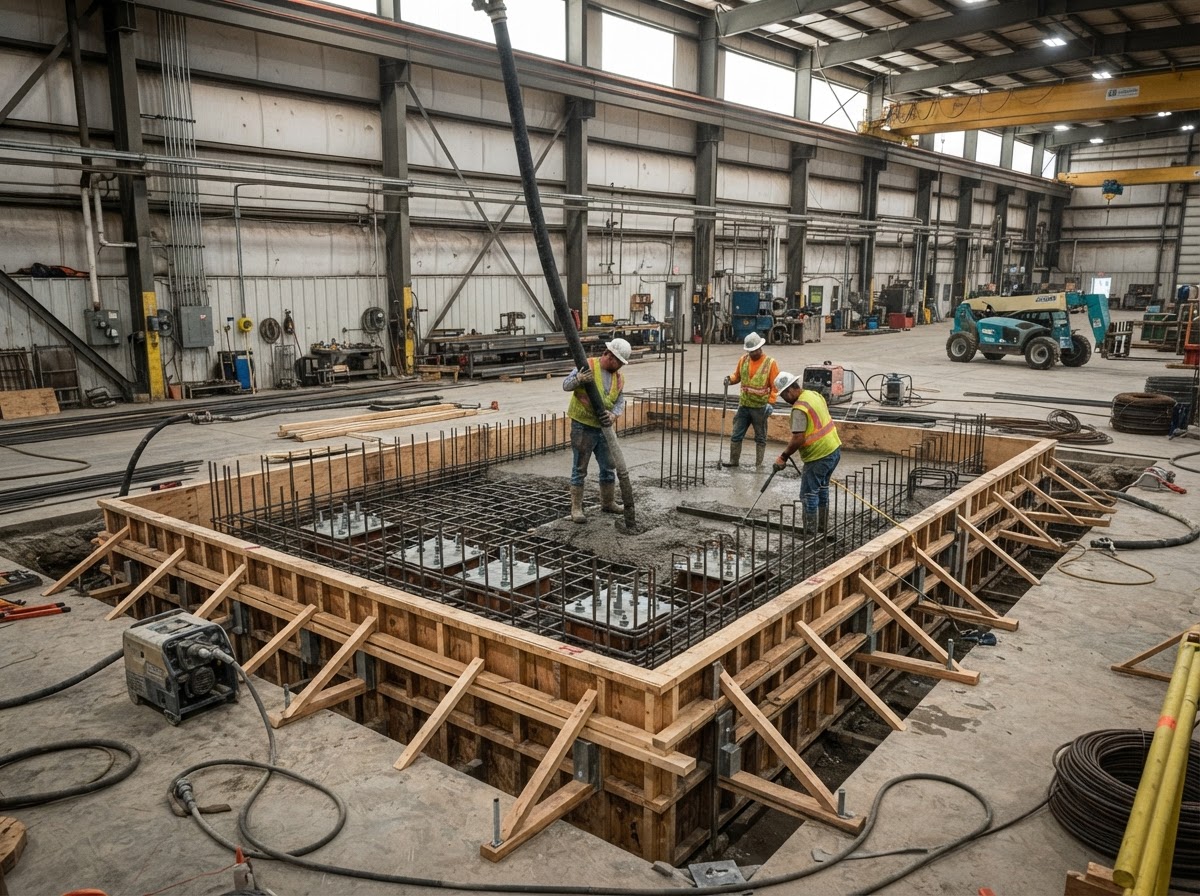
An equipment foundation is built around the equipment specifications and the approved layout. The anchor coordination, the reinforcement, and the elevation are all set before the pour because they are hard to change after the concrete is in place.
- 1Equipment specifications — confirm the loads, anchors, and requirements.
- 2Approved layout — set the foundation location and elevation to the plans.
- 3Load and design information — align the slab with the equipment requirements.
- 4Existing slab removal where necessary — cut and remove floor where a base goes in.
- 5Excavation — dig to the depth the foundation requires.
- 6Subgrade and base preparation — compact the soil and prepare the base.
- 7Forms — set forms to the foundation dimensions and elevation.
- 8Reinforcement per plans and specifications — add the reinforcement the design calls for.
- 9Anchor and embedded-item coordination — set bolts, plates, and embeds to layout.
- 10Concrete placement — pour and consolidate the concrete into the foundation.
- 11Finishing — finish the surface to the elevation and tolerance the equipment needs.
- 12Curing — allow the concrete to gain strength before equipment is set.
- 13Equipment-installation coordination — hand off to the equipment installation sequence.
We do not claim to install the machinery itself unless that is part of an agreed scope. The foundation is built to the equipment specifications and the approved plans, and the equipment installation is coordinated with the foundation schedule so the concrete is ready when the machinery arrives.
Equipment Loads, Anchors, Vibration & Foundation Planning
An equipment foundation is designed around the loads it carries and the anchoring the equipment requires. Static loads, dynamic loads, vibration, and the anchor layout all shape the slab, and the elevation and clearance are set so the equipment can be installed and serviced.
Design Factors
- Static loads from the weight of the equipment
- Dynamic loads from moving parts and operating forces
- Vibration and how it is managed or isolated where specified
- Anchor bolts and the embeds the equipment requires
- Embedded items set to the equipment layout
- Equipment footprint and the slab size that supports it
- Required elevation and the base height the equipment needs
- Maintenance clearance around the equipment
- Surrounding floor and how the foundation ties into it
- Slab isolation where the equipment needs to be separated from the floor
- Manufacturer requirements that drive the design
For general slabs and pads, see our concrete slabs, pads and foundations page; for smaller exterior equipment pads, our generator and equipment pads page. Large interior floor slabs are covered in our warehouse and industrial floors page, existing concrete removal in our concrete demolition page, and structural footings in our concrete footings and addition foundations page.
Existing Slab vs. Dedicated Machine Foundation
Whether equipment can sit on an existing slab or needs a dedicated foundation depends on the equipment loads, the manufacturer requirements, and the condition and design of the surrounding floor. An existing slab may be sufficient only when its condition and design suit the specific equipment requirements — otherwise a dedicated base is the safer path.
A dedicated foundation may be needed for heavier, concentrated, dynamic, or specially anchored equipment based on the project requirements. Where the loads exceed what the floor was built to carry, or the equipment needs isolation, vibration support, or a specific anchor layout, a dedicated base is built to those specifications rather than relying on the surrounding slab.
Replacement and Retrofit Challenges
Installing a foundation in an existing facility means cutting the existing floor, excavating, working around utilities, managing access, phasing the work around operations, planning for operational downtime, and curing the concrete before the equipment can be set. Each of those is a constraint on the schedule, and we plan them during the scope review. For Maryland facilities, the exterior-to-interior transitions, the loading-door exposure, and any connected exterior slabs are where weather and deicing matter most — the foundation itself is sheltered, but the entries and connected slabs see freeze-thaw and tracked-in salts.
Discuss Your Concrete Project
Have questions about scope, timing, or whether repair or replacement is the right call? We are happy to review your project and provide a clear, honest estimate.
Industrial Equipment Foundation FAQs & Estimates
Does industrial equipment need a separate concrete foundation?
It depends on the equipment loads, the manufacturer requirements, and the condition and design of the surrounding floor. Lighter equipment can often sit on a suitable existing slab, while heavier, concentrated, dynamic, or specially anchored equipment may need a dedicated foundation. We do not state that every machine needs an isolated base — the decision follows the equipment specifications and the project requirements.
How thick should a machine foundation be?
Machine foundation thickness depends on the equipment loads, the manufacturer specifications, the project plans, and any structural requirements. A foundation for heavy rotating equipment is built differently than one for a static compressor. We do not give a universal dimension — the thickness follows the equipment requirements and the approved design rather than a generic number.
Who determines equipment-foundation dimensions?
Equipment-foundation dimensions are determined by the equipment manufacturer specifications, the project plans, and any structural or engineered requirements for the specific installation. The loads, the anchoring, the vibration, and the elevation all feed the design. We build the foundation to those requirements rather than inventing dimensions, and project-specific engineering or approved structural plans may determine the final dimensions, reinforcement, and concrete specifications.
Can a machine pad be installed inside an existing warehouse?
Yes. A machine pad or foundation can be installed inside an existing facility by cutting the existing floor, excavating, pouring the new base, and curing the concrete before the equipment is set. The work is phased around the facility's operations, and the access, utilities, and downtime are planned during the scope review. We coordinate the installation so the floor around the work can keep operating where possible.
Can an existing slab support heavy equipment?
An existing slab can support heavy equipment only when its condition and design suit the specific equipment loads and anchoring requirements. Where the loads exceed what the slab was built to carry, or the equipment needs isolation or a specific anchor layout, a dedicated foundation is the safer path. We assess the slab and the equipment requirements before recommending a slab-only or dedicated-foundation approach.
How are anchor bolts coordinated?
Anchor bolts and embedded items are coordinated by setting them to the equipment layout before the pour, using templates or a layout that matches the manufacturer specifications. The bolts, plates, and embeds are placed so the equipment can be anchored and aligned to the foundation as installed. We do not invent anchor-bolt patterns — the layout follows the equipment requirements and the approved plans.
What affects industrial equipment foundation cost?
Cost depends on the foundation dimensions, the slab thickness, the reinforcement, the anchor and embed requirements, the excavation, the existing floor removal, the concrete volume, the site access, the phasing around operations, and the equipment loads the foundation must carry. A larger, deeper base under heavy equipment with tight access costs more than a simple pad in an open area. We provide project-specific estimates based on the actual equipment and site.
Discuss an Industrial Equipment Foundation Project
If you need a concrete equipment foundation or machine pad installed, Gaithersburg Concrete will review the equipment loads, anchoring, layout, and site access, then provide a clear estimate. Serving Gaithersburg and surrounding Montgomery County communities.
Related Concrete Services Near Gaithersburg
Concrete Slabs, Pads & Foundations
Heavy-duty concrete pads for backyard sheds, hot tubs, HVAC units, backup generators, and residential accessory structures.
Learn moreConcrete Generator Pads & Equipment Pads
Concrete generator and equipment pads for standby generators, HVAC units, and mechanical equipment.
Learn moreWarehouse & Industrial Concrete Floor Slabs
Warehouse and industrial concrete floor slabs planned around rack loads, forklift traffic, joint layout, and the finish a facility's operations require.
Learn moreConcrete Demolition, Removal & Replacement
Concrete demolition, removal, haul-away, and replacement for driveways, patios, walkways, and slabs.
Learn moreConcrete Footings & Addition Foundations
Concrete footings and foundation concrete for home additions, porches, and small structures.
Learn moreDiscuss an Industrial Equipment Foundation Project
If you need a concrete equipment foundation or machine pad installed, Gaithersburg Concrete will review the equipment loads, anchoring, layout, and site access, then provide a clear estimate. Serving Gaithersburg and surrounding Montgomery County communities.
- Project-specific estimates — no obligation
- Residential and commercial concrete work
- Serving Gaithersburg and surrounding Montgomery County
Request a Free Estimate
Tell us about your concrete project in Gaithersburg or nearby.