Concrete Bollards & Protective Equipment Bases in Gaithersburg, MD
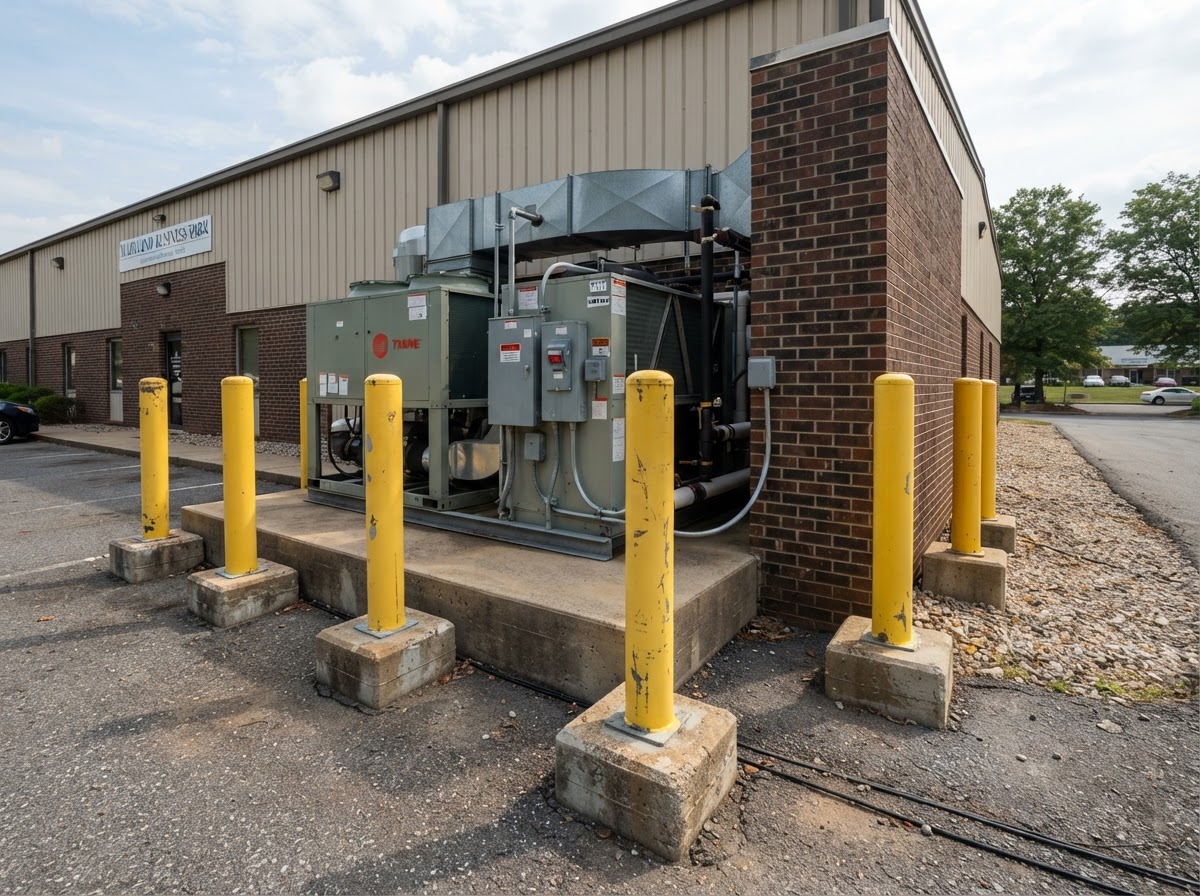
A concrete bollard is a protective post set in a concrete base to keep equipment, utility gear, building corners, and service areas from being struck by vehicles. Gaithersburg Concrete installs concrete bollard bases and protective equipment foundations for commercial properties across Gaithersburg, Maryland and surrounding communities, planning the post, footing, and surrounding slab around what the bollard is there to protect. Bollard design depends on the intended use — a post protecting a generator from a wayward car is planned differently than one guarding a building corner or a dumpster enclosure — so the size, depth, and placement are matched to the application. This page focuses on standard protective concrete bollard and base applications rather than crash-rated or security-certified systems, which are a separate and specialized scope.
Request a Free Estimate
Tell us about your concrete project in Gaithersburg or nearby.
Concrete Bollards in Gaithersburg
A concrete bollard is a protective post — usually steel pipe filled with concrete or set in a concrete base — installed to keep vehicles from hitting something they should not. In Gaithersburg and across Montgomery County, bollards protect equipment, utilities, building corners, dumpster areas, loading areas, storefronts, service areas, and the vehicle-control points on commercial properties.
What a bollard is built for shapes how it is built. A post that stops a slow parking-lot car from reaching a generator is one thing; a post guarding a building corner where delivery trucks back in is another. The post size, the footing depth, the placement, and the surrounding slab all reflect what the bollard is protecting and the vehicle exposure it faces.
This page focuses on standard protective concrete bollard and base applications — the posts and footings used for general equipment and property protection. We do not claim to provide crash-rated, anti-ram, or security-certified bollard systems unless that specialized scope is verified and agreed.
Where Protective Bollards & Concrete Bases Are Used
Bollards are used wherever a piece of equipment, a structure, or a pedestrian area needs a physical barrier against vehicle contact. The application drives the design.
Common Protective Bollard Locations
- Generators and standby equipment that sit within vehicle reach
- Utility equipment and meters near driveways or parking areas
- HVAC and mechanical equipment adjacent to traffic or loading areas
- Loading docks where trailers need guidance or protection
- Dumpster enclosures where the container or walls need protection
- Warehouse doors and overhead doors within vehicle paths
- Service areas where equipment or structures sit near traffic
- Parking structures and the columns, walls, and equipment within them
- Commercial entrances where storefronts or entries face traffic
Not all bollards are vehicle-impact rated, and not every bollard needs to be. A bollard used for general equipment or property protection is a physical deterrent against accidental contact, not a security-rated barrier. Where a true crash-rated or anti-ram system is required, that is a specialized application with its own engineering and testing — we do not imply that standard protective bollards meet those ratings.
Concrete Bollard Base Installation Process
A bollard base is a small but load-specific concrete pour. The post, the footing, and the surrounding slab are planned together so the bollard sits where it does the most good and the concrete around it holds up.
- 1Site layout — mark the post locations and the clearance they need.
- 2Equipment-clearance review — confirm the bollards protect without blocking access.
- 3Post location — set the posts to the layout and the protection needed.
- 4Excavation — dig the footing to the depth the application requires.
- 5Footing and base preparation — prepare the hole for the concrete pour.
- 6Bollard and post placement — set the pipe or post in the footing.
- 7Reinforcement where required — add reinforcement suited to the post and load.
- 8Concrete placement — pour the concrete around the post and into the footing.
- 9Alignment — check that the post is plumb and placed correctly.
- 10Curing — allow the concrete to gain strength before the post sees load.
- 11Surrounding slab repair — patch or replace the concrete around the base where needed.
We do not prescribe one universal depth or diameter. The footing depth and post size for a bollard depend on the intended protection, the vehicle exposure, the equipment clearance, and the site conditions — a post guarding a generator in a low-traffic area is not built the same as one protecting a loading dock corner.
Bollard Spacing, Equipment Clearance & Foundation Considerations
A bollard is only useful if it is in the right place, at the right height, with the right clearance around the equipment it protects. The layout balances protection against access — a bollard that blocks the vehicle but also blocks the technician defeats the purpose.
Design Factors
- Intended protection and what the bollard is there to stop
- Equipment access and the clearance technicians need to service the gear
- Vehicle paths and where a car or truck could reach the equipment
- Maintenance clearance around the protected equipment
- Post size and the footing the post needs
- Footing and base requirements for the post and the loads
- Adjacent concrete and how the base ties into the surrounding slab
- Drainage around the base so water does not collect at the post
- Door and gate operation where bollards sit near entries
- Accessibility paths where bollards meet pedestrian routes
For broader commercial flatwork, see our commercial concrete and flatwork page; for refuse-area protection, our concrete dumpster pads page. Equipment pads are covered in our generator and equipment pads page, machinery bases in our industrial equipment foundations page, and the surrounding pavement in our concrete parking lots page.
Protective Concrete for Commercial Properties
Bollards on a Gaithersburg commercial property sit outside through every Maryland season, which means freeze-thaw cycles around the exterior bases, repeated vehicle exposure, service vehicles, and corrosion exposure all act on the post and the concrete. Snowplows, salt, and impact damage are recurring factors for bollards in traffic areas.
The concrete around a bollard base can crack or spall from impact, freeze-thaw exposure, or settlement of the footing, and the surrounding slab can break down where the base ties into it. Keeping the base drained and the surrounding concrete sound helps the bollard do its job over time.
Are All Concrete Bollards Crash-Rated?
No. Bollards used for general equipment and property protection should not automatically be described as crash-rated or security-certified. Standard protective bollards are physical deterrents against accidental vehicle contact, not engineered anti-ram barriers. Specialized security applications — those that must stop a vehicle at a defined speed — require engineered or tested systems with their own design, and we do not represent standard bollards as meeting those ratings.
Discuss Your Concrete Project
Have questions about scope, timing, or whether repair or replacement is the right call? We are happy to review your project and provide a clear, honest estimate.
Concrete Bollard FAQs & Estimates
What are concrete bollards used for?
Concrete bollards are used to protect equipment, utilities, building corners, dumpster areas, loading areas, and service areas from accidental vehicle contact. A bollard is a physical barrier — usually a steel post set in or filled with concrete — placed between the vehicle path and the thing it protects. The post, footing, and placement are planned around what the bollard is protecting and the vehicle exposure it faces.
Do bollards need concrete footings?
Most protective bollards are set in a concrete footing or base so the post stays in place and can resist the contact it is there to stop. The footing depth and size depend on the post, the intended protection, and the site conditions. A bollard that needs to resist more than a slow parking-lot contact may need a larger footing or a different system than a standard protective post.
How deep should a bollard be installed?
Bollard depth depends on the post size, the intended protection, the vehicle exposure, and the site conditions. A post guarding equipment in a low-traffic area is not set the same as one protecting a loading dock corner where trucks back in. We do not give a universal depth — the footing is planned around the actual application rather than a generic dimension.
Can bollards protect HVAC or generator equipment?
Yes. Bollards are commonly used to protect HVAC equipment, generators, utility meters, and other mechanical gear that sits within reach of vehicles. The posts are placed to block the vehicle path while leaving the clearance technicians need to service the equipment. The layout balances protection against access so the bollard does its job without blocking maintenance.
Can damaged bollards be replaced?
Yes. A damaged bollard — a bent post, a cracked base, or concrete that has spalled around the footing — can be removed and replaced, with the old post pulled, the footing reprepared, and a new post set and poured. Where the surrounding slab was damaged by the impact, that concrete is repaired or replaced as part of the work. We assess the post and the base before recommending repair or replacement.
Are all bollards crash-rated?
No. Bollards used for general equipment and property protection are physical deterrents against accidental contact, not crash-rated or security-certified anti-ram barriers. Specialized security applications that must stop a vehicle at a defined speed require engineered or tested systems with their own design. We do not represent standard protective bollards as meeting those ratings.
What affects concrete bollard installation cost?
Cost depends on the number of bollards, the post size, the footing depth, the reinforcement, the excavation, the surrounding slab repair, the site access, and any equipment-clearance coordination. A few posts in an open area cost less than a row of bollards that require slab demolition and tight access. We provide project-specific estimates based on the actual posts and site.
Discuss a Concrete Bollard or Equipment Protection Project
If you need protective bollards installed or damaged posts replaced, Gaithersburg Concrete will review the equipment, vehicle exposure, clearance, and footing requirements, then provide a clear estimate. Serving Gaithersburg and surrounding Montgomery County communities.
Related Concrete Services Near Gaithersburg
Commercial Concrete & Concrete Flatwork
High-spec flatwork for commercial centers, retail plazas, loading docks, dumpster pads, and multi-family communities.
Learn moreConcrete Dumpster Pads
Concrete dumpster pads and trash enclosure slabs built for service-truck traffic, container loads, and outdoor exposure on commercial properties.
Learn moreConcrete Generator Pads & Equipment Pads
Concrete generator and equipment pads for standby generators, HVAC units, and mechanical equipment.
Learn moreIndustrial Equipment Foundations & Machine Pads
Concrete equipment foundations and machine pads built to equipment loads, anchoring, vibration, and manufacturer specifications for industrial facilities.
Learn moreConcrete Parking Lot Installation & Replacement
Concrete parking lot installation and replacement for commercial properties, private parking areas, and heavy-duty paved surfaces with drainage and joint planning.
Learn moreDiscuss a Concrete Bollard or Equipment Protection Project
If you need protective bollards installed or damaged posts replaced, Gaithersburg Concrete will review the equipment, vehicle exposure, clearance, and footing requirements, then provide a clear estimate. Serving Gaithersburg and surrounding Montgomery County communities.
- Project-specific estimates — no obligation
- Residential and commercial concrete work
- Serving Gaithersburg and surrounding Montgomery County
Request a Free Estimate
Tell us about your concrete project in Gaithersburg or nearby.