Vertical Concrete Wall Repair in Gaithersburg, MD
Vertical concrete wall repair addresses the cracks, spalling, honeycombing, broken corners, and surface deterioration that develop on vertical concrete surfaces over time. Gaithersburg Concrete repairs damaged vertical concrete across Gaithersburg, Maryland and surrounding communities, evaluating each defect before recommending a fix — because wall cracking can have different causes, from harmless shrinkage to movement that signals a deeper problem. This page focuses specifically on vertical concrete surfaces, while our broad concrete repair page covers general concrete damage and our retaining wall repair page handles retaining-wall system problems. We do not diagnose structural failure remotely, and repairing the concrete surface does not automatically correct underlying drainage, foundation movement, or structural issues.
Request a Free Estimate
Tell us about your concrete project in Gaithersburg or nearby.
Concrete Wall Repair in Gaithersburg
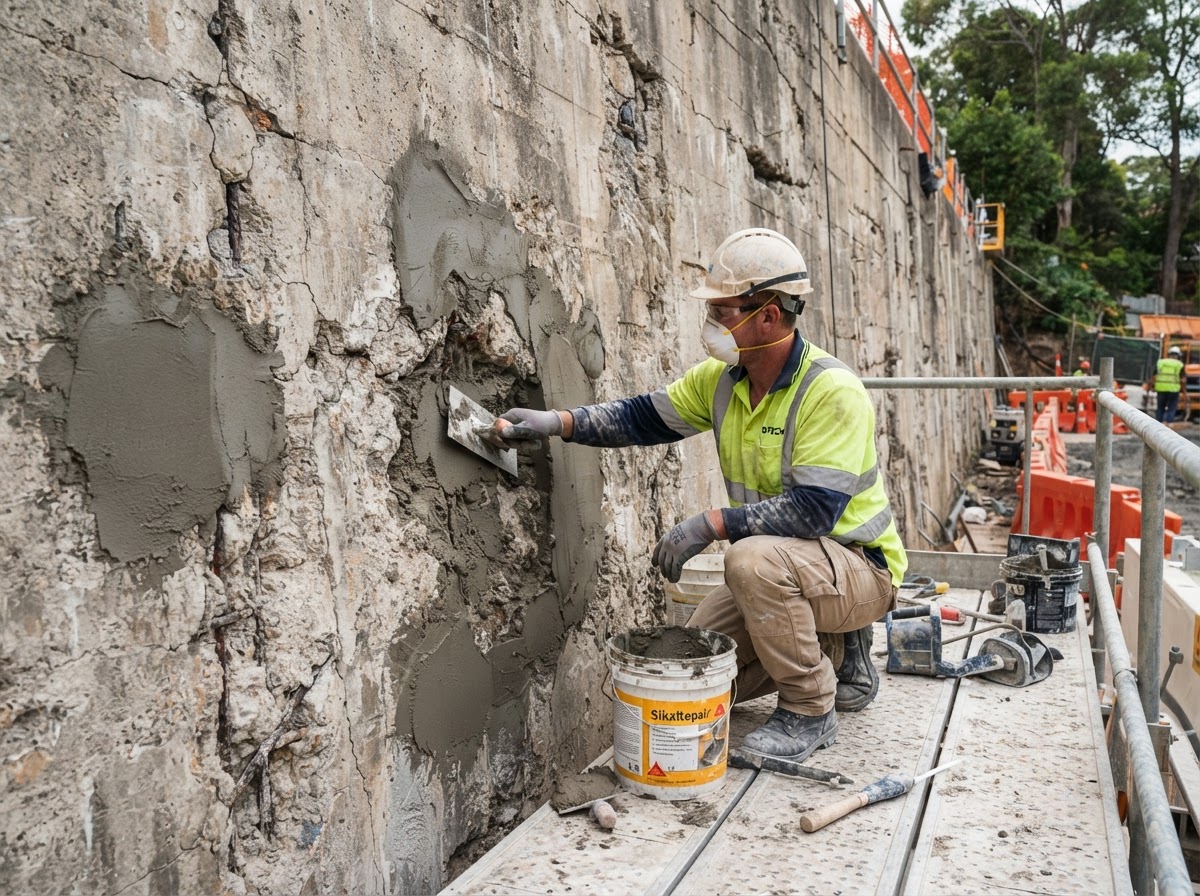
Vertical concrete wall repair is the targeted treatment of damage on upright concrete surfaces — cracks running up a wall face, spalling where the surface breaks away, honeycombing from poor consolidation during the original pour, broken corners, exposed aggregate, and general surface deterioration. Unlike a horizontal slab, a vertical wall shows damage differently, and the repair approach has to account for gravity, material adhesion on a vertical face, and whether the wall is still moving.
In Gaithersburg, vertical concrete walls appear on foundations, retaining walls, basement walls, site walls, and structural elements, and each develops its own patterns of wear. A hairline shrinkage crack on a stable wall is a different concern than a wide, active crack on a wall that is still shifting. Wall cracking can have different causes, and the right repair depends on which cause is at work.
This page focuses specifically on vertical concrete surfaces. Our broad concrete repair page covers general concrete damage, and our retaining wall repair page handles retaining-wall system problems — leaning, bulging, drainage failure, and full wall replacement. Here the focus is the wall face itself: the cracks, spalling, and surface deterioration that can often be repaired without rebuilding the wall.
Common Problems With Vertical Concrete
Vertical concrete develops a recognizable set of defects, and identifying the type helps determine whether a surface repair will hold or whether the wall has a deeper problem.
Defects We Evaluate
- Shrinkage cracks — narrow cracks that often form as concrete cures
- Water-related deterioration — spalling and surface breakdown from moisture
- Spalling where the surface layer breaks away from the wall
- Exposed reinforcement where concrete has broken away from steel
- Impact damage — broken corners and chipped edges
- Failed previous patches that did not bond or match the wall
- Surface delamination where a thin layer separates from the wall
- Leakage paths where water moves through cracks or joints
- Settlement or movement indications — cracks that signal the wall is shifting
We do not diagnose structural failure remotely. A crack's width, pattern, and whether it is still moving determine whether it is a surface repair or a sign of something deeper. Where a wall shows movement, drainage failure, or structural distress, the underlying issue has to be addressed — a surface patch over an active problem will not hold.
How Vertical Concrete Repairs Are Completed
A durable vertical repair depends on preparation as much as on the repair material. Loose material, contamination, and moisture all affect how well a repair bonds to a vertical face, where gravity works against the material.
- 1Evaluating the damaged area — assess the defect type, extent, and cause.
- 2Determining whether movement appears active — check whether the wall is still shifting.
- 3Removing loose material — chip away unsound concrete down to solid material.
- 4Cleaning — remove dust, debris, and contamination from the repair area.
- 5Preparing repair edges — profile the edges so the repair material bonds.
- 6Treating exposed reinforcement where appropriate — address steel where concrete has broken away.
- 7Choosing repair material — select a material suited to the defect and the vertical surface.
- 8Patching — place repair material in spalled, broken, or deteriorated areas.
- 9Crack repair — fill or seal cracks appropriate to their width and type.
- 10Finishing — match the surrounding texture as closely as practical.
- 11Curing — allow the repair to gain strength before the area returns to use.
We do not state that one repair material works for every wall. The repair material is chosen based on the defect type, the wall surface, and whether the repair needs to be structural or cosmetic — a shrinkage crack, a spalled area, and an active movement crack each call for a different approach.
Wall Crack Repair vs. Surface Patching vs. Replacement
Different defects call for different responses, and understanding the distinction helps set realistic expectations for what a repair can and cannot do.
When Each Approach Fits
- Crack repair — addresses localized cracks, from hairline shrinkage to wider structural cracks, on a stable wall.
- Patch repair — fills spalled or broken areas where the surface has come away but the wall beneath is sound.
- Surface repair — renews localized deterioration without rebuilding the wall, suited to stable concrete with surface damage.
- Replacement or rebuilding — for severely failed sections where the wall has lost structural integrity or is still moving.
A surface repair does not correct an underlying problem. If a crack is active because the wall is still settling, or if spalling is driven by ongoing moisture behind the wall, the repair will not hold until the cause is addressed. We are straightforward about when a repair will work and when the wall needs a deeper solution.
For broad concrete repair, see our concrete repair and crack repair page; for surface deterioration specifically, our spalling and crumbling concrete repair services. Retaining wall system problems are handled in our retaining wall repair and replacement page, and new wall construction is covered in our poured concrete walls services.
Moisture & Freeze-Thaw Effects on Concrete Walls
Vertical concrete walls in Gaithersburg face moisture penetration, freeze-thaw cycles, and the water that moves behind or through them. Moisture that enters a crack or sits against a wall face expands as it freezes, stressing the surface and driving spalling and deterioration over Maryland winters.
Water behind a wall is a particular concern. A wall that retains soil or sits below grade deals with groundwater and drainage, and failed drainage lets water pressure build against the wall — the same pressure that causes leaning and bulging also drives the surface deterioration a repair is meant to fix. Drainage has to be addressed alongside the surface repair where it is part of the problem.
Exposed reinforcement and deicing exposure near entries add to the wear. Where concrete has broken away from steel, the reinforcement can corrode and expand, pushing more concrete off the wall in a cycle that a surface patch alone will not stop. Deicing salts carried near entry walls contribute to surface scaling over time.
Repairing the concrete surface does not automatically correct underlying drainage, foundation movement, or structural issues. A surface repair addresses the visible damage; where the cause is still active, the wall will continue to deteriorate until the cause is addressed. We are clear about what a repair will and will not fix before we start.
Discuss Your Concrete Project
Have questions about scope, timing, or whether repair or replacement is the right call? We are happy to review your project and provide a clear, honest estimate.
Concrete Wall Repair FAQs & Evaluations
Can vertical concrete cracks be repaired?
Yes, many vertical concrete cracks can be repaired, especially shrinkage cracks and stable surface cracks on a wall that is not moving. Wider or active cracks that signal ongoing movement may need a deeper solution than a surface repair. We evaluate whether the crack is stable before recommending a repair approach.
What causes concrete walls to spall?
Concrete walls spall when the surface layer breaks away from the wall beneath, usually driven by freeze-thaw cycles, moisture penetration, deicing salts, or corrosion of reinforcement near the surface. Identifying the cause matters — a surface patch over spalling driven by ongoing moisture will not hold until the moisture source is addressed.
Can exposed reinforcement be repaired?
Exposed reinforcement can often be treated as part of a concrete repair where the steel has been uncovered by spalling or breakage. The loose concrete is removed, the reinforcement is treated where appropriate, and repair material is placed back over the steel. The repair addresses the visible damage; where corrosion is driven by ongoing moisture, the cause also needs attention.
Can a deteriorated concrete wall be resurfaced?
A deteriorated wall can sometimes be resurfaced if the damage is surface-level and the concrete beneath is structurally sound. Where deterioration extends into the wall or the wall is still moving, resurfacing alone will not hold and replacement or a deeper repair may be needed. We assess the wall's condition before recommending resurfacing.
When should part of a concrete wall be replaced?
A section of a concrete wall may need replacement when it has severely failed — broken away, lost structural integrity, or deteriorated beyond what a repair can restore. Where damage is localized and the surrounding wall is sound, a section can sometimes be rebuilt; where the wall has moved or failed broadly, full replacement may be the better call.
Are wall cracks always structural?
No. Hairline shrinkage cracks are common as concrete cures and are often harmless, while wider, active, or patterned cracks can signal movement or structural distress. The width, pattern, and whether the crack is still growing determine whether it is a surface concern or a structural one. We do not diagnose structural failure remotely — we assess the crack in context before recommending a scope.
What affects concrete wall repair cost?
Cost depends on the extent and depth of the damage, the repair approach — crack repair, patching, resurfacing, or section replacement — the wall area involved, whether drainage or reinforcement treatment is needed, and site access. Localized surface repairs cost less than rebuilding a failed section. We provide project-specific estimates based on the actual wall and condition.
Request a Concrete Wall Repair Evaluation
If a vertical concrete wall on your Gaithersburg property is cracking, spalling, or deteriorating, Gaithersburg Concrete will assess the damage, determine whether it is stable, and recommend a repair or replacement scope with a clear estimate. Serving Gaithersburg and surrounding Montgomery County communities.
Related Concrete Services Near Gaithersburg
Concrete Repair & Crack Repair
Targeted structural crack filling, spalling remediation, and damaged section patching to extend concrete longevity.
Learn moreSpalling, Flaking & Crumbling Concrete Repair
Repair of spalling, flaking, scaling, and crumbling concrete surfaces on driveways, patios, and walkways.
Learn moreConcrete Retaining Wall Repair & Replacement
Repair and replacement of cracked, leaning, bulging, or deteriorated concrete retaining walls, with drainage and stability evaluated before a scope is recommended.
Learn morePoured Concrete Walls
Cast-in-place poured concrete walls for foundations, landscape applications, and structural wall elements built to approved plans and specifications.
Learn moreRequest a Concrete Wall Repair Evaluation
If a vertical concrete wall on your Gaithersburg property is cracking, spalling, or deteriorating, Gaithersburg Concrete will assess the damage, determine whether it is stable, and recommend a repair or replacement scope with a clear estimate. Serving Gaithersburg and surrounding Montgomery County communities.
- Project-specific estimates — no obligation
- Residential and commercial concrete work
- Serving Gaithersburg and surrounding Montgomery County
Request a Free Estimate
Tell us about your concrete project in Gaithersburg or nearby.