Stamped Concrete vs. Pavers for Maryland Patios
Stamped concrete and pavers can both create decorative outdoor surfaces, but they differ in installation, joint patterns, repair methods, maintenance, and design flexibility. The better option depends on desired appearance, site conditions, maintenance preferences, and project priorities — not on one being universally superior. This guide from Gaithersburg Concrete compares the two for Maryland patios in a balanced, factual way, covering how each system is built, how it behaves in freeze-thaw and wet conditions, and how repairs and maintenance differ. The goal is to help homeowners in Gaithersburg and surrounding Montgomery County weigh which surface fits their patio, then move to the right service — whether that is a stamped concrete patio, a decorative concrete pour, or a related outdoor living slab.
Request a Free Estimate
Tell us about your concrete project in Gaithersburg or nearby.
Stamped Concrete or Pavers: Which Is Better for a Patio?
Stamped concrete and pavers can both create decorative outdoor surfaces, but they differ in installation, joint patterns, repair methods, maintenance, and design flexibility. The better option depends on desired appearance, site conditions, maintenance preferences, and project priorities. Neither is universally better — stamped concrete is a single poured slab with a patterned, sealed surface, while pavers are individual units set on a bedding and base with joints between them.
Stamped Concrete Tends to Appeal When
- A monolithic, patterned slab is desired
- A stone-, brick-, or wood-inspired look is wanted without individual units
- Integration with adjacent concrete — steps, walkways, outdoor kitchen pads — matters
- Fewer joint gaps across the surface are preferred
Pavers Tend to Appeal When
- Individual unit patterns and joints are desired
- Resetting or replacing individual units is preferred over slab repair
- A modular look with joint sand is wanted
- Project priorities align with a paver system
This guide does not take sides. Both can produce attractive, durable patios when installed on a properly prepared base with good drainage. The aim is a balanced comparison so you can weigh which system fits your patio, your maintenance tolerance, and your appearance goals.
What Is Stamped Concrete?
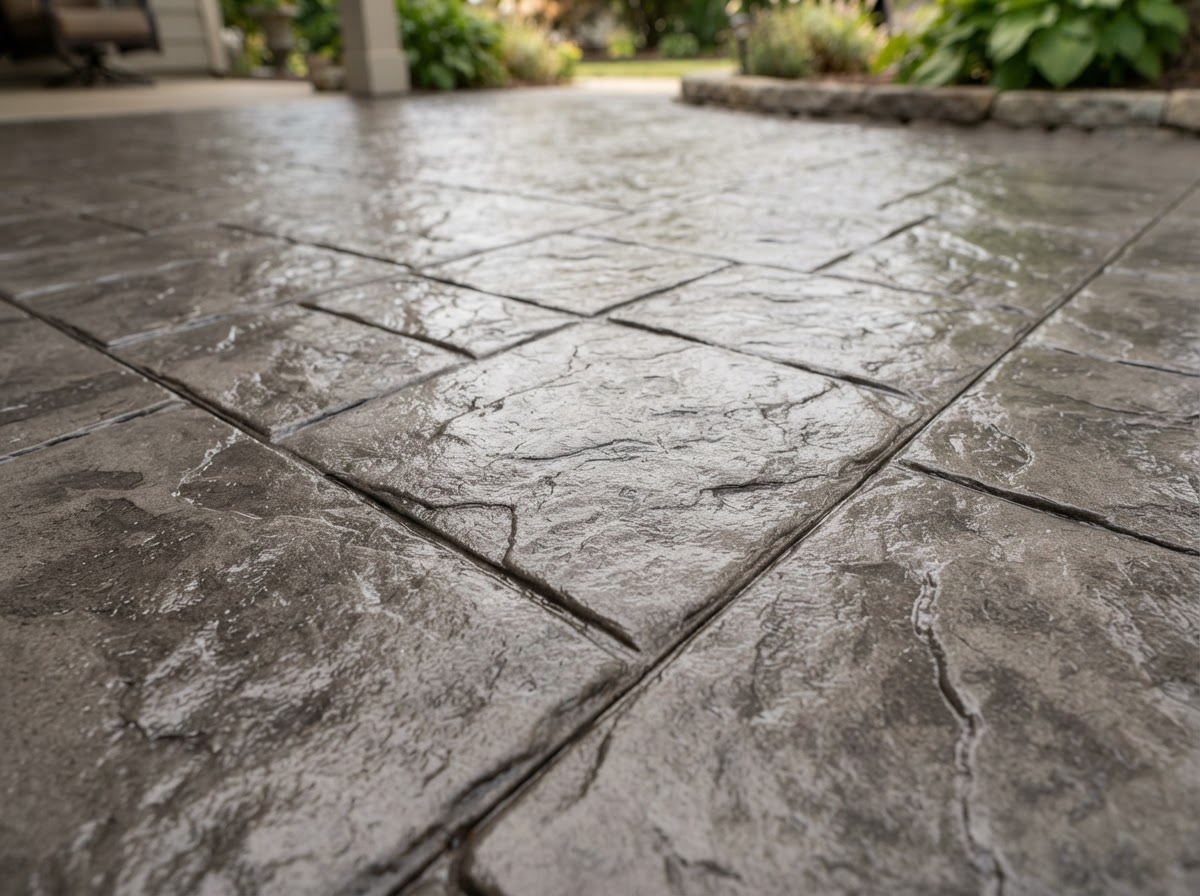
Stamped concrete is a single, monolithic concrete slab that is patterned and often colored while still wet to mimic stone, brick, slate, wood, or other textures. It is poured as one continuous surface and then sealed, so the pattern runs across a solid slab rather than between individual units.
Stamped Concrete Characteristics
- Monolithic slab — one continuous pour
- Stamped patterns — stone, brick, slate, wood, and similar textures
- Integral or surface-applied color
- Decorative borders and banding
- Joint planning to control where the slab cracks
- Sealing to protect the pattern and color
- Stone- or brick-inspired appearance without individual units
How Pavers Differ
- Individual units — separate pieces rather than one slab
- Bedding and base beneath the units
- Joints between units filled with sand or polymeric material
- Patterns created by unit layout
- Replaceable individual units
Gaithersburg Concrete installs stamped and decorative concrete — not pavers. For the stamped concrete side of this comparison, see our stamped and decorative concrete page.
Stamped Concrete vs. Paver Comparison
The table below compares the two systems across the factors that usually drive a patio decision. It is a general comparison — actual performance depends on base preparation, drainage, installation quality, and maintenance — but it shows where each system tends to fit.
| Factor | Stamped Concrete | Pavers |
|---|---|---|
| Appearance | Continuous patterned slab | Individual units with joint patterns |
| Pattern options | Stone, brick, slate, wood textures | Unit shapes and layout patterns |
| Joints | Control joints in the slab | Joints between every unit |
| Settlement behavior | Slab can crack if base settles | Units can shift or settle individually |
| Repair approach | Crack repair, patching, slab replacement | Resetting or replacing units |
| Maintenance | Sealing, crack and joint care | Joint sand, weed control, resetting |
| Weeds and joint maintenance | Fewer joints — less weed intrusion | More joints — ongoing joint upkeep |
| Sealing | Recommended to protect pattern and color | Optional; joint sand stabilization |
| Drainage | Slope built into the slab | Drainage through joints and base |
| Installation format | Poured and stamped on site | Units set on bedding and base |
| Color variation | Integral and surface color options | Unit color selection |
| Integration with concrete steps and walkways | Seamless — same material family | Transition between systems |
No single system wins every row. Stamped concrete offers a continuous, sealed surface with fewer joints; pavers offer individual units that can be reset or replaced. The right call depends on which set of trade-offs fits your patio and maintenance preferences.
Repair & Maintenance Differences
Both surfaces need maintenance, but the kind of maintenance differs because the systems are built differently. Stamped concrete is a single slab; pavers are individual units. That difference shapes how each surface is repaired and maintained.
Stamped Concrete Upkeep
- Crack and joint maintenance — keeping control joints sealed
- Resealing where appropriate to protect the pattern and color
- Color and finish maintenance over time
- Slab repair limitations — a cracked stamped slab is repaired as a slab, not unit by unit
Paver Upkeep
- Joint sand replenishment and stabilization
- Individual unit movement — resetting settled or shifted units
- Weed and joint maintenance between units
- Individual unit replacement for damaged pieces
The maintenance rhythm is different, not necessarily heavier or lighter in every case. Stamped concrete tends to need sealing and occasional crack or joint attention; pavers tend to need joint sand, weed control, and resetting of units that have moved. Either surface lasts longer when the base and drainage are right and problems are addressed early.
Maryland Weather & Patio Surfaces
Maryland weather affects both stamped concrete and pavers, and base preparation plus drainage matter as much as the surface choice. Freeze-thaw cycles, water, snow, deicing materials, and ground movement all stress a patio regardless of which system is installed.
- Freeze-thaw cycles stress both monolithic slabs and individual units
- Water and snow wear either surface
- Deicing materials can affect concrete sealing and paver joints
- Drainage and base condition matter for both systems
- Ground movement can crack a stamped slab or shift paver units
- Shaded, moist areas can hold water on either surface
- Surface traction differs — sealed stamped concrete versus jointed pavers
Neither material always performs better in Maryland. A well-built stamped concrete patio on a properly prepared base with good drainage can perform well; so can a well-built paver patio. The failures that show up in either system usually trace back to base preparation, drainage, or maintenance — not to the surface being wrong for the climate.
How to Choose Between Stamped Concrete & Pavers
Base Your Choice On
- The desired look — continuous pattern versus individual units
- Joint pattern preference — fewer control joints versus unit joints
- Maintenance tolerance — sealing versus joint sand and resetting
- Repair preference — slab repair versus unit replacement
- Surrounding materials — integration with concrete steps, walkways, or slabs
- Patio shape and layout complexity
- Drainage and slope requirements
- Connections to steps, walkways, or outdoor structures
- Outdoor kitchen or hot tub plans that need a supporting slab
For the concrete side of the decision, see our concrete patios, stamped concrete, and exposed aggregate pages, plus our patio cost guide. For slabs supporting outdoor features, see our outdoor kitchen pads and hot tub pads.
Discuss Your Concrete Project
Have questions about scope, timing, or whether repair or replacement is the right call? We are happy to review your project and provide a clear, honest estimate.
Stamped Concrete vs. Paver FAQs & Estimates
Is stamped concrete cheaper than pavers?
It can be, but a reliable comparison depends on the specific project — patio size, site access, base preparation, finish complexity, and layout. Stamped concrete is a single poured slab, while pavers involve individual units, bedding, and base work. We do not claim an exact cost comparison without current, project-specific data; the right way to compare is to review total scope for your patio.
Does stamped concrete crack more than pavers?
Stamped concrete is a monolithic slab, so when it cracks it does so across the slab along control joints or elsewhere; pavers crack as individual units and can shift at the joints. Neither is immune to cracking — both depend on base preparation, drainage, and installation quality. Stamped concrete uses control joints to manage where cracks occur.
Which requires more maintenance?
Different maintenance, not necessarily more. Stamped concrete tends to need sealing and occasional crack or joint attention; pavers tend to need joint sand replenishment, weed control, and resetting of units that have moved. Either surface lasts longer when the base and drainage are right and problems are addressed early.
Can stamped concrete look like natural stone?
Yes. Stamped concrete is patterned and often colored to mimic stone, brick, slate, wood, and similar textures. With the right pattern, color, and sealing, it can closely resemble natural stone while remaining a single poured slab.
Are pavers better for drainage?
Pavers drain through the joints between units and the base beneath them, while stamped concrete drains across the sloped slab surface. Each handles drainage differently. Neither is universally better for drainage — what matters is that the base, slope, and drainage plan suit the site, regardless of which surface is chosen.
Can stamped concrete be repaired?
Yes. Cracks, joints, and surface wear on a stamped slab can be repaired, and sealing can renew the appearance. Because it is a single slab, repairs are made on the slab rather than by replacing individual units. Severe damage may require partial or full slab replacement.
Which works better around an outdoor kitchen?
Both can work, but stamped concrete integrates seamlessly with the concrete slabs that support outdoor kitchens, grills, and adjacent walkways or steps. If a supporting pad is needed under a grill island or counter, a concrete slab is part of that scope. See our outdoor kitchen pads page for the slab side of an outdoor kitchen project.
How do I get a stamped concrete patio estimate?
Call (240) 690-6035 or request a free estimate through our contact page. We review the patio dimensions, access, drainage, and finish preferences and provide a project-specific stamped concrete patio estimate.
Discuss a Decorative Concrete Patio
Considering a stamped concrete patio in Gaithersburg or surrounding Montgomery County? Gaithersburg Concrete will review your site, drainage, and finish preferences and provide a clear, project-specific estimate. Call (240) 690-6035 or request a free estimate.
Keep Learning About Concrete in Gaithersburg
Concrete Patio Cost Guide for Gaithersburg, MD
What affects concrete patio cost in Gaithersburg — size, excavation, access, finish, decorative options and existing patio removal.
Read the guideConcrete Cost Guide for Gaithersburg, MD
What affects concrete project costs in Gaithersburg — size, demolition, access, base, thickness, reinforcement, finish, grading and drainage.
Read the guideRelated Concrete Services Near Gaithersburg
Stamped & Decorative Concrete
Premium slate, cobblestone, stone, and wood-plank patterns combined with integral colors and protective sealants.
Learn moreConcrete Patio Installation & Replacement
Custom concrete backyard patios engineered for outdoor living, cookouts, and year-round family entertainment.
Learn moreExposed Aggregate Concrete
Decorative exposed aggregate concrete for patios, walkways, driveways, and outdoor living areas.
Learn moreDiscuss a Decorative Concrete Patio
Considering a stamped concrete patio in Gaithersburg or surrounding Montgomery County? Gaithersburg Concrete will review your site, drainage, and finish preferences and provide a clear, project-specific estimate. Call (240) 690-6035 or request a free estimate.
- Project-specific estimates — no obligation
- Residential and commercial concrete work
- Serving Gaithersburg and surrounding Montgomery County
Request a Free Estimate
Tell us about your concrete project in Gaithersburg or nearby.