Concrete Basketball Court Slabs in Gaithersburg, MD
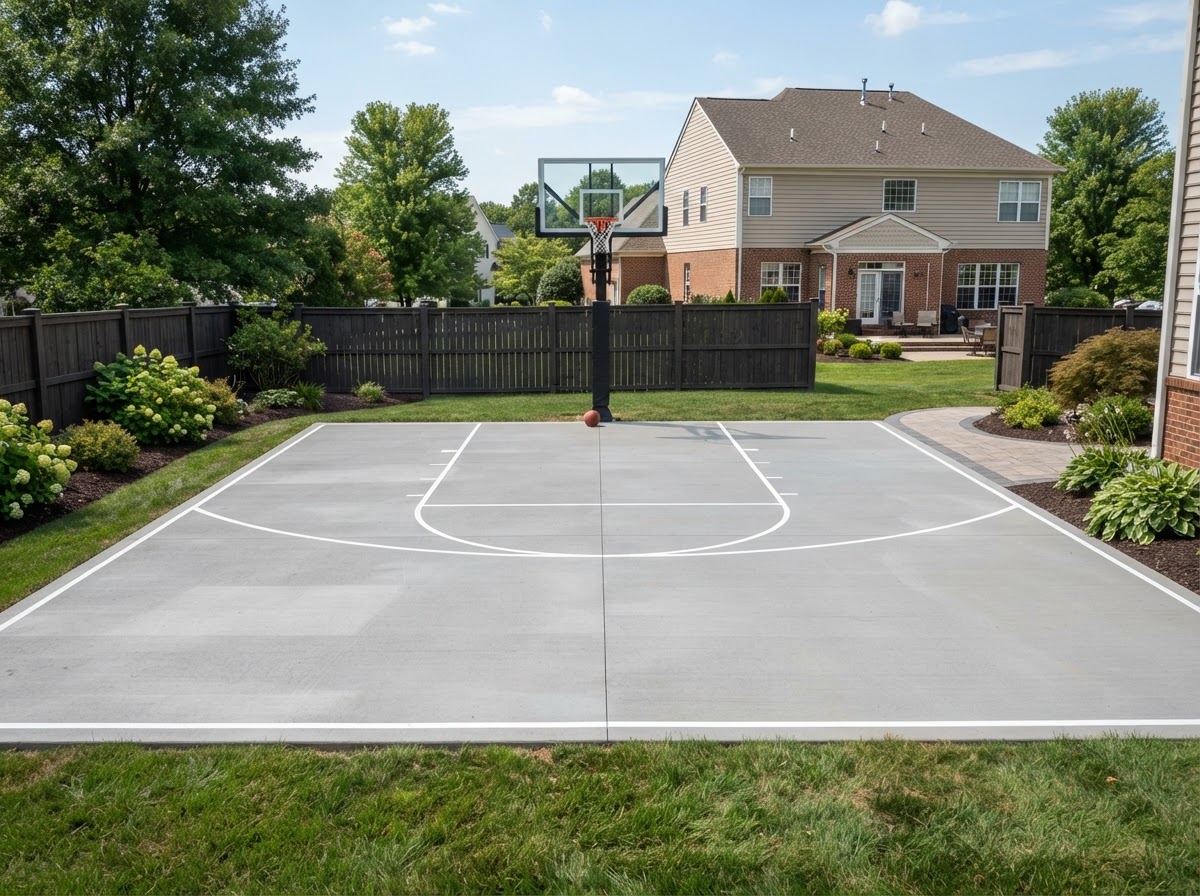
A concrete basketball court slab gives a Gaithersburg backyard a smooth, level, durable playing surface for shooting hoops, half-court games, and multi-use recreation. Gaithersburg Concrete pours backyard basketball court slabs and half-court slabs planned around the available yard space, the hoop location, and the drainage the site needs to keep the surface usable year-round. Because a court slab is larger than a typical patio and is expected to stay flat and consistent for play, the layout, base, slope, and finish are planned together before any concrete is ordered. This page focuses on the concrete slab and base — the playing surface itself — rather than specialty sports coatings, striping, or basketball-system installation.
Request a Free Estimate
Tell us about your concrete project in Gaithersburg or nearby.
Concrete Basketball Court Slabs in Gaithersburg
A concrete basketball court slab is a poured playing surface built for shooting, dribbling, and casual games in a backyard or private recreation area. In Gaithersburg, where homes often have the yard space for a half court or practice area, a concrete slab gives a flat, clean, durable surface that holds up to foot traffic, ball bounce, and Maryland weather better than asphalt or a worn grass area.
Court slabs come in a range of sizes, from a compact shooting pad to a full half court with a three-point line. The slab is the foundation of the court — the surface everything else sits on — so the dimensions, flatness, slope, and finish are what make it playable. A slab that pools water in the shooting lane or cracks across the key is not usable the way a well-planned court is.
This page covers the concrete slab and base that make up the playing surface. We do not claim to provide specialty sports coatings, game striping, or basketball-system installation unless those services are part of an agreed scope. The focus is the durable, well-drained concrete court slab the rest of the court is built on.
Planning a Backyard Basketball Court
Planning a basketball court slab starts with the yard it will sit in. The available space, the slope of the lot, the location of the hoop, and how the court connects to the rest of the landscape all shape the layout before any excavation begins.
What We Plan Around
- Available yard space and whether a full court, half court, or shooting area fits
- Hoop location and the clear space behind and beside the playing area
- Setbacks and space constraints without inventing specific rules
- Slope of the lot and how the court drains
- Nearby structures, fences, and landscape transitions
- Fencing coordination where a court is enclosed
- Pedestrian access and connections to walkways or the driveway
Not every property has room for a full court, and a half court or shooting area is often the better fit for a residential lot. The slab layout is planned before excavation so the finished court sits where it is actually usable — with room to play, room behind the hoop, and drainage that keeps the surface dry. Applicable requirements depend on the property, project scope, and jurisdiction.
Basketball Court Concrete Installation Process
A basketball court slab follows the same pour sequence as other flatwork, with extra attention to dimensions, flatness, and a consistent playing surface. Skipping base preparation is the most common reason a court slab fails early.
- 1Project layout — mark the court footprint, dimensions, and hoop location.
- 2Dimensions — confirm the court size and clear space around the playing area.
- 3Excavation — remove soil to the depth needed for base and slab.
- 4Subgrade preparation — compact the soil to a stable, uniform surface.
- 5Stone and base preparation — add and compact base material for a stable foundation.
- 6Grading — set the slope so water sheds off the court without pooling.
- 7Forms — set forms to the court dimensions, thickness, and edges.
- 8Reinforcement where appropriate — add reinforcement suited to the court loads and use.
- 9Concrete placement — pour and spread the concrete across the court footprint.
- 10Screeding — level the concrete to a consistent, flat playing surface.
- 11Finishing — apply a finish suited to play, smooth but traction-conscious.
- 12Control joints — place joints so the slab cracks where intended, not across the key.
- 13Curing — allow the concrete to gain strength before the court is used.
We do not prescribe one universal slab thickness. The thickness and reinforcement for a court slab depend on the intended use, the base conditions, and the project requirements — a court that sees only casual shooting places different demands on the concrete than one used for regular full-court games.
Court Flatness, Drainage, Finish & Load Considerations
A basketball court slab has to be flat enough to play on but finished with enough texture to be safe when wet. A perfectly slick surface is slippery; a heavily broomed surface is rough on a basketball. The finish balances playability and traction, and the slope balances flatness against drainage.
Performance Factors
- A smooth but traction-conscious finish suited to outdoor play
- Water runoff and slope so the court sheds rain rather than pooling
- Low spots eliminated so water does not collect in the shooting lane
- Joint placement planned so cracks form where intended, not across play areas
- Hoop footing coordination so the post anchors into stable concrete
- Equipment loads from the hoop, posts, and any fencing
- Edge protection so the court perimeter does not chip under use
Drainage is important because standing water reduces usability and contributes to surface deterioration. A court that holds water after rain is not playable until it dries, and repeated saturation stresses the surface over Maryland winters. Slope, base preparation, and joint placement are what keep a court slab flat, dry, and usable.
For general-purpose slabs and pads, see our concrete slabs, pads and foundations page; for a connected outdoor living surface, our concrete patio installation services. Existing concrete that needs to be removed before a court is poured is handled through our concrete demolition work, and connecting paths are covered in our concrete walkways services.
Outdoor Sports Concrete in Maryland
A backyard basketball court in Gaithersburg sits outside through every Maryland season, which means freeze-thaw cycles, rain, snow, and deicing exposure all act on the slab. Moisture that sits on or moves beneath the court contributes to surface scaling and settlement, and a court that traps water deteriorates faster than one that sheds it.
Seasonal movement is a factor too. The base beneath a court slab shifts with wet and frozen cycles, and a poorly prepared base takes the slab with it — cracks appear, edges drop, and the playing surface becomes uneven. Base preparation, slope, and joint placement are what keep a court slab flat and stable through the seasons.
Maintenance matters on a court slab the way it does on any exterior concrete. Deicing products used carefully, snow removed promptly, and drainage kept clear all help the surface hold up. We do not promise a court will never show wear — we build it to handle Maryland conditions as well as the site and scope allow.
Basketball Court Slab vs. General Patio Slab
A basketball court slab and a general patio slab are both poured flat surfaces, but they differ in dimensions, surface consistency, and drainage planning. A court slab is larger, is expected to stay flat across the whole playing area, and is planned around a hoop location and clear play space. A patio slab is sized to furniture and foot traffic and finished for walking and seating. Court dimensions, surface consistency, and drainage make the project different even when both start as a poured concrete slab.
Discuss Your Concrete Project
Have questions about scope, timing, or whether repair or replacement is the right call? We are happy to review your project and provide a clear, honest estimate.
Concrete Basketball Court FAQs & Free Estimates
How thick should a concrete basketball court be?
Basketball court slab thickness depends on the intended use, base conditions, and project requirements. A court that sees regular full-court play places different demands on the concrete than a casual shooting pad. We recommend thickness based on how the court will be used rather than a universal dimension.
How large should a backyard basketball court be?
A backyard court size depends on the available yard space and whether a full court, half court, or shooting area fits. A half court is a common residential fit, while a full court requires substantially more space. We plan the dimensions around the lot, the hoop location, and the clear space needed to play before any concrete is poured.
Can a basketball hoop be installed in the concrete?
Yes. A basketball hoop post can be set into or anchored to the court slab, with the footing or anchor coordinated with the pour so the post sits in stable concrete. The hoop system itself is typically a separate item — we focus on the concrete slab and the footing or anchor location it requires.
Does a basketball court slab need reinforcement?
Reinforcement is specified based on the court loads, span, and project conditions. A larger court slab often benefits from reinforcement to manage cracking across a wide surface, while a smaller shooting pad may not require the same approach. We recommend reinforcement where appropriate to the specific court.
Should a concrete basketball court be perfectly level?
A court should be flat for play but not perfectly level — it needs a slight slope so water sheds off the surface rather than pooling. A court that holds water in the shooting lane is not playable after rain and deteriorates faster. We balance flatness against drainage so the court plays well and drains well.
Can an old concrete court be replaced?
Yes. A cracked, settled, or deteriorated court slab can be removed and replaced, with the old concrete demolished and the base reprepared before the new slab is poured. Replacement also gives a chance to correct drainage or dimension problems the original pour had. We assess whether the existing court can be repaired or should be replaced before recommending a scope.
What affects the cost of a concrete basketball court?
Cost depends on the court dimensions, slab thickness, reinforcement, excavation and base preparation, drainage work, finish, site access, and any demolition of an existing slab. A larger court with more preparation and reinforcement costs more than a compact shooting pad. We provide project-specific estimates based on the actual court and site.
Request a Basketball Court Slab Estimate
If you are planning a backyard basketball court or half court in Gaithersburg, Gaithersburg Concrete will review the yard space, dimensions, drainage, and hoop location, then provide a clear estimate for the court slab. Serving Gaithersburg and surrounding Montgomery County communities.
Related Concrete Services Near Gaithersburg
Concrete Slabs, Pads & Foundations
Heavy-duty concrete pads for backyard sheds, hot tubs, HVAC units, backup generators, and residential accessory structures.
Learn moreConcrete Patio Installation & Replacement
Custom concrete backyard patios engineered for outdoor living, cookouts, and year-round family entertainment.
Learn moreConcrete Demolition, Removal & Replacement
Concrete demolition, removal, haul-away, and replacement for driveways, patios, walkways, and slabs.
Learn moreConcrete Sidewalks, Walkways & Paths
Safe, level pedestrian access ways, garden paths, front walkways, and commercial footpaths built for heavy foot traffic.
Learn moreRequest a Basketball Court Slab Estimate
If you are planning a backyard basketball court or half court in Gaithersburg, Gaithersburg Concrete will review the yard space, dimensions, drainage, and hoop location, then provide a clear estimate for the court slab. Serving Gaithersburg and surrounding Montgomery County communities.
- Project-specific estimates — no obligation
- Residential and commercial concrete work
- Serving Gaithersburg and surrounding Montgomery County
Request a Free Estimate
Tell us about your concrete project in Gaithersburg or nearby.