Concrete Resurfacing vs. Replacement in Gaithersburg, MD
Concrete resurfacing is usually considered when the existing slab remains stable and structurally suitable but has surface wear, discoloration, minor spalling, or cosmetic deterioration. Replacement is generally more appropriate when the slab has widespread cracking, significant settlement, severe deterioration, or active movement. This guide from Gaithersburg Concrete helps homeowners and property managers in Gaithersburg, Maryland tell the two scopes apart — what resurfacing can and cannot do, when replacement is the more durable answer, and how Maryland freeze-thaw exposure and drainage factor into the decision. The goal is a clear, honest framework so you can move from understanding the condition of your concrete to the right service — whether that is a resurfacing overlay, targeted repair, or a full new pour.
Request a Free Estimate
Tell us about your concrete project in Gaithersburg or nearby.
Should Concrete Be Resurfaced or Replaced?
Concrete resurfacing is usually considered when the existing slab remains stable and structurally suitable but has surface wear, discoloration, minor spalling, or cosmetic deterioration. Replacement is generally more appropriate when the slab has widespread cracking, significant settlement, severe deterioration, or active movement. The right choice depends on whether the slab beneath the surface is still sound — resurfacing renews a stable surface, while replacement rebuilds a slab that can no longer be relied on.
Resurfacing May Make Sense When
- The slab is stable with no ongoing movement
- Damage is mostly surface-level — wear, discoloration, or minor scaling
- Appearance is the main concern
- Minor spalling is present but confined to the surface
- Existing elevations and drainage are acceptable
- The slab has not cracked through or settled unevenly
Replacement May Make Sense When
- The slab is badly broken or cracked through
- Movement is ongoing and the cause has not stopped
- Settlement is severe or uneven
- The base has failed
- The structural condition is poor
- Extensive deterioration runs deeper than the surface
The dividing line is slab stability. A stable, sound slab with a tired surface is a resurfacing candidate; a slab that is moving, cracking through, or no longer providing dependable support is a replacement project. When the cause of the surface damage is still active — drainage, settlement, or freeze-thaw — resurfacing alone rarely holds up for long.
What Is Concrete Resurfacing?
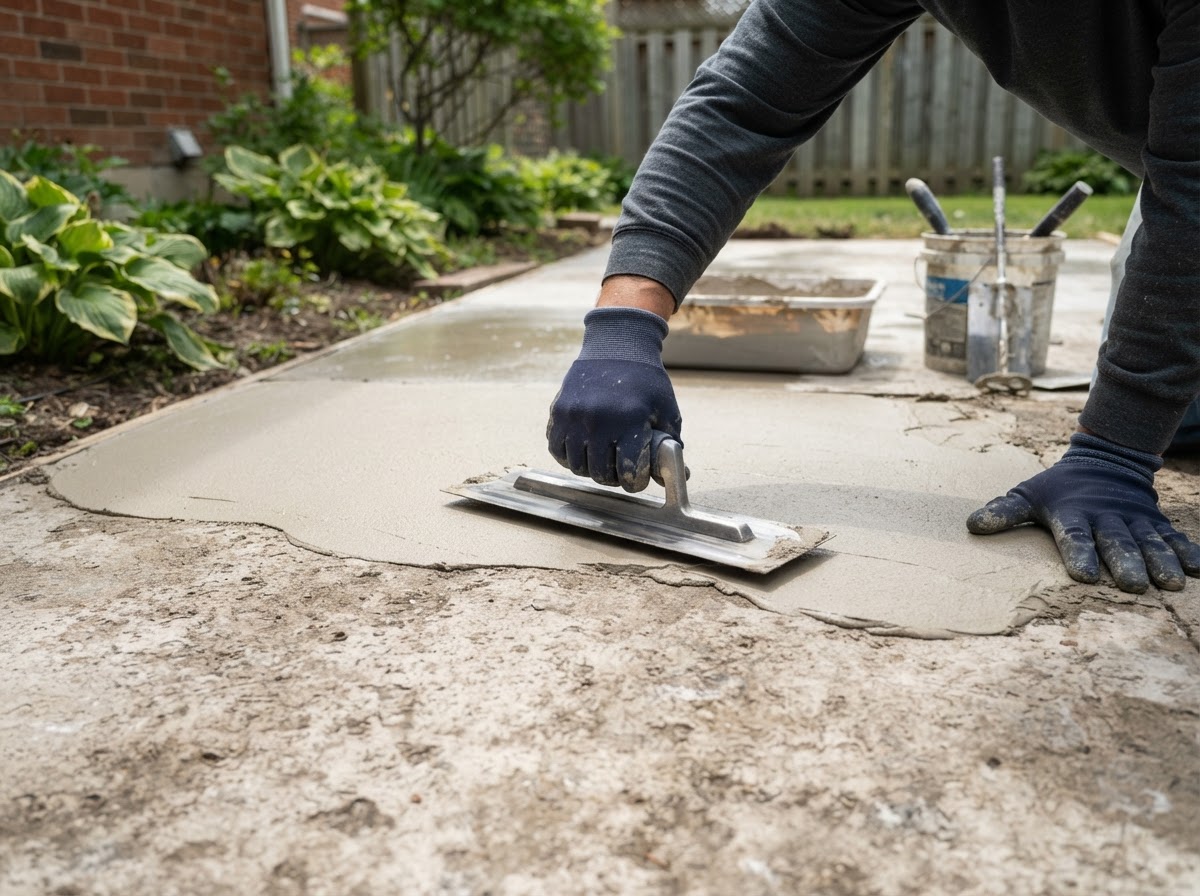
Resurfacing renews the top of an existing concrete slab with an overlay or bonding layer rather than tearing the slab out and starting over. It is a lighter-scope option aimed at appearance and surface condition when the concrete beneath is still doing its job structurally.
What Resurfacing Addresses
- Surface wear and cosmetic aging
- Minor spalling and light scaling
- Discoloration and inconsistent finish
- A refreshed, more uniform appearance
- Decorative resurfacing — patterned or colored overlays on sound slabs
What Resurfacing Does Not Do
- Fix active settlement or a slab that is still sinking
- Rebuild a failed base or restore support beneath the slab
- Stabilize severely broken or cracked-through concrete
- Correct major structural problems or widespread cracking
- Change the elevation, slope, or drainage of the slab
Because resurfacing depends on the slab beneath it, the existing concrete has to be a suitable substrate. For a full overview of the overlay process, see our concrete resurfacing and overlays service page.
What Does Concrete Replacement Involve?
Replacement removes the existing slab and builds a new one in its place. It is the heavier scope, but it is also the option that lets you address the underlying problems — base condition, drainage, elevation, and layout — that resurfacing cannot reach.
Typical Replacement Steps
- Demolition and removal of the existing concrete
- Haul-away and disposal of old material
- Subgrade review and recompaction
- Base preparation and grading
- Forming and layout
- New concrete placement, finishing, and jointing
- Curing before the surface is returned to use
Because replacement rebuilds the slab from the base up, it is the more complete fix when the original concrete has failed. It also gives a chance to correct drainage, slope, or thickness problems the first pour had — which is why it is often the better long-term value when damage is extensive rather than cosmetic.
Replacement starts with demolition. See our concrete demolition and removal page, and for the broader repair context, our concrete repair overview.
Resurfacing vs. Replacement Comparison
The table below compares the two scopes across the factors that usually drive the decision. It is a starting point — the actual recommendation depends on a hands-on assessment of the slab — but it shows how the condition of the concrete maps to the right scope.
| Factor | Resurfacing | Replacement |
|---|---|---|
| Slab stability | Requires a stable, sound slab | Rebuilds a failed or unstable slab |
| Cracking | Only minor, non-structural cracks | Addresses widespread or structural cracking |
| Settlement | Does not correct uneven settlement | Re-establishes proper grade and support |
| Appearance | Renews a worn surface | New, consistent finish throughout |
| Demolition | None — slab stays in place | Full removal and haul-away |
| Project disruption | Lighter, shorter scope | Longer, heavier scope |
| Finish options | Overlay and decorative options | Full range of new-pour finishes |
| Substrate dependence | Depends entirely on existing slab | Independent — new base and slab |
| Drainage correction | Limited — keeps existing slope | Can re-grade and correct drainage |
| Long-term suitability | Best for sound slabs with surface wear | Best for failed or failing slabs |
Can Cracked Concrete Be Resurfaced?
Only when the cracks are minor, non-structural, and the slab is stable. A surface overlay can bridge hairline or shallow cracks on a sound slab, but it will not hold over a slab that is still moving or cracking through. Widespread or structural cracking points toward repair or replacement, not resurfacing.
Can Sunken Concrete Be Resurfaced?
Not on its own. Resurfacing renews the surface but does not lift a settled slab or change its elevation. If the slab is intact and only settled, concrete leveling may raise it first; if it is cracked through or the base has failed, replacement is usually the better path. Resurfacing over a sunken slab leaves the trip hazard and drainage problem in place.
Can Spalling Concrete Be Resurfaced?
Yes, when the spalling is surface-level and the slab beneath is stable. Resurfacing renews a spalled surface with an overlay or topping. When spalling runs deeper or the slab has cracked through, repair or replacement is more appropriate than resurfacing.
Maryland Conditions That Affect the Decision
In Gaithersburg and across Maryland, exterior concrete faces freeze-thaw cycles, moisture, and deicing salts that wear surfaces and stress slabs over time. These conditions shape the resurfacing-vs-replacement decision because they affect both the surface and what lies beneath it.
- Freeze-thaw cycles stress the surface and can worsen scaling and spalling
- Moisture penetration contributes to surface deterioration
- Deicing salts accelerate surface scaling and wear
- Settlement from saturated or eroding base material can crack a slab through
- Drainage problems let water run beneath or pool on the slab
- Winter exposure compounds surface and structural wear together
The key point: surface damage caused by moisture and freeze-thaw may continue if the underlying issues are not addressed. Resurfacing a slab that is still taking on water, still settling, or still exposed to deicing salts without correcting drainage may renew the look temporarily but will not stop the cause. That is why the condition of the slab — not just the appearance of the surface — drives the decision.
How to Decide Between Resurfacing & Replacement
Ask These Questions
- Is the slab stable, or is it still moving?
- Is the damage surface-level, or does it run deeper?
- Are the cracks active, or have they stopped?
- Is there settlement or uneven elevation?
- Are there drainage issues contributing to the wear?
- Is the substrate sound beneath the surface?
- Are the existing elevations and slope acceptable?
- Has the surface been resurfaced before and failed?
- Is a major layout or drainage change planned?
If the answers point to a stable slab with surface-level wear, resurfacing is likely the right path. If they point to movement, settlement, a failed base, or widespread cracking, replacement is usually the more durable long-term value. The checklist is a starting point — a hands-on assessment confirms which scope fits a specific slab.
For the broader repair decision, see our repair vs. replacement guide and our repair cost guide. For the resurfacing service itself, see our concrete resurfacing and overlays page, and for the removal side, our concrete demolition overview.
Discuss Your Concrete Project
Have questions about scope, timing, or whether repair or replacement is the right call? We are happy to review your project and provide a clear, honest estimate.
Concrete Resurfacing vs. Replacement FAQs & Estimates
Can cracked concrete be resurfaced?
Only when the cracks are minor and non-structural and the slab is stable. A surface overlay can bridge hairline or shallow cracks on a sound slab, but it will not hold over a slab that is still moving or cracking through. Widespread or structural cracking points toward repair or replacement rather than resurfacing.
Can resurfacing fix uneven concrete?
No. Resurfacing renews the surface but does not lift a settled slab or change its elevation. If the slab is intact and only settled, concrete leveling may raise it first; if it is cracked through or the base has failed, replacement is usually the better path. Resurfacing over a sunken slab leaves the trip hazard and drainage problem in place.
When is concrete too damaged to resurface?
Concrete is typically too damaged to resurface when it has widespread cracking, significant settlement, severe spalling that runs deeper than the surface, a failed base, or active movement. In those cases the slab can no longer serve as a dependable substrate, and replacement is the more durable option.
Can a driveway be resurfaced instead of replaced?
Sometimes, when the driveway slab is stable and the wear is mostly surface-level. Resurfacing renews a sound, worn driveway. When the driveway has cracked through, settled unevenly, or has a failed base, replacement is usually the better long-term value because resurfacing cannot rebuild the support beneath it.
Does resurfacing hide old cracks?
It can mask minor, non-structural cracks on a stable slab, but it does not repair them or stop them from returning if the cause is still active. A slab that is still moving or cracking through will telegraph those cracks back through an overlay. Resurfacing is not a fix for structural cracking.
Can resurfaced concrete be decorative?
Yes. Decorative resurfacing applies patterned, colored, or textured overlays to a sound slab to renew its appearance. It is an option when the existing concrete is stable and the goal is a refreshed, decorative surface rather than a structural rebuild.
What affects resurfacing suitability?
Suitability depends on slab stability, the type and extent of cracking, whether movement is active, the depth of any spalling, the condition of the base, drainage, and the existing elevations. A hands-on assessment confirms whether the slab is a suitable substrate for an overlay or whether replacement is the better fit.
How can I get my concrete evaluated?
Call (240) 690-6035 or request a free estimate through our contact page. We assess whether the slab is stable, whether the damage is surface-level or structural, and whether resurfacing, repair, leveling, or replacement is the right scope for the condition.
Request a Concrete Surface Evaluation
Not sure whether your concrete can be resurfaced or needs to be replaced? Gaithersburg Concrete will assess the slab, identify whether the damage is surface-level or structural, and recommend the right scope. Call (240) 690-6035 or request a free estimate.
Keep Learning About Concrete in Gaithersburg
Concrete Repair vs. Replacement: How to Decide
A decision framework for repairing or replacing damaged concrete in Gaithersburg — cracking, settlement, spalling, movement and slab condition.
Read the guideConcrete Repair Cost Guide for Gaithersburg, MD
What affects concrete repair cost in Gaithersburg — crack type, spalling, settlement, repair size, access and replacement needs.
Read the guideConcrete Cost Guide for Gaithersburg, MD
What affects concrete project costs in Gaithersburg — size, demolition, access, base, thickness, reinforcement, finish, grading and drainage.
Read the guideRelated Concrete Services Near Gaithersburg
Concrete Resurfacing & Concrete Overlays
Restorative polymer-modified micro-toppings and decorative cement overlays for structurally sound yet worn concrete.
Learn moreConcrete Repair & Crack Repair
Targeted structural crack filling, spalling remediation, and damaged section patching to extend concrete longevity.
Learn moreConcrete Demolition, Removal & Replacement
Concrete demolition, removal, haul-away, and replacement for driveways, patios, walkways, and slabs.
Learn moreConcrete Driveway Installation & Replacement
Durable residential and light commercial concrete driveways built to withstand vehicular weight and Maryland freeze-thaw cycles.
Learn moreRequest a Concrete Surface Evaluation
Not sure whether your concrete can be resurfaced or needs to be replaced? Gaithersburg Concrete will assess the slab, identify whether the damage is surface-level or structural, and recommend the right scope. Call (240) 690-6035 or request a free estimate.
- Project-specific estimates — no obligation
- Residential and commercial concrete work
- Serving Gaithersburg and surrounding Montgomery County
Request a Free Estimate
Tell us about your concrete project in Gaithersburg or nearby.