ADA Concrete Ramps & Accessible Ramp Installation in Gaithersburg, MD
An accessible concrete ramp provides a safe, stable path over a grade change for people using wheelchairs, walkers, strollers, or limited mobility, and Gaithersburg Concrete installs concrete ramps for residential and commercial properties in Gaithersburg, Maryland and surrounding service areas. A concrete ramp is a poured, permanent structure that replaces or supplements steps at an entry, connecting a walkway or driveway to a doorway with a controlled slope and a level landing. Where ADA or other accessibility standards apply, ramp dimensions, slope, landings, transitions, handrail requirements, and other details must be planned according to the applicable project requirements. We do not assume every ramp automatically complies with ADA or publish invented dimensional requirements. Every project starts with a site measurement of the elevation change, the available run, and the entry conditions so the ramp can be laid out correctly.
Accessible Concrete Ramp Installation in Gaithersburg
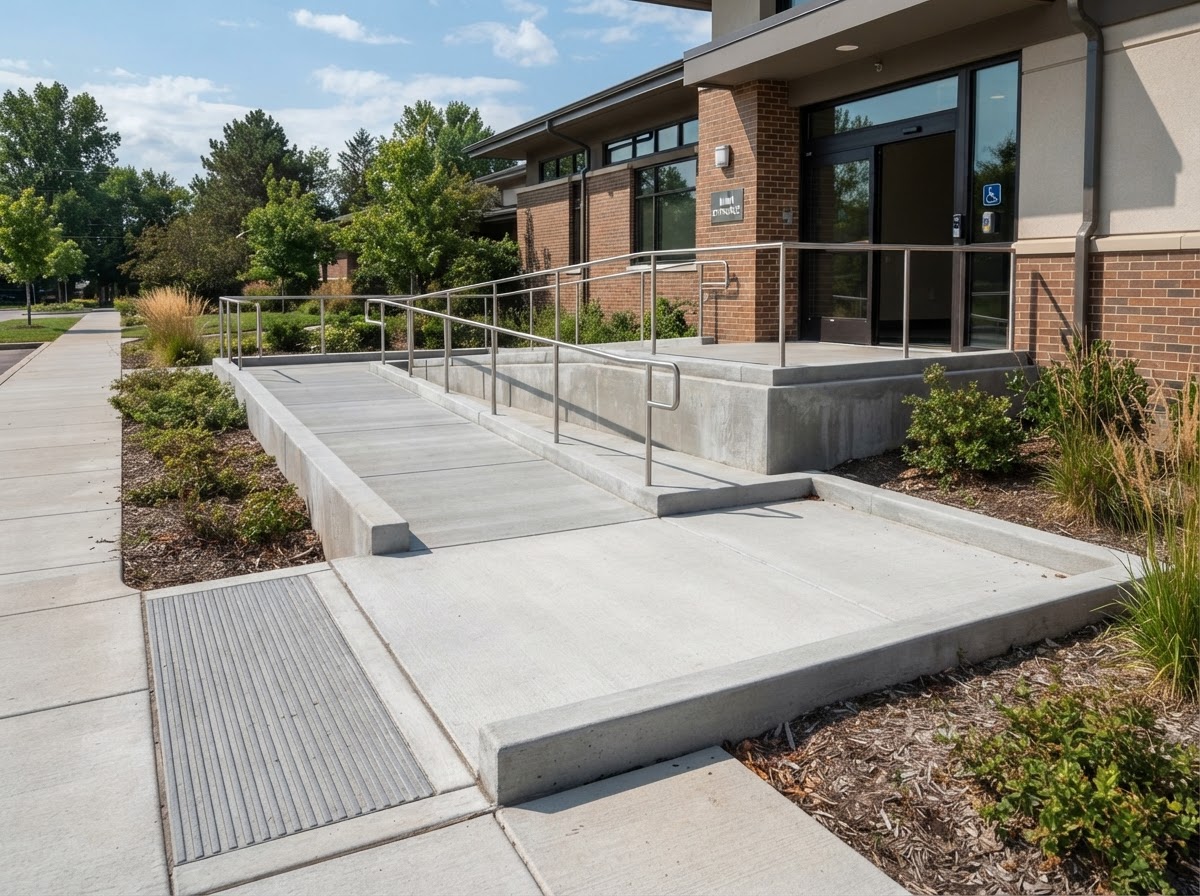
A concrete accessibility ramp is a poured ramp that spans a change in elevation, giving people a gradual, navigable surface instead of steps. Ramps are used at residential entries, business entrances, commercial walkways, and public-facing properties where access over a grade change is needed.
Concrete is a common ramp material because it is permanent, stable, and can be finished with a texture that improves traction. A ramp typically includes a sloped surface, a level landing at the top or bottom, and clean transitions to the walkway and doorway. The layout depends on the elevation change and the available distance to run the slope.
Where ADA or other accessibility standards apply, ramp dimensions, slope, landings, transitions, handrail requirements, and other details must be planned according to the applicable project requirements. We do not guarantee ADA compliance based on a generic page, and we do not assume ADA applies to every residential project. Applicable requirements depend on property type, jurisdiction, and scope.
Where Concrete Accessibility Ramps May Be Needed
Concrete ramps are considered wherever a grade change blocks access for someone using wheels or limited mobility.
Common Settings
- Business entrances where steps create a barrier
- Commercial walkways with elevation changes
- Multifamily and common-area access where applicable
- Residential access modifications for aging-in-place or recovery
- Public-facing properties with entry transitions
- Side or rear entries where the grade differs from the front
Not every residential ramp is subject to ADA. ADA requirements generally apply to public accommodations and commercial facilities, while a residential ramp may be built to the owner's preferences. We discuss which standards may apply based on the property type and scope rather than assuming one set of rules.
Concrete Ramp Installation Process
A concrete ramp follows the same fundamentals as other flatwork, with added attention to slope, landings, and transitions.
- 1Site measurement — determine the elevation change and available run.
- 2Layout — mark the ramp path, width, landings, and transitions.
- 3Excavation — cut to grade and prepare the subgrade.
- 4Base — add and compact base material for a stable foundation.
- 5Forming — set forms to the ramp profile, slope, and landing dimensions.
- 6Reinforcement where appropriate — add reinforcement based on project needs.
- 7Concrete placement — pour and screed to the planned slope.
- 8Finish — apply a texture that improves traction on the surface.
- 9Landings and transitions — form level landings and clean edge transitions.
- 10Curing — allow the concrete to gain strength before use.
The slope and landing layout are the most planning-intensive parts. The ramp must rise at a controlled rate, and landings provide a level resting point. We set these carefully based on the site measurement and any applicable requirements.
Ramp Slope, Landings, Traction & Accessibility Planning
Ramp planning centers on slope, landings, width, traction, and how the ramp connects to the surrounding surfaces.
Planning Factors
- Project requirements — applicable standards based on property type and scope
- Slope — the rate of rise over the available run
- Landing areas — level resting points at top, bottom, or turns
- Clear width — the usable width of the ramp surface
- Edge transitions — clean connections to walkway and doorway
- Surface texture — a finish that improves traction
- Drainage — slope and grading that keep water off the surface
- Handrail coordination where applicable — coordinated with the railing provider
We do not publish universal dimensions unless specifically verified. Where standards apply, the slope, landing size, clear width, and handrail requirements are set according to those standards. For the walkways that connect to a ramp, our concrete sidewalk and walkway services handle the pedestrian surface, and concrete steps cover stair alternatives. Commercial concrete flatwork covers broader site concrete, and concrete slabs handle pad and foundation work.
Accessibility Requirements & Project Coordination
Applicable accessibility, building, zoning, or permitting requirements depend on property type, jurisdiction, and project scope. We do not guarantee certification or compliance, and we do not invent specific ADA measurements. Where standards apply, the ramp is planned according to those requirements, and the property owner or project team confirms what approvals apply.
Outdoor ramps face Maryland weather. Surface traction matters especially on a ramp, where a slippery surface is more dangerous than on a flat walkway. A textured finish improves traction, and drainage keeps water and ice off the surface. Snow and ice accumulation are concerns in winter, and freeze-thaw affects the concrete over time.
Maintenance keeps a ramp safe over time. Cracks, surface wear, and edge breakdown should be addressed before they create trip hazards on a surface that people rely on for access. Regular observation and timely repair help the ramp perform through Maryland's seasonal conditions.
Discuss Your Concrete Project
Have questions about scope, timing, or whether repair or replacement is the right call? We are happy to review your project and provide a clear, honest estimate.
Accessible Concrete Ramp FAQs
What is an accessible concrete ramp?
An accessible concrete ramp is a poured concrete structure that spans a change in elevation with a controlled slope and level landings, providing a navigable surface for wheelchairs, walkers, and limited mobility instead of steps. It is a permanent ramp built from concrete with a traction-improving finish.
Does every wheelchair ramp need to meet ADA requirements?
Not necessarily. ADA requirements generally apply to public accommodations and commercial facilities, while a residential ramp may be built to the owner's preferences. Whether ADA or other standards apply depends on the property type, jurisdiction, and project scope. We plan the ramp according to applicable requirements rather than assuming one set of rules.
Can concrete ramps be added to existing walkways?
Yes, a concrete ramp can often be added to or alongside an existing walkway to bridge a grade change. We review the elevation, available run, and the connection to the existing surface so the ramp and walkway transition cleanly without a lip or trip point.
Do concrete ramps need landings?
Landings are a common feature of accessible ramps, providing a level resting point at the top, bottom, or at turns. Whether a landing is required and its dimensions depend on the applicable standards and the ramp layout. We plan landings based on the site measurement and any requirements that apply.
What type of finish works well on an outdoor ramp?
A textured finish that improves traction works well on an outdoor ramp, because a slippery surface is more dangerous on a slope than on flat ground. A broom or similar texture can help improve traction. We do not claim any finish is completely non-slip, but texture can reduce slip risk.
Can damaged concrete ramps be repaired?
Yes, damaged concrete ramps can often be repaired. Cracks, surface wear, and broken edges can be patched or addressed through concrete repair, while settlement may be a candidate for leveling if the slab is sound. Severely damaged ramps may need section replacement. We assess the condition before recommending repair or replacement.
What affects concrete ramp installation cost?
Cost depends on the ramp size, elevation change, slope and landing layout, excavation, base preparation, reinforcement, surface finish, site access, and any applicable requirements. We provide project-specific estimates based on the actual scope and conditions.
Discuss an Accessible Concrete Ramp Project
If you need an accessible concrete ramp at a residential or commercial property, Gaithersburg Concrete will measure the site, review the layout, and provide a clear estimate. Serving Gaithersburg and surrounding Montgomery County communities.
Related Concrete Services Near Gaithersburg
Concrete Sidewalks, Walkways & Paths
Safe, level pedestrian access ways, garden paths, front walkways, and commercial footpaths built for heavy foot traffic.
Learn moreConcrete Steps, Stairs & Stoops
Solid poured entry stairs, replacement porch stoops, and grade-transition steps built for safety and architectural appeal.
Learn moreCommercial Concrete & Concrete Flatwork
High-spec flatwork for commercial centers, retail plazas, loading docks, dumpster pads, and multi-family communities.
Learn moreConcrete Slabs, Pads & Foundations
Heavy-duty concrete pads for backyard sheds, hot tubs, HVAC units, backup generators, and residential accessory structures.
Learn moreDiscuss an Accessible Concrete Ramp Project
If you need an accessible concrete ramp at a residential or commercial property, Gaithersburg Concrete will measure the site, review the layout, and provide a clear estimate. Serving Gaithersburg and surrounding Montgomery County communities.
- Project-specific estimates — no obligation
- Residential and commercial concrete work
- Serving Gaithersburg and surrounding Montgomery County
Request a Free Estimate
Tell us about your concrete project in Gaithersburg or nearby.